Deutsche Bank Agrees To $7.2 Billion Mortgage Settlement With US
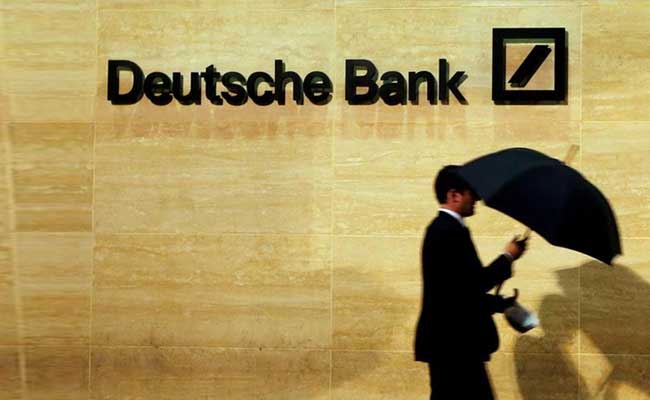
New York/Frankfurt: Deutsche Bank has agreed to a $7.2 billion settlement with the U.S. Department of Justice over its sale and pooling of toxic mortgage securities in the run-up to the 2008 financial crisis.
The agreement in principle, announced by Deutsche Bank's Frankfurt headquarters early Friday morning, offers some relief to the German lender, whose stock was hit hard in September after it acknowledged the Justice Department had been seeking nearly twice as much.
It also highlights the Justice Department's recent efforts to hold European banks accountable for shoddy securities that contributed to the U.S. housing market collapse.
The department sued Barclays PLC on Thursday over similar claims, after having reached $46 billion in settlements with U.S. banks over the last three years.
Deutsche Bank does not plan a capital increase to cover the settlement, a person close to the bank said. The lender expects the agreement to be finalized in early 2017, before President-elect Donald Trump takes office, said the source, who spoke on the condition of anonymity.
Deutsche does expect to record a pretax charge of about $1.17 billion in its fourth quarter because of the civil monetary penalty, according to its press release.
As part of the agreement, Deutsche Bank would pay a civil monetary penalty of $3.1 billion and provide $4.1 billion in consumer relief, such as loan forgiveness. The bank cautioned that there is "no assurance" the two sides will agree on the final documents.
A spokesman for the Justice Department declined to comment.
Settling the mortgage-securities case would mean Deutsche Bank has shaken off one legal headache. Three major probes remain.
Deutsche faces investigations into the alleged manipulation of foreign exchange rates, suspicious equities trades in Russia, as well as alleged violations of U.S. sanctions on Iran and other countries.
Since 2012, Deutsche Bank has already paid more than 12 billion euros for litigation, including a deal with U.S. mortgage-finance giants Fannie Mae and Freddie Mac.
Deutsche Bank's "troubling practices" were widespread, including when trader Greg Lippmann told colleagues that many home loans the bank was packaging into securities were "crap" and "pigs," according to a 2011 U.S. Senate subcommittee report.
Lippmann has declined to comment on the report.
There has been fear among investors, companies and regulators that the penalties are too much for Deutsche Bank to withstand.
Its shares plunged to a record low of 9.90 euros in September, after the bank confirmed the Justice Department was demanding $14 billion. The stock has recovered substantially, but is down from the beginning of 2016.
OTHER BANKS
The Justice Department is still pursuing mortgage allegations against other lenders in addition to Barclays.
Credit Suisse Group AG is in late-stage negotiations and has resisted a demand by the agency that it pay between $5 billion and $7 billion over its sale of mortgage securities, sources have said.
Royal Bank of Scotland Group PLC, Wells Fargo & Co, UBS Group AG and HSBC are also under investigation, according to company disclosures.
U.S. banks have paid tens of billions of dollars over the past three years to settle with U.S. authorities over misleading investors about the quality of mortgages underlying securities.
In 2013, JPMorgan Chase & Co agreed to pay $13 billion. The following year, Bank of America Corp agreed to pay $16.65 billion, while Citigroup cut a deal for $7 billion. In February this year, Morgan Stanley agreed to pay $2.6 billion, and in April, Goldman Sachs Group Inc negotiated a $5 billion deal.
Deutsche is not the first bank to announce a settlement amount before both sides have agreed on the final documentation. Morgan Stanley disclosed its agreement a year before it was finalized and formally announced.
(This story has not been edited by NDTV staff and is auto-generated from a syndicated feed.)

-
One El Nino, India Can Handle. Two Could Break The Granary

India's grain stocks can absorb one bad year, but a second El Nino could drain the buffer in two to three years, economists say.
-
India's Troika Of Good Luck | Joining The Dots
As Jensen Huang's exit drags Nvidia down, a cooling AI trade and resilient earnings have revived investor interest in India. A likely RBI rate hike looms.
-
Talking Points This Week: Leadership Shock At Nvidia, Earnings Strength, And The Fog Over Hormuz
The Anthropic IPO pricing and first trading day, Nvidia's upcoming earnings, and any fresh signals from Iran will set the tone for the following week.
-
Signature Play: The Classic Cocktail Is Dead. Or Is It?
Classic cocktails are disappearing from India's cocktail menus. But they're still being ordered, taught to bartenders and borrowed from. So, who's really having the last drink?
-
A New Samvat Wishlist: Inclusive Prosperity And Human Development
India has strengthened its economic foundations through infrastructure, digital access and enterprise. Its next growth chapter must deepen productivity, create better livelihoods and widen participation in prosperity.
-
Love, Sex Aur Dhokha: The Audacious Plot To Spy On Jensen Huang
A Taipei dinner, a Singapore chip buyer and a suspected Chinese asset: inside the alleged spy operation that got close to NVIDIA's Jensen Huang.
-
Ten Things I Learnt This Samvat
Patience can be a trap. Cheap stocks can stay cheap. Leverage can wipe you out. What did Samvat 2082 teach us? Niraj Shah writes on 10 lessons from the year gone by.
-
Talking Points This Week: Tech Nerves, FII Buying, And A Faraway Banking Shock
The global markets are not shining this Diwali. The exception in the large markets is, India.
-
Midterm Rally Lasted A Day. The Hard Reality Of A Divided US May Last Two Years | Opinion
Between a contested AI boom, a debt ceiling that arrives in 2027 and a president with every incentive to act alone, the next two years may prove more volatile than the first day's rally suggests.
-
Blue Wave Will Derail the AI Trade but Won't Dismantle the AI Era | Unhedged Position
The Democrats' sweep of the US Congress will see politics collide with economic forces both over the long and short term.









