Defining ‘America First’ In The Trump Raj

The effects of a concept are different from, yet depend on, the definition of that concept. Depicting Donald Trump beheading the Statue of Liberty, the February 4 cover of the German news magazine, Der Spiegel, illustrates this relationship. His left hand clutches a blood-soaked sword. His right hand holds up the blood-dripping head of Lady Liberty. The concept written on the stage is ‘America First'.
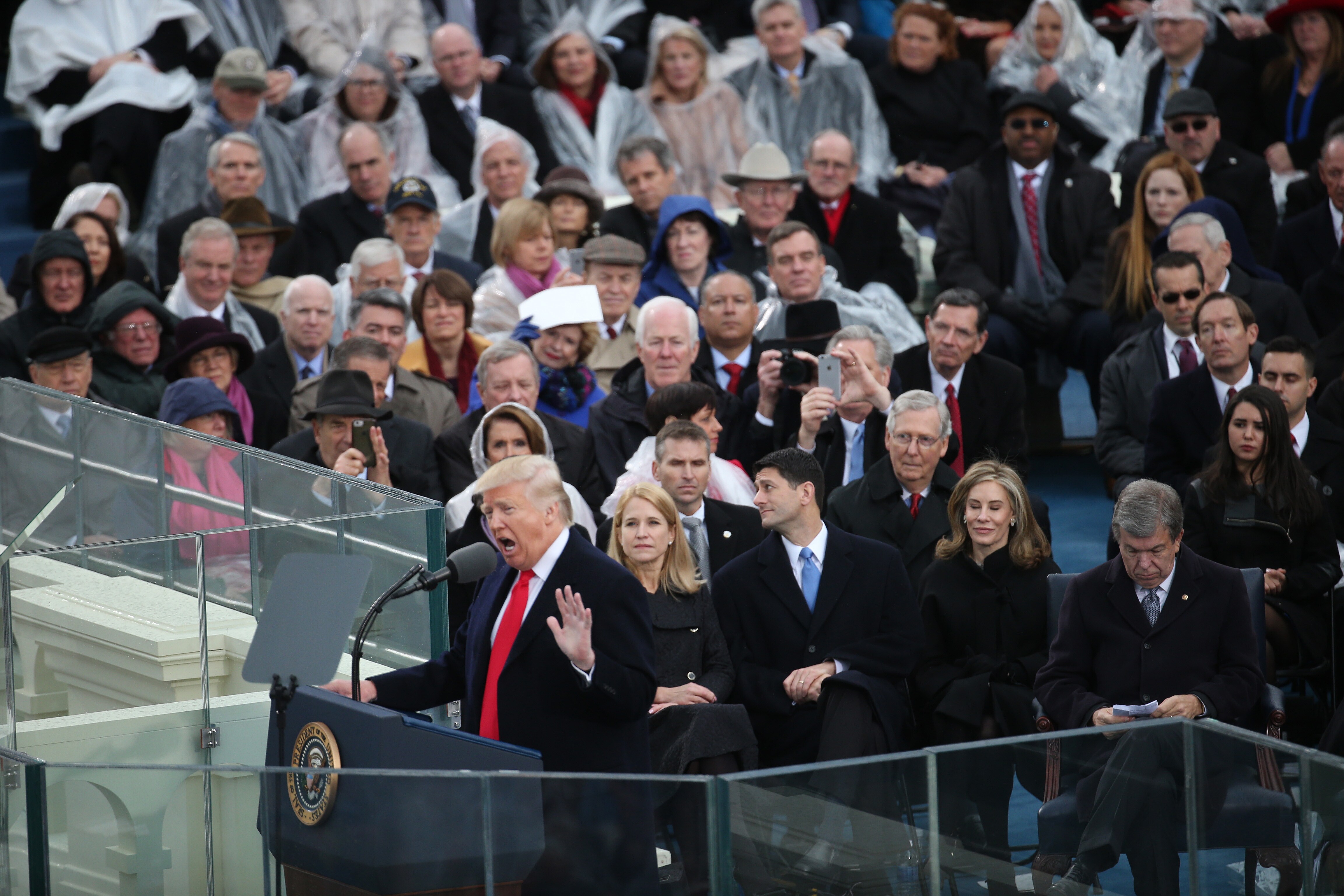
This concept peppers the pronouncements of the Trump Raj. “From this moment on, it's going to be America First,” the new President intoned in his inaugural address on January 20 in front of a large (never mind how large) crowd. Does America First mean self-interested economic and international isolationism?
Maybe yes. He said in the inaugural that America “will follow two simple rules: Buy American and Hire American”.
Maybe no. At the National Prayer Breakfast on February 2, he professed: “America is a nation of believers. In towns all across our land, it's plain to see what we easily forget… that the quality of our lives is not defined by our material success, but by our spiritual success.”
Maybe yes. Back to the inaugural address, in which he asserted realism in global affairs: “the right of all nations to put their own interests first.”
Maybe no. Later in that address, he proposed America as a metaphor to “shine as an example for everyone to follow.”
Maybe yes. Again to the Prayer Breakfast, where he prayerfully boasted: “The world is in trouble, but we're going to straighten it out. Okay? That's what I do. I fix things… We have to be tough… We're taken advantage of by every nation in the world, virtually. It's not going to happen anymore…”
Evidently, America First is a confusing concept, which explains why its champions tout its effects as salubrious, but critics as nefarious. So polarized are the two sides that each points to the same effects to prove its case. Walling off bad hombres, deportations, judicial independence, Trans-Pacific Partnership withdrawal. Amidst ambiguity, good and evil lexicography is poured.
Mahatma Gandhi appreciated the risks of galvanizing crowds with an ambiguous concept. In the Quit India movement, the process – non-violent non-cooperation with the British Raj – mattered as much as the outcome.
Also Read: The Trump Raj Begins… But How Will It Endure?
What, Pray Tell, Ought ‘America First' To Mean?
History informs the answer. America First was a slogan President Woodrow Wilson used in his successful bid for re-election in 1916 to summarise his pledge to keep the country out of the First World War - a non-intervention pledge he broke in April 1917 following unrestrained German attacks on American ships and intelligence in the infamous ‘Zimmermann Telegram' revealing Germany sought an alliance with Mexico against America. In June 1940, Yale Law School was the incubator for the America First mission, as Marc Wortman writes in his 2016 book 1941: Fighting the Shadow War.
Privileged circles at Harvard and beyond – mostly Republican – joined. The Chicago-based Committee for America First coordinated an anti-war movement.
Keeping the country from intervening yet again in European conflict was, in the best light, a mission redolent of George Washington's admonition in his 1796 Farewell Address to stay out of European entanglements. The famous aviator Charles Lindbergh expanded America First to mean isolationism and the independent pursuit of national destiny, and gave voice to a hateful anti-Semitic element in the term.
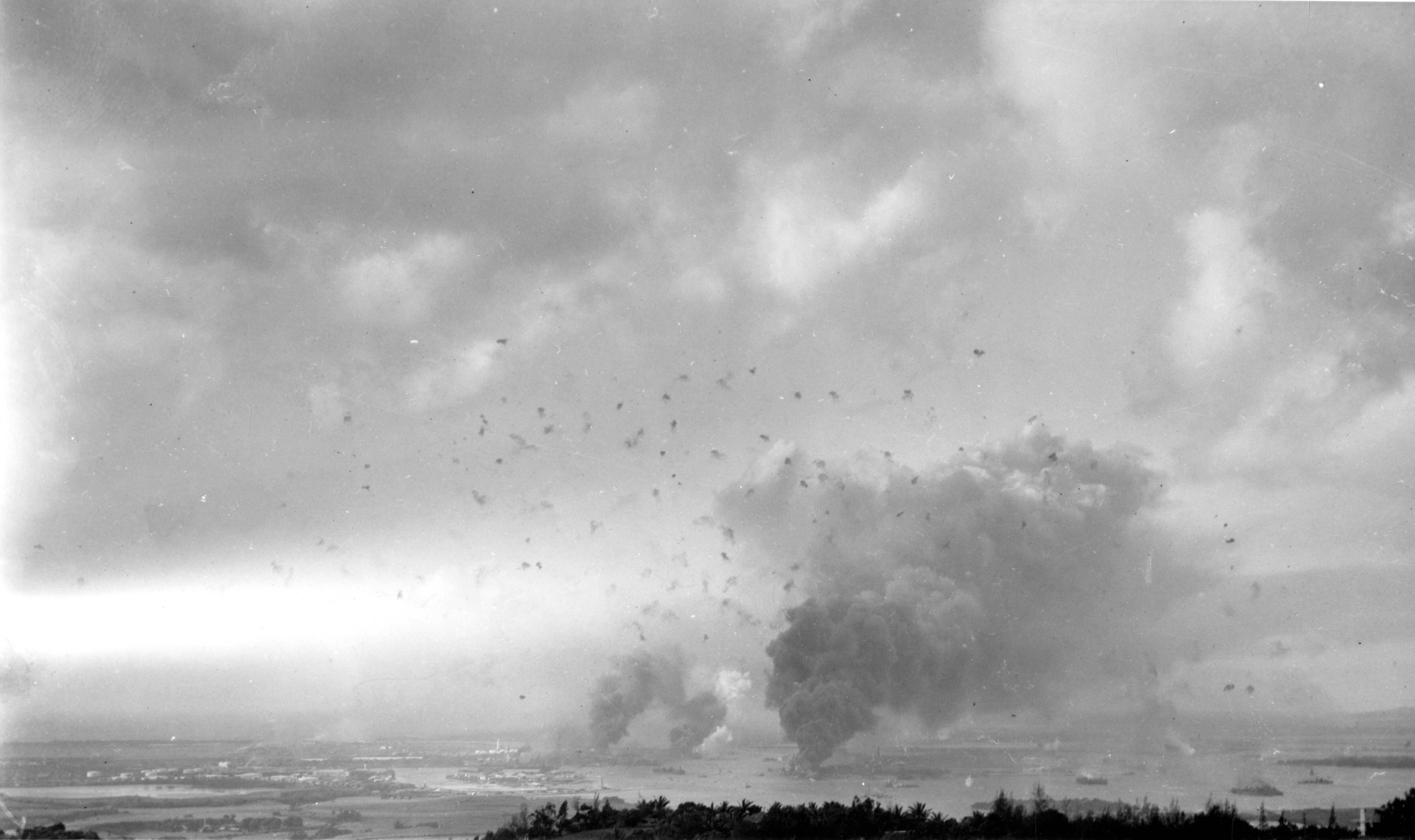
The December 1941 Pearl Harbor attack supposedly ended the America First mission, and isolationism seemed isolated to pariah states.
Today, international trade – both imports and exports – account for about 25 percent of America's GDP.
Its navy ensures freedom of navigation for commerce. To pursue autarky (i.e., no trade) would be to plagiarize from Pyongyang, and invite a catastrophic fall in American output and employment. To cease protecting international sea lanes would be to change the conclusion of the movie Captain Phillips from reality to fantasy.
The Contradiction In ‘America First'
If the Trump Raj intends America First to mean reducing these engagements, then it should define the term candidly as ‘American Decline'. Despite its aversion to the role of world's policeman, it cannot retreat.
Moreover, reductionism requires recognition of regions still in America's interests. That line drawing is fraught with peril, as America learned when President Harry Truman's Secretary of State, Dean Acheson, excluded Korea from the Asian Defense Perimeter. In June 1950, communists from the North poured over the 38th Parallel.
Here is the fundamental contradiction of defining America First as setting the nation apart to make it great again: isolationism assures decline.
Consider a little-known example: intellectual property enforcement at Salaleh.
This Omani port receives containers of merchandise produced across the Middle East, East Africa, and Asia Pacific regions, which are trans-shipped to major American and European markets.
Contrary to what the manifests of some ships entering Salaleh say, the containers might have pirated articles that infringe on a copyright, such as DVDs, CDs, software, and books, and counterfeit goods that infringe on a trademark, auto parts, cosmetics, eyeglass frames, shoes, and textiles and apparel.
Who holds the valid IP rights? American firms.
The manifests also may obfuscate the routing, not showing, for instance, that goods said to be destined for Aqaba actually are headed for Baltimore or Southampton, after their containers are switched at a warehouse in Aqaba.
The United States has helped Omani customs authorities screen containers for weapons of mass destruction – that is in America's national security interest. But, has the United States helped Oman, a strategically vital country with which it has had a bilateral free trade agreement since 2009, build capacity to identify, trace, and seize containers with merchandise infringing on American IP rights? That assistance bolsters America's economy.
Not to provide it, thanks to ‘America First' isolationism, is to invite the decline of America's IP industries.
Also Read: The Spectacle of Trump Acting Presidential
‘First' Versus The Common Good
There is another justification to provide Oman with the help it needs to help America: sacred scripture, to which many in the Trump Raj turn for justification. In other words, theology also informs the answer to what America First should mean.
Two millennia ago, Jesus eschewed the life of a hermit in favor of engaging with crowds, and in an encounter with a rich, young ruler, said: “many who are first will be last, and many who are last will be first” (Matthew 19:30).
To focus on being “first” is to focus on one's own survival, to stop imagining – dare it be said, dreaming – a common good, and to let conventional rankings trump enduring values.
That focus is self-destructive, akin to racing to church while elbowing out others for the front pew, and then rushing out in a mad dash for Sunday brunch, which if the entire congregation did, would consume all available resources in what lawyers call the tragedy of the commons.
Here, then, is a spiritually and economically defensible definition of America First for the Trump Raj: ‘America First' means priority for the last among us in the global community. America cherishes the prosperity of the last, regardless of faith (or lack thereof), color, gender, sexual orientation, or disability, plus anticipates the potential of the last to be its future best customers and suppliers. To engage with and empower them is to catalyze American renewal.
Also Read: Trump Says Immigration Order to Be Tailored to Court Review
Raj Bhala is Associate Dean for International and Comparative Law and Rice Distinguished Professor, The University of Kansas, School of Law. The views expressed here are his and do not necessarily represent the views of the State of Kansas or the University.
The views expressed here are those of the author's and do not necessarily represent the views of BloombergQuint or its editorial team .

-
Why Swapping Your Old Gold Can Trigger A Rs 5 Lakh Tax Bill, And How You Can Avoid It Legally

Swapping old gold for new is taxed as a sale and a fresh purchase. Getting your own gold remade can cut most of that bill, though it has its own costs.
-
The AI Trade is Done. The Real Opportunity for Investors Starts in 2027 | Unhedged Position
As pureplay AI stocks plunge and circular, capex-led financing unwinds, 2027 is set to be a year of reckoning for AI companies. Yet the bust clears the way for a better opportunity for investors in 2027 -- shifting the spotlight from AI builders to the companies using AI.
-
Leadership As Mission: Why The Age Of AI Demands More Human Leadership
Debjani Ghosh examines how AI is changing leadership, arguing that its success must be measured by its impact on people and the accountability of those guiding its use.
-
We May Need Another Tukaram Mundhe To Fight Air Pollution | The Reason Why
Developers may install basic measures such as sprinklers and green nets, resume work, and continue violating rules when this equipment stops working.
-
Extracting Value From Battery Scrap Could Be Challenging For India | The Reason Why
A discarded lithium-ion battery still contains valuable materials such as lithium, nickel and cobalt. These can be recovered and reused. When such batteries are crushed and shredded, they produce a dark powder called black mass.
-
One El Nino, India Can Handle. Two Could Break The Granary
India's grain stocks can absorb one bad year, but a second El Nino could drain the buffer in two to three years, economists say.
-
India's Troika Of Good Luck | Joining The Dots
As Jensen Huang's exit drags Nvidia down, a cooling AI trade and resilient earnings have revived investor interest in India. A likely RBI rate hike looms.
-
Talking Points This Week: Leadership Shock At Nvidia, Earnings Strength, And The Fog Over Hormuz
The Anthropic IPO pricing and first trading day, Nvidia's upcoming earnings, and any fresh signals from Iran will set the tone for the following week.
-
Signature Play: The Classic Cocktail Is Dead. Or Is It?
Classic cocktails are disappearing from India's cocktail menus. But they're still being ordered, taught to bartenders and borrowed from. So, who's really having the last drink?
-
A New Samvat Wishlist: Inclusive Prosperity And Human Development
India has strengthened its economic foundations through infrastructure, digital access and enterprise. Its next growth chapter must deepen productivity, create better livelihoods and widen participation in prosperity.









