Dabur Q1 Results: Profit Up 3.5%, Margin Remains Flat
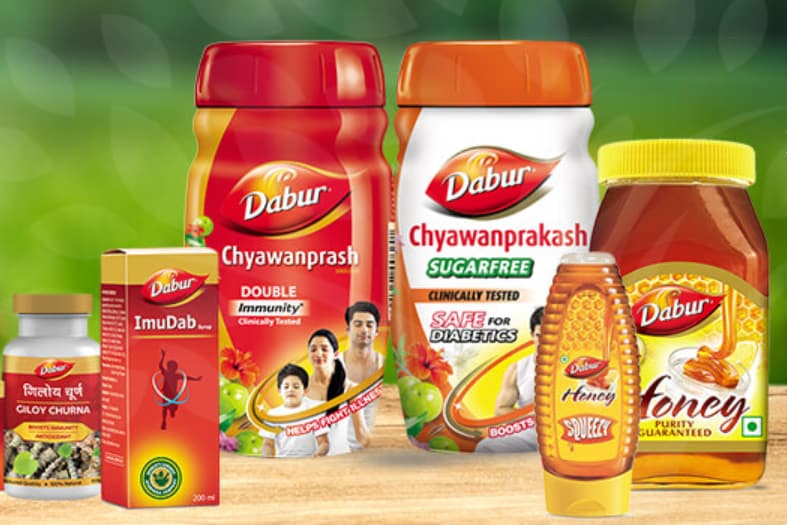
Dabur India Ltd.'s first-quarter profit rose in line with analysts' estimates even as margin stayed flat owing to higher costs and advertising spends.
The Ayurvedic product maker's net profit rose 3.5% over the previous year to Rs 456.61 crore during the April-June period, according to an exchange filing. That compares with the Rs 461.56 crore consensus estimate of analysts tracked by Bloomberg.
The profit, excluding amortisation related to Badshah acquisition, grew 8% to Rs 475 crore.
Dabur India Q1 FY24 Highlights (YoY)
Revenue rose 10.9% to Rs 3,130.5 crore, as against an estimate of Rs 3,118.4 crore.
Operating profit rose 11.23% to Rs 604.76 crore, as compared with an estimate of Rs 600.98 crore.
Margin remained flat at 19.3%, exactly in line with estimates.
Revenue for domestic business rose 8% to Rs 2,347 crore, while that of international business grew 20.6% in constant currency terms.
Advertisement spends rose 30% to Rs 204.34 crore.
Domestic volume growth stood at 3% versus 1% in the March quarter.
Dabur crossed the Rs 3,000 crore revenue mark for the first time in the June quarter, driven by double-digit growth in home and personal care as well as the healthcare businesses, the company said.
However, the beverages business was impacted due to unusual rainfall—mostly in the northern and western regions—and a moderate summer.
"With the inflation softening, we have seen our rural growth bounce back to high single digits after three quarters," said Chief Executive Officer Mohit Malhotra. While rural growth continues to lag urban demand, the gap has reduced significantly, he said.
Categorywise Performance
Food business grew 35%, while that of beverages fell 2%. The addition of Badshah Masala—which saw 24% growth—to the food portfolio is adding to the growth momentum.
Oral care grew 13%, driven by Dabur Red toothpaste.
Hair oil portfolio rose 10%, despite the category growing by 3.7% in value terms. Dabur recently forayed into the Rs 1,000-crore cooling hair oil category with 'Cool King'.
Shampoo portfolio grew 9% on a high base of 17%.
Home care grew 14.5%, aided by Odonil and Odomos.
Skincare grew 3.5% driven by Gulabari.
Health supplements grew 5.5%, as the glucose portfolio was impacted on account of bad weather. Ex-glucose, the category rose 10%.
Digestives grew 14.3% on a high base of 40%, driven by Hajmola franchise.
OTC grew 24.3%, driven by double-digit growth in Lal Tail, Honitus, Dabur health juices and Shilajit, while the ethicals portfolio grew 7.3%.
During the quarter, Malhotra said the company initiated several measures to pursue greater efficiency and the gains were ploughed back in the form of higher advertisement and publicity to drive demand. It has seen "strong consumer engagement" with its brands, helping them grow ahead of the market and report market share gains across 90% of the portfolio.
Market Share Gains
In the hair oil category, Dabur gained 200 basis points to end the quarter at its highest-ever share of 17.4%.
Dabur Red Paste gained 50 basis points, taking the overall toothpaste market share to 16.9%.
Odomos gained 340 basis points, taking the share of mosquito repellent category to 58.9%.
Dabur's market share in Chyawanprash grew 320 basis points.
Market share in shampoo category increased 10 basis points.
Dabur gained 140 basis points in baby massage oils and 20 basis points in cough and cold segment.
Shares of Dabur fell 1.05% after the results were declared, as compared with a 0.95% decline in the benchmark Nifty 50. The shares were also trading lower on reports that claimed Dabur Honey contains cancer-causing chemicals, citing lab reports.

-
Signature Play: The Classic Cocktail Is Dead. Or Is It?

Classic cocktails are disappearing from India's cocktail menus. But they're still being ordered, taught to bartenders and borrowed from. So, who's really having the last drink?
-
A New Samvat Wishlist: Inclusive Prosperity And Human Development
India has strengthened its economic foundations through infrastructure, digital access and enterprise. Its next growth chapter must deepen productivity, create better livelihoods and widen participation in prosperity.
-
Love, Sex Aur Dhokha: The Audacious Plot To Spy On Jensen Huang
A Taipei dinner, a Singapore chip buyer and a suspected Chinese asset: inside the alleged spy operation that got close to NVIDIA's Jensen Huang.
-
Ten Things I Learnt This Samvat
Patience can be a trap. Cheap stocks can stay cheap. Leverage can wipe you out. What did Samvat 2082 teach us? Niraj Shah writes on 10 lessons from the year gone by.
-
Talking Points This Week: Tech Nerves, FII Buying, And A Faraway Banking Shock
The global markets are not shining this Diwali. The exception in the large markets is, India.
-
Midterm Rally Lasted A Day. The Hard Reality Of A Divided US May Last Two Years | Opinion
Between a contested AI boom, a debt ceiling that arrives in 2027 and a president with every incentive to act alone, the next two years may prove more volatile than the first day's rally suggests.
-
Blue Wave Will Derail the AI Trade but Won't Dismantle the AI Era | Unhedged Position
The Democrats' sweep of the US Congress will see politics collide with economic forces both over the long and short term.
-
It's Time To Take The GST Council's Bet On Trust Global
Payment records can prove India's services exports, and clear, proportionate rules can bring foreign digital sellers into the tax net.
-
Opinion | India at 38: From Innovation Overperformer to Innovation Powerhouse
India now has 453 VC-backed deep science startups, 18 of them late-stage, after 117 percent growth since 2020. Laurus Labs, at USD 9.3 billion, is the most valuable deep science company in any middle-income economy outside China.









