"Crypto Winter" Is Here. Bitcoin Crash Signals Tough Times, Say Experts

There are few things scarier for investors than a bear market -- unless you're involved in crypto, in which case a winter is worse.
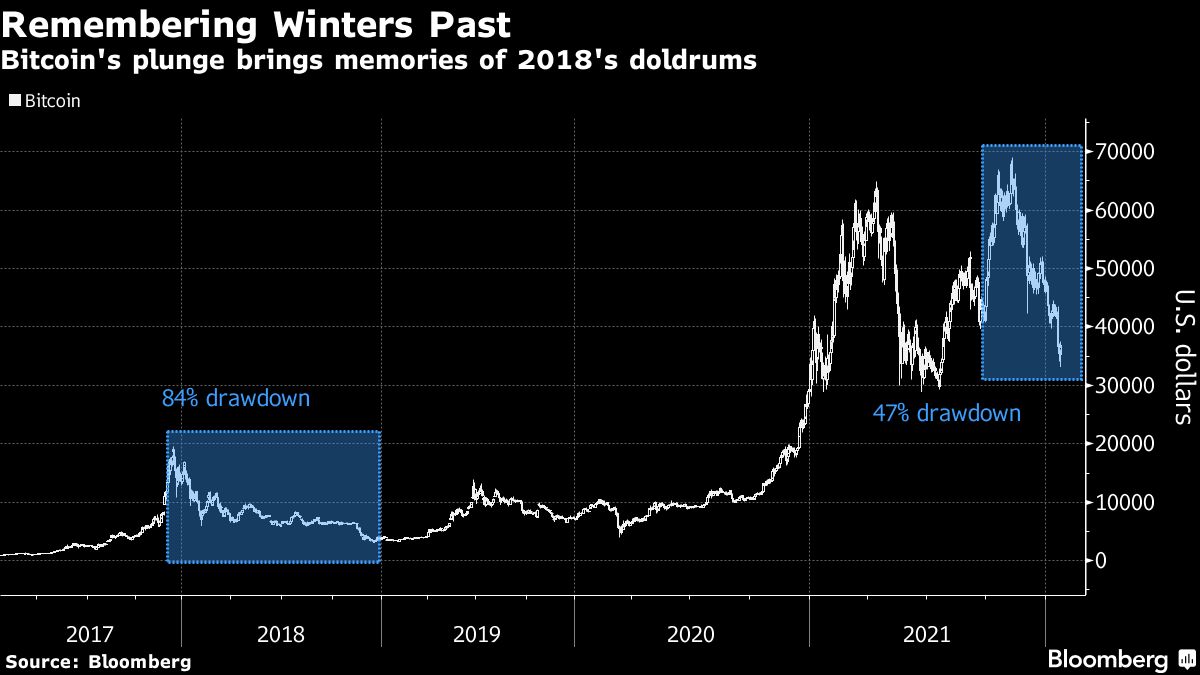
The chilling term refers to a sharp slump, followed by a drop-off in trading and months of market doldrums -- a phenomenon that memorably befell the crypto market in 2018. Bitcoin's price plunged by more than 80% to as low as $3,100 from the end of 2017 through December of the following year, a period characterized by the boom-and-bust of initial coin offerings and several big banks shelving their plans to start cryptocurrency trading desks. Bitcoin wouldn't reach a new high until December 2020, according to data compiled by Bloomberg.
Memories of 2018 are sparking fears that a repeat is playing out now after the world's largest cryptocurrency plummeted 50% from its most recent high of almost $69,000 in November. The crypto universe has shed more than $1 trillion in market value on growing conviction that the Federal Reserve is set to start ratcheting back the ultra-accommodative policy settings that fueled a boom in risk assets. The pullback has hit all corners of the crypto ecosystem, from Bitcoin to memecoins and publicly listed crypto exchanges. While the collapse has been rattling enough on its own, it has spawned an even bigger concern that the pain may persist for many months, according to UBS.
“There's this question of how do we characterize that and the nearest analogy is probably 2018, which is this idea of a crypto winter,” James Malcolm, head of foreign exchange research at UBS, said by phone. “It looks likely to be a fairly difficult and potentially prolonged period and therefore, the crypto winter analogy is quite good. Remember, the crypto winter in 2018 wasn't just over the Northern Hemisphere winter months. It basically extended for a whole year -- so it was a crypto winter that lasted effectively a year.”
Mentions of “crypto winter” and “crypto ice age” have flooded social media amid the latest drop. “Gm gm -- make sure you stay warm, crypto winter is in full force,” Twitter user @brycent_ posted on Monday, using the crypto shorthand for “good morning” to start his tweet. “Enjoy this #bitcoin winter,” user @mir_btc tweeted over the weekend.
To Antoni Trenchev, co-founder and managing partner at Nexo, there's a definite chill in the air. Bitcoin has already satisfied half of his two-part crypto-winter definition: a sharp decline in prices.
“I'm not looking for a re-run of the last ‘crypto winter,'” he said. “Undeniably, there are regulatory and macro storms ahead, and another leg down to $28,000-$30,000 can't be ruled out in the current risk-off climate.”
Unlike the winter of three years ago, investment in the crypto-sphere remains robust -- at least for now. In January alone, crypto-exchange FTX announced the launch of a $2 billion venture fund to target Web3 opportunities, while the Financial Times reported that Andreessen Horowitz is looking to raise $4.5 billion for crypto funds. Of course, a prolonged slump could douse enthusiasm for the sector.
Outside of venture capital, companies are also looking to expand into corners of the crypto ecosystem. Filings with the U.S. Patent and Trademark Office show that Walmart Inc. is preparing to create its own cryptocurrency and non-fungible tokens. Meanwhile, GameStop Corp. reportedly is also planning to launch an NFT marketplace for gamers by the end of the year.
To Tacen Inc.'s Budd White, that momentum is a sign that the crypto complex is in the midst of repricing, rather than a freeze.
“I don't believe we are entering a crypto winter because there is still increasing momentum on the build-side -- we are just seeing more realistic pricing of what is currently built,” said White, chief product officer and co-founder at the software development company that builds open-source, blockchain-based software.
The looming threat of intensified regulatory action adds to the risks embedded in the crypto complex. The Fed is considering the launch of its own digital currency, while crypto mining's energy use has attracted scrutiny from the U.S. Congress and foreign governments.
“The White House may soon unveil some national security challenges posed by cryptocurrencies and the Fed's paper on central bank digital currencies didn't answer any questions on if we will see a digital dollar or how they could work with stablecoins,” said Edward Moya, a senior market analyst at Oanda Corp. “The regulatory environment got a lot cloudier now.”
(Except for the headline, this story has not been edited by NDTV staff and is published from a syndicated feed.)

-
Signature Play: The Classic Cocktail Is Dead. Or Is It?

Classic cocktails are disappearing from India's cocktail menus. But they're still being ordered, taught to bartenders and borrowed from. So, who's really having the last drink?
-
A New Samvat Wishlist: Inclusive Prosperity And Human Development
India has strengthened its economic foundations through infrastructure, digital access and enterprise. Its next growth chapter must deepen productivity, create better livelihoods and widen participation in prosperity.
-
Love, Sex Aur Dhokha: The Audacious Plot To Spy On Jensen Huang
A Taipei dinner, a Singapore chip buyer and a suspected Chinese asset: inside the alleged spy operation that got close to NVIDIA's Jensen Huang.
-
Ten Things I Learnt This Samvat
Patience can be a trap. Cheap stocks can stay cheap. Leverage can wipe you out. What did Samvat 2082 teach us? Niraj Shah writes on 10 lessons from the year gone by.
-
Talking Points This Week: Tech Nerves, FII Buying, And A Faraway Banking Shock
The global markets are not shining this Diwali. The exception in the large markets is, India.
-
Midterm Rally Lasted A Day. The Hard Reality Of A Divided US May Last Two Years | Opinion
Between a contested AI boom, a debt ceiling that arrives in 2027 and a president with every incentive to act alone, the next two years may prove more volatile than the first day's rally suggests.
-
Blue Wave Will Derail the AI Trade but Won't Dismantle the AI Era | Unhedged Position
The Democrats' sweep of the US Congress will see politics collide with economic forces both over the long and short term.
-
It's Time To Take The GST Council's Bet On Trust Global
Payment records can prove India's services exports, and clear, proportionate rules can bring foreign digital sellers into the tax net.
-
Opinion | India at 38: From Innovation Overperformer to Innovation Powerhouse
India now has 453 VC-backed deep science startups, 18 of them late-stage, after 117 percent growth since 2020. Laurus Labs, at USD 9.3 billion, is the most valuable deep science company in any middle-income economy outside China.









