Crypto Market Unnerved by DeFi Exchange Curve’s Sinking CRV Token
(Bloomberg) -- A tumble in the native token of key decentralized cryptocurrency exchange Curve Finance sapped sentiment toward digital assets on concern that the episode could lead to wider turbulence.
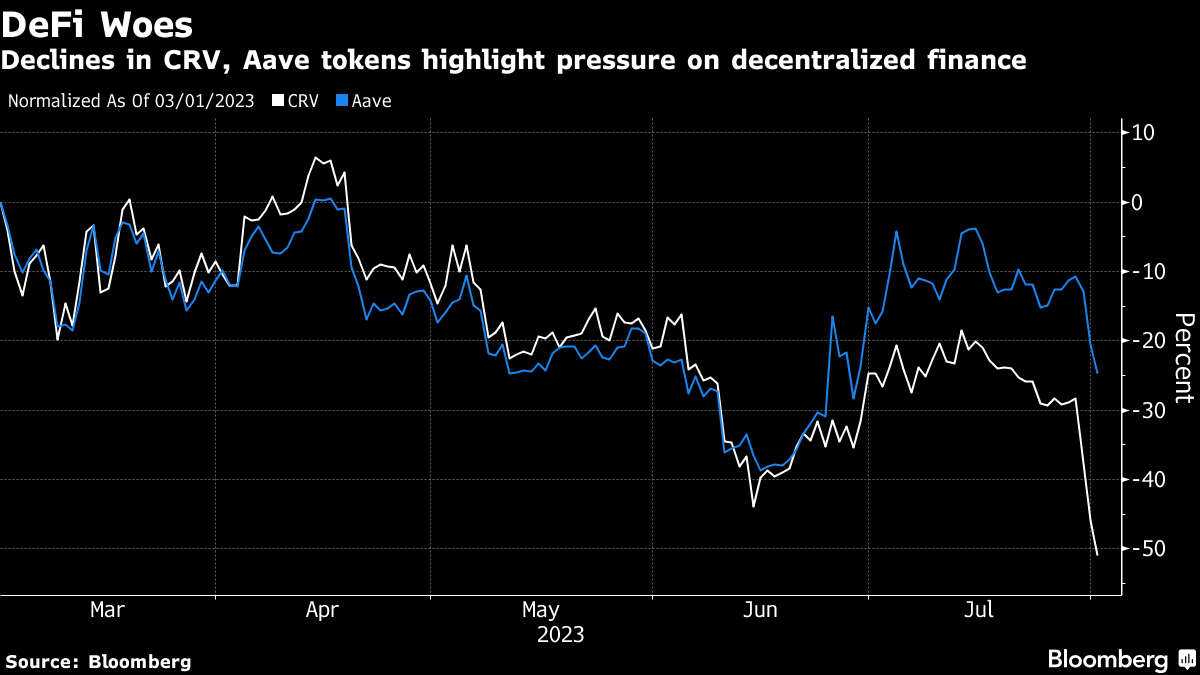
Curve's CRV coin has shed about 25% over three days after a hack on the platform. Its founder Michael Egorov has borrowed over $100 million across various crypto lending projects, backed by CRV. The worry is more CRV declines could foment losses by sparking forced liquidations of the loan positions.
“If we move lower still and these liquidation levels are hit, we could see a domino effect” across the decentralized finance sector, said Stefan von Haenisch, head of sales trading at OSL SG Pte in Singapore.
The amount of crypto using the Curve Finance service, the second-largest decentralized — or DeFi — digital-asset exchange, is down to $1.9 billion from $3.6 billion since the hack was revealed on Sunday, DefiLlama data shows.
Egorov earlier said the DeFi industry will survive the security incident. “We, and I personally, work on minimizing or eliminating the impact,” he wrote in an email, adding that he is also planning to reduce his loans.
CRV fell almost 14% on Tuesday before paring the retreat to trade at about 56 US cents as of 2:15 p.m. on Tuesday in Singapore. Wider crypto markets also struggled, including drops of about 1% in Bitcoin and Ether.
Figures from DeFi portfolio tracker DeBank indicate Egorov took a $63 million loan in the Tether stablecoin via a DeFi platform known as Aave, and that over 300 million CRV tokens worth some $168 million back the borrowing.
Aave's Slide
A significant chunk of the collateral is at risk of being liquidated if the CRV token drops to 37.5 US cents, according to DefiLlama. Aave's eponymously named native token has dropped 14% in the past three days.
An Aave spokesperson didn't immediately respond to a request for comment.
Curve Finance is viewed as one of the most important liquidity providers in DeFi, especially for stablecoins. Digital-asset security firm BlockSec estimated that hackers took $47 million in the attack on the protocol.
People who exploit vulnerabilities in networks and alert organizations to fix them — so-called white-hat hackers — may have been involved in the incident, according to Will Sheehan, founder of crypto data provider Parsec Finance.
Curve identified four main liquidity pools that had been hacked, the result of a vulnerability in Vyper, a programming language used in DeFi applications.
DeFi relies on blockchain-based software known as smart contracts, rather than Wall Street-style middlemen, to facilitate activities like trading or lending. The risk of security breaches remains a major challenge for such services.
--With assistance from Muyao Shen.
More stories like this are available on bloomberg.com
©2023 Bloomberg L.P.

-
Signature Play: The Classic Cocktail Is Dead. Or Is It?

Classic cocktails are disappearing from India's cocktail menus. But they're still being ordered, taught to bartenders and borrowed from. So, who's really having the last drink?
-
A New Samvat Wishlist: Inclusive Prosperity And Human Development
India has strengthened its economic foundations through infrastructure, digital access and enterprise. Its next growth chapter must deepen productivity, create better livelihoods and widen participation in prosperity.
-
Love, Sex Aur Dhokha: The Audacious Plot To Spy On Jensen Huang
A Taipei dinner, a Singapore chip buyer and a suspected Chinese asset: inside the alleged spy operation that got close to NVIDIA's Jensen Huang.
-
Ten Things I Learnt This Samvat
Patience can be a trap. Cheap stocks can stay cheap. Leverage can wipe you out. What did Samvat 2082 teach us? Niraj Shah writes on 10 lessons from the year gone by.
-
Talking Points This Week: Tech Nerves, FII Buying, And A Faraway Banking Shock
The global markets are not shining this Diwali. The exception in the large markets is, India.
-
Midterm Rally Lasted A Day. The Hard Reality Of A Divided US May Last Two Years | Opinion
Between a contested AI boom, a debt ceiling that arrives in 2027 and a president with every incentive to act alone, the next two years may prove more volatile than the first day's rally suggests.
-
Blue Wave Will Derail the AI Trade but Won't Dismantle the AI Era | Unhedged Position
The Democrats' sweep of the US Congress will see politics collide with economic forces both over the long and short term.
-
It's Time To Take The GST Council's Bet On Trust Global
Payment records can prove India's services exports, and clear, proportionate rules can bring foreign digital sellers into the tax net.
-
Opinion | India at 38: From Innovation Overperformer to Innovation Powerhouse
India now has 453 VC-backed deep science startups, 18 of them late-stage, after 117 percent growth since 2020. Laurus Labs, at USD 9.3 billion, is the most valuable deep science company in any middle-income economy outside China.









