When Will Coronavirus-Hit Global Markets Heal? 12 Charts To Monitor
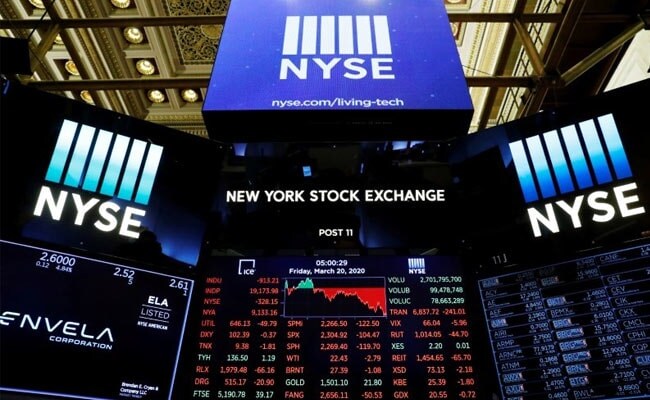
Assessing the longer-term financial impact of the coronavirus spread worldwide now hinges on the success of lockdowns in containing the pandemic and trillions of dollar of support in easing the burden, thereby limiting the duration of the deep freeze and hastening any rebound.
Since the virus exploded beyond China in early March - triggering shutdowns of the biggest economies in the world - financial markets have gone into tailspin. Stock markets lost almost a third of value, volatility spiked, credit stress soared and a dash for dollar cash worldwide amplified the anxiety.
That shock has been met with a rapid and unprecedented pushback from economic policymakers, pledging trillions of dollars to ensure containment efforts do not lead to permanent fracture of both the economy and markets that keep it moving.
Investors now need to assess whether, like China, draconian lockdowns work in stopping the virus and so limiting the length of the deliberate sudden stop in activity to the second quarter. And, in the meantime, whether gigantic government rescue programmes can prevent markets crystallizing crises of their own by choking funding, forcing bankruptcies and mass unemployment.
Following are a dozen charts that tell the story of the financial and economic crisis so far. Investors can monitor them for signs that markets are healing and seeing through the crisis:
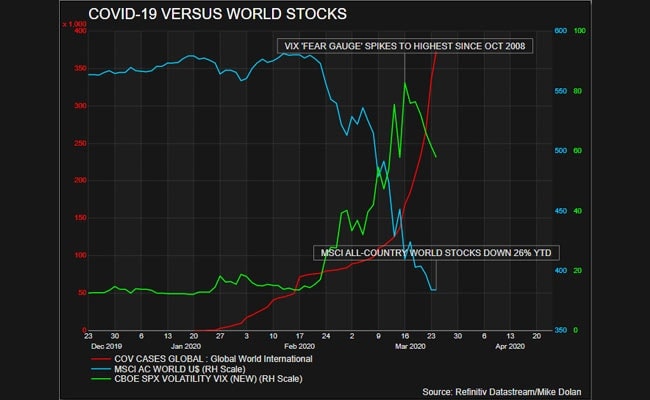
1) The collapse of world equity indices accelerated as the COVID-19 spread well beyond China's borders and the case count continues to climb even as policy support has broken the fall of stock markets:
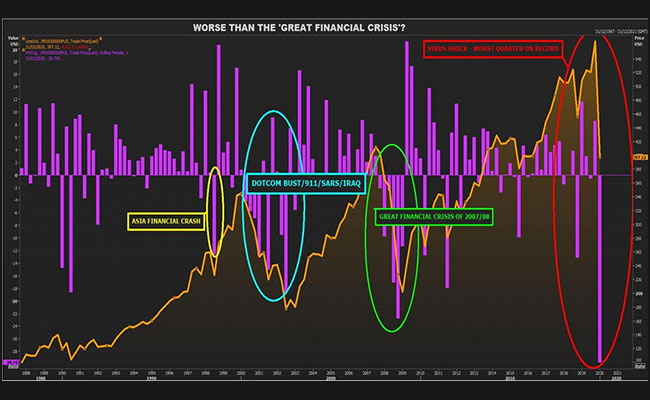
2) The scale and speed of the market drawdown outstripped everything seen for more than 30 years as the extent of the coming recession became clear:
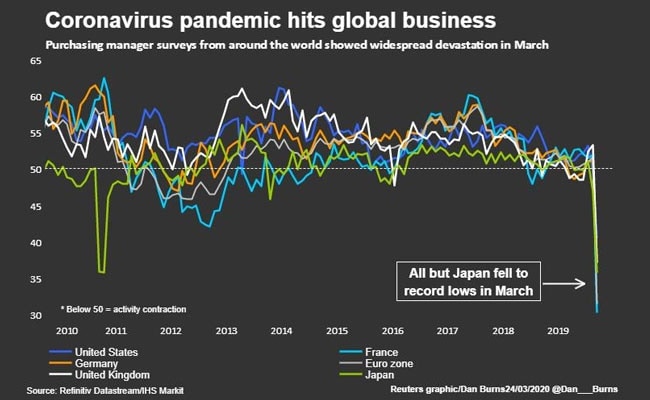
3) With forecasts mounting of deep double-digit contractions of the world's major economies in the second quarter, the first business surveys to reflect the shock outside China reflected the gloom:
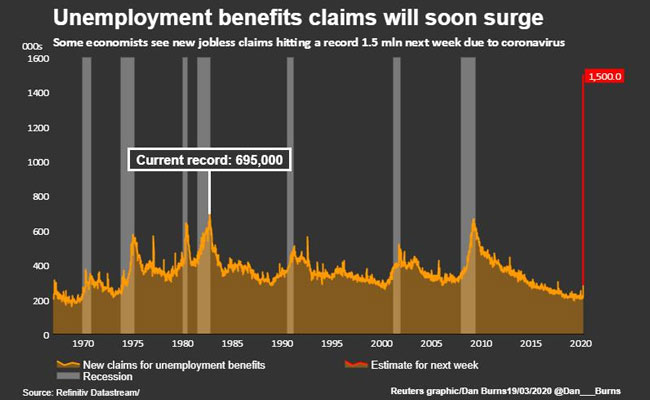
4) While policy support efforts may keep many businesses afloat, the wider demand shock will hinge on how many retain their workers and avoid a mass spike in unemployment:
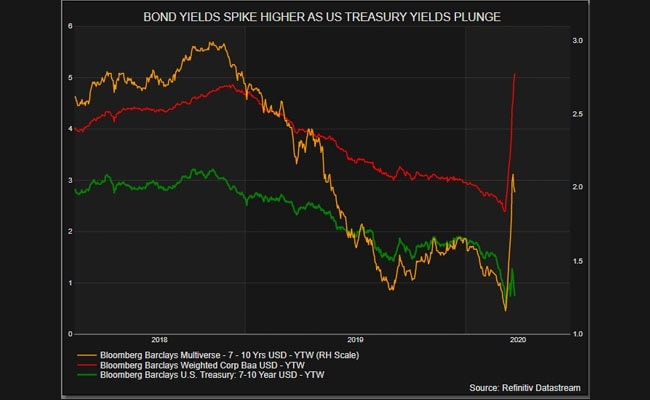
5) Critical to a calming of financial markets is preventing a spike in credit downgrades and defaults while keeping government funding channels open and cheap to ease the official backstops. As U.S. Treasury yields plumbed below 1% this month, the relative cost of credit for everyone else surged.
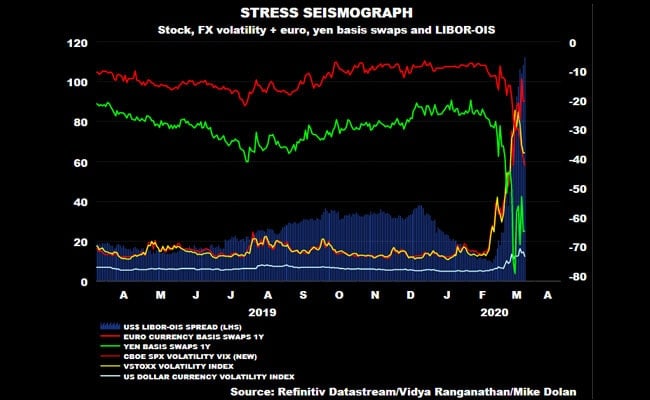
6) Corporate credit concerns and a dash to draw down credit lines and secure dollar funding saw the relative cost of borrowing dollars balloon in tandem with the overall spike in volatility levels - forcing the Federal Reserve to unleash unlimited dollars into the world economy via daily and more varied swap lines with other central banks:
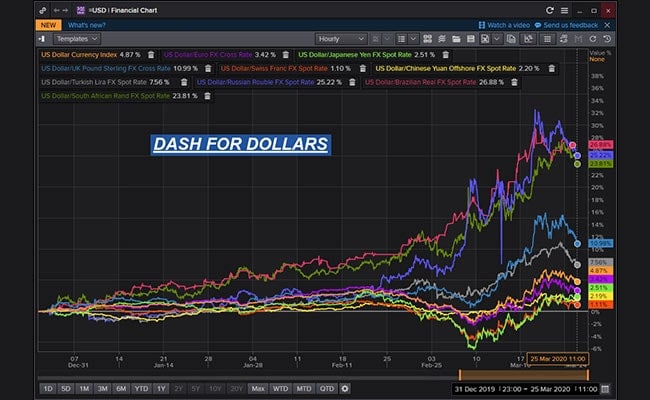
7) The scramble for dollars worldwide has sent the dollar exchange rate sky-rocketing, amplifying the stress on a world economy with huge dollar debts:
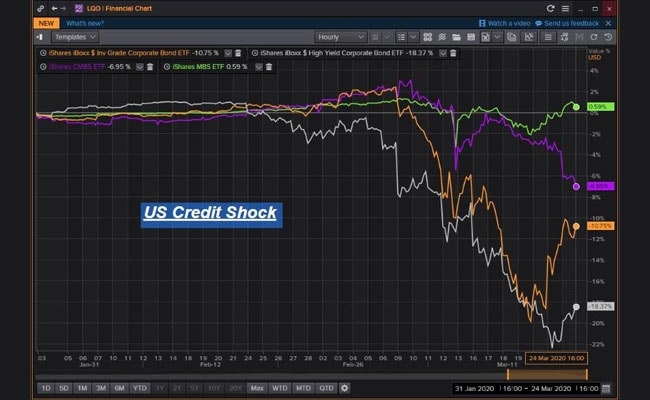
8) Massive support from the Federal Reserve and via a $2 trillion U.S. government support package has helped draw a line under losses in U.S. credit funds:
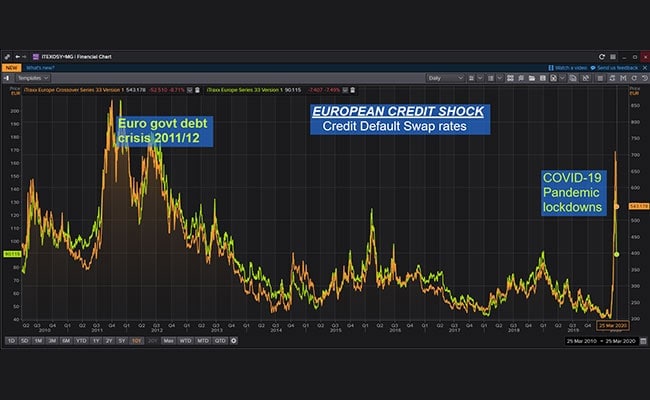
9) European Central Bank and Bank of England supports alongside serial European Union and national government fiscal rescues have helped cap the surge in European credit default swap rates:
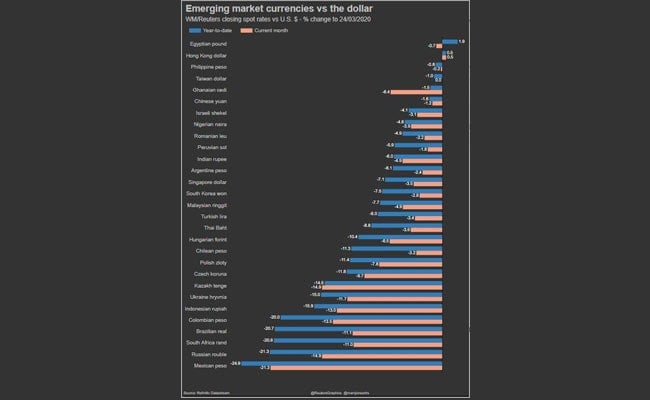
10) Emerging markets currencies have borne the brunt of the dollar surge as investors withdrew money due to the looming world recession, fears for low grade credits, the shock to world supply chains and the oil price collapse due partly to a parallel price war between Saudi Arabia and Russia:
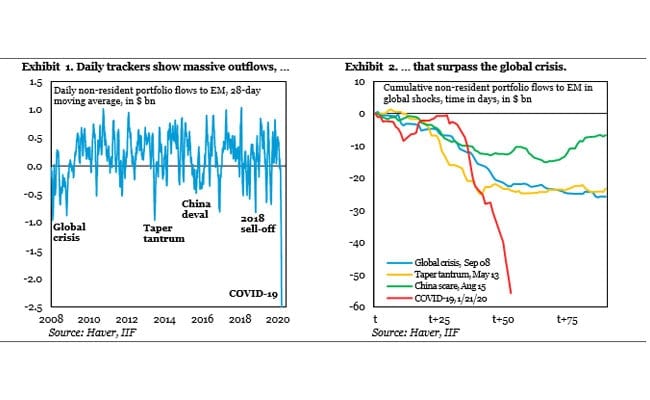
11) The scale of the investment outflows from developing economies surpass the withering withdrawal of the financial crisis of 2008/2009:
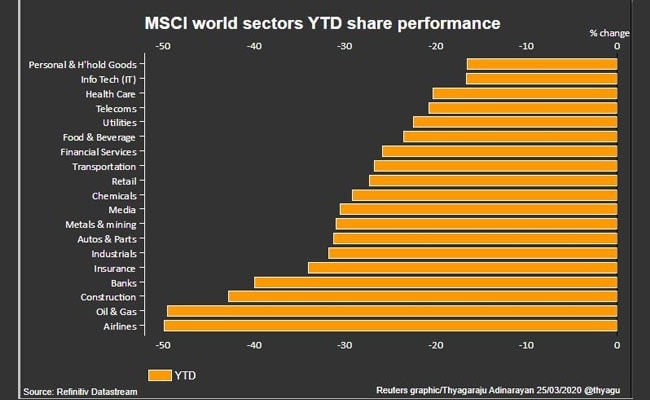
12) For global business sectors, the hit has been near universal but some have been more damaged than others - with airlines, energy, construction and banks bearing the brunt of the hit - while defensives since as household goods, IT, healthcare, telecoms and utilities doing relatively better:

-
Leadership As Mission: Why The Age Of AI Demands More Human Leadership

Debjani Ghosh examines how AI is changing leadership, arguing that its success must be measured by its impact on people and the accountability of those guiding its use.
-
We May Need Another Tukaram Mundhe To Fight Air Pollution | The Reason Why
Developers may install basic measures such as sprinklers and green nets, resume work, and continue violating rules when this equipment stops working.
-
Extracting Value From Battery Scrap Could Be Challenging For India | The Reason Why
A discarded lithium-ion battery still contains valuable materials such as lithium, nickel and cobalt. These can be recovered and reused. When such batteries are crushed and shredded, they produce a dark powder called black mass.
-
One El Nino, India Can Handle. Two Could Break The Granary
India's grain stocks can absorb one bad year, but a second El Nino could drain the buffer in two to three years, economists say.
-
India's Troika Of Good Luck | Joining The Dots
As Jensen Huang's exit drags Nvidia down, a cooling AI trade and resilient earnings have revived investor interest in India. A likely RBI rate hike looms.
-
Talking Points This Week: Leadership Shock At Nvidia, Earnings Strength, And The Fog Over Hormuz
The Anthropic IPO pricing and first trading day, Nvidia's upcoming earnings, and any fresh signals from Iran will set the tone for the following week.
-
Signature Play: The Classic Cocktail Is Dead. Or Is It?
Classic cocktails are disappearing from India's cocktail menus. But they're still being ordered, taught to bartenders and borrowed from. So, who's really having the last drink?
-
A New Samvat Wishlist: Inclusive Prosperity And Human Development
India has strengthened its economic foundations through infrastructure, digital access and enterprise. Its next growth chapter must deepen productivity, create better livelihoods and widen participation in prosperity.
-
Love, Sex Aur Dhokha: The Audacious Plot To Spy On Jensen Huang
A Taipei dinner, a Singapore chip buyer and a suspected Chinese asset: inside the alleged spy operation that got close to NVIDIA's Jensen Huang.
-
Ten Things I Learnt This Samvat
Patience can be a trap. Cheap stocks can stay cheap. Leverage can wipe you out. What did Samvat 2082 teach us? Niraj Shah writes on 10 lessons from the year gone by.









