India-Dominated Clearing Union Moves Toward Rupee Settlement
(Bloomberg) -- Nine central banks linked to a South Asia-focused clearing house have reached a consensus to settle trade in local currencies, including the Indian rupee, to reduce dependence on the US dollar and the euro.
All the members of the Asian Clearing Union, which includes all South Asian countries as well as Iran and Myanmar are on board with the plan, said Khaing Shwe War, director general at the Central Bank of Myanmar.
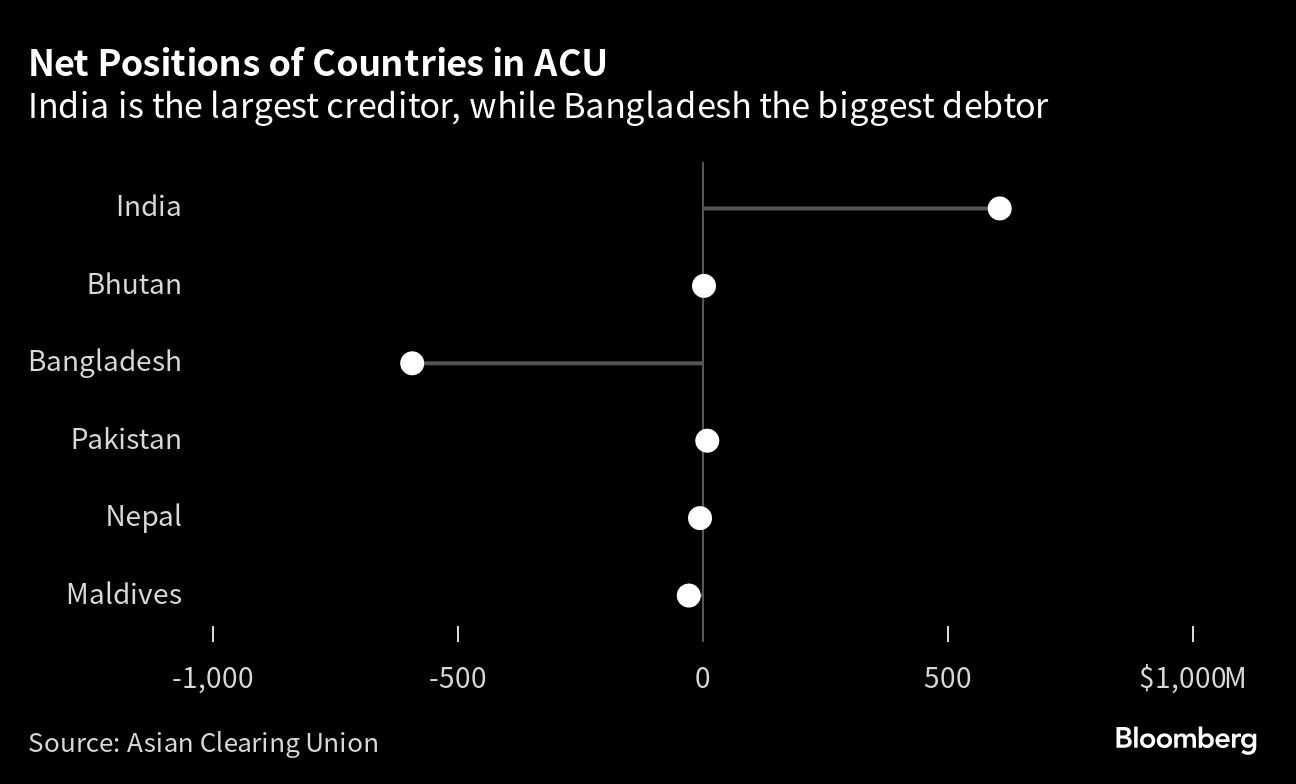
A formal announcement is likely in the next few months, according to people familiar with the matter. India will likely lead in the settlement of trades in the ACU, which had transactions worth $28.8 billion in 2021, a surge of nearly 55% in a year.
The South Asian country controls nearly 93% of the ACU's credit positions as of May, making it the most influential member in the group. The arrangement is one of the few deals being worked out by India to globalize the rupee and make it more acceptable for international trade settlements.
The change is part of an emerging global movement to form trade blocs that rely less on the dollar.
Movements in the US dollar can weaken emerging market currencies fast, and “all the ACU member states dislike it,” said Khaing Shwe War, who is also an official with the clearing house. “Reducing reliance on US dollars has become our common goal.”
Under the proposed plan, transactions will be invoiced in local currencies and settled once in two months, said the people who asked not to be identified as the discussions are private. If there is any surplus currency left, India can offer rupees in exchange and accumulate the currency, they said. Currently, dollars, euros and yen are used for settlement.
Invoicing in local currencies can help developing nations preserve foreign exchange reserves in times of crisis. India has a similar arrangement with Sri Lanka after the island nation faced its worst economic meltdown in decades. Iran has sought trade in non-dollar currencies after facing repeated US sanctions.
Countries in the ACU will also be able to invest in financial assets using excess currencies, while the option of converting to the dollar and euro will also be available. The ACU and the central banks from India, Pakistan, Bangladesh, Nepal, Bhutan, Sri Lanka, Maldives, and Iran didn't respond to emailed requests for comment.
A report by a panel appointed by the Reserve Bank of India also suggested using the ACU-mechanism to increase settlements in the rupee as a way to internationalize the currency and utilize the trade surpluses India runs with most of the countries in the region.
“India will be acquiring the currencies of other countries, which may be deployed in the financial markets of respective countries/acquisition of strategic assets or netting from invisibles,” the report said. It doesn't represent the official views on the RBI.
READ: India Should Push to Add Its Bonds to Global Indexes: RBI Report
The ACU's plan comes as the RBI has allowed more than a dozen banks to settle trades in rupees with 18 countries and held talks with big oil exporters such as the UAE and Saudi Arabia to accept the Indian currency as payment.
Other countries have also shown interest in joining ACU, with Belarus making a formal request in May.
In the clearing union's last meeting in May, representatives from Russia, Afghanistan, Belarus and Saudi Arabia-based Islamic Development Bank were present as observers, according to a statement by the Central Bank of Myanmar.
--With assistance from Faseeh Mangi, Arsalan Shahla, Arun Devnath, Anusha Ondaatjie and Preeti Singh.
(Updates with details in last paragraph.)
More stories like this are available on bloomberg.com
©2023 Bloomberg L.P.

-
Gold Is Rs 22,000 Cheaper Than A Month Ago. Should You Buy Amid The Wedding Season?

Gold's potential slide to $3,500 could save around Rs 4,700 per 10 grams, but a soft inflation print could just as easily push prices back up. One way to split the risk is to buy in parts, some now and the rest after the Fed's Dec. 9 decision.
-
AI Agents Are Gaining Power. Who Governs Them?
Artificial intelligence agents promise to transform productivity by moving machines from assisting decisions to executing them. But as organisations delegate greater authority to these AI-agents, they must first establish who controls that authority and who remains accountable when things go wrong.
-
Why Swapping Your Old Gold Can Trigger A Rs 5 Lakh Tax Bill, And How You Can Avoid It Legally
Swapping old gold for new is taxed as a sale and a fresh purchase. Getting your own gold remade can cut most of that bill, though it has its own costs.
-
The AI Trade is Done. The Real Opportunity for Investors Starts in 2027 | Unhedged Position
As pureplay AI stocks plunge and circular, capex-led financing unwinds, 2027 is set to be a year of reckoning for AI companies. Yet the bust clears the way for a better opportunity for investors in 2027 -- shifting the spotlight from AI builders to the companies using AI.
-
Leadership As Mission: Why The Age Of AI Demands More Human Leadership
Debjani Ghosh examines how AI is changing leadership, arguing that its success must be measured by its impact on people and the accountability of those guiding its use.
-
We May Need Another Tukaram Mundhe To Fight Air Pollution | The Reason Why
Developers may install basic measures such as sprinklers and green nets, resume work, and continue violating rules when this equipment stops working.
-
Extracting Value From Battery Scrap Could Be Challenging For India | The Reason Why
A discarded lithium-ion battery still contains valuable materials such as lithium, nickel and cobalt. These can be recovered and reused. When such batteries are crushed and shredded, they produce a dark powder called black mass.
-
One El Nino, India Can Handle. Two Could Break The Granary
India's grain stocks can absorb one bad year, but a second El Nino could drain the buffer in two to three years, economists say.
-
India's Troika Of Good Luck | Joining The Dots
As Jensen Huang's exit drags Nvidia down, a cooling AI trade and resilient earnings have revived investor interest in India. A likely RBI rate hike looms.
-
Talking Points This Week: Leadership Shock At Nvidia, Earnings Strength, And The Fog Over Hormuz
The Anthropic IPO pricing and first trading day, Nvidia's upcoming earnings, and any fresh signals from Iran will set the tone for the following week.









