Chinese Economy Contracts For First Time In Decades Due To Coronavirus Crisis: Report
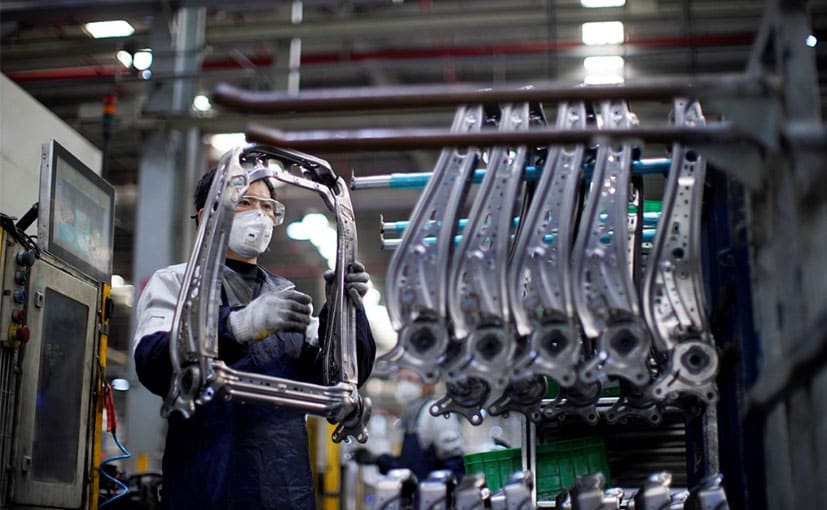
China's economy contracted for the first time in around three decades in the first quarter as the coronavirus crisis brought the country to a standstill, according to an AFP poll of economists.
The world's second-largest economy tanked in the first three months of the year as factories closed, consumers were compelled to stay home and the virus spread to other countries.
Analysts from 14 institutions expect China's economy to have shrunk 8.2 percent from a year ago in the first quarter -- the first contraction since quarterly data started to be reported in the early 1990s.
They also forecast that full-year gross domestic product (GDP) growth will come in at 1.7 percent, a dramatic drop from the 6.1 percent expansion logged last year and well below the pre-coronavirus prediction.
If the forecast is accurate, it would represent the worst annual growth since 1976, the year Communist Party Chairman Mao Zedong died.
The International Monetary Fund on Tuesday gave an even more dire estimate of 1.2 per cent growth in 2020.
While many businesses in China have resumed work, the coronavirus pandemic has brought other economies to their knees around the world with many key trading partners under lockdown.
The IMF said the pandemic will cut world output by three per cent this year.
Economists differed on the impact of the coronavirus on China's economy, with first-quarter contraction estimates ranging from 4.6 per cent to 15 per cent.
Larger Fall Than Expected
China's downturn is "more disappointing than anyone expected", said Moody's Analytics economist Xu Xiaochun.
He also noted that China's workforce returned to work slower than anticipated, pointing to a significant contraction in the first quarter.
While labour supply will not be an issue in April and greater fiscal and monetary support for the economy is expected, "it will not be enough to overcome the heavy drag from suppressed world demand for the remainder of the year", he added.
The slow return to work also bodes badly for jobs, and the unemployment rate has already risen from last December.
Economists at ANZ Research noted in a recent report that double-digit contractions in economic indicators for the first two months had not been followed by a strong bounce-back in March.
Labour flows were also not back to pre-virus levels, especially in major production bases, they said.
"This is despite the central government's efforts in encouraging workers to return to the cities where they work, such as the relaxation of travel restrictions," they added.
Difficult Recovery
Although the virus situation in China has largely improved, JP Morgan chief China economist Zhu Haibin said: "External risks will likely restrain the expected second-quarter recovery in China's export-related manufacturing activity."
Lockdowns in other countries could disrupt global supply chains, while fears over imported cases will probably cause a slower return to normal life, delaying the recovery of China's service consumption and domestic demand, Zhu added.
Raphie Hayat, senior economist at Rabobank, added that the short-term impact of COVID-19 is expected to be "greater than the Great Financial Crisis of 2008/2009", with the fallout hurting China's growth.
HSBC chief China economist Qu Hongbin warned that the shock to external demand should not be seen as a mere trade contraction.
"US-China trade tensions last year showed us that an external demand shock can rapidly lead to a material deterioration in domestic demand growth," he said.
The hit to supply chains is "deeper and more sprawling" this time, he added.
"As we are now forecasting a contraction or very weak growth in almost all Asian countries this year, the impact of the headwinds this year for China could be much deeper and more broad-based compared with last year."

-
Getting To Work Costs Women More | The Reason Why

It is not just about women paying more than men. It is about women paying much more in cities than in villages.
-
AI Bias In Investing Cannot Be Eliminated, But It Can Be Governed
Framing is a particularly important example as identical financial information presented in terms of gains rather than losses can lead an LLM to reach a different assessment.
-
Joining The Dots | Dark Skies, Steady Diya: Why Hope Holds This Diwali
With war, a weak rupee and foreign outflows weighing on sentiment, policymakers at the NDTV World Summit and market veterans at NDTV Profit Ignite: Diwali Edition offered the same advice: stay invested and filter out the noise.
-
The Curious Case of Equitas Small Finance Bank And A CEO Who Quit For Stock
PN Vasudevan believes persistent investor concerns over a perceived conflict of interest had become a governance overhang on Equitas Small Finance Bank's stock, even as the lender improved profitability and asset quality.
-
Talking Points This Week: AI Cash Burn, A Tiger Comeback And An India That Still Finds Its Own Path
India is not immune to higher oil or tighter global liquidity, yet its earnings base is broader, its domestic policy levers are still available.
-
Foreign Investors Own Half Of HDFC Bank and ICICI Bank. An LTCG Cut Could Matter Most Here
Foreign portfolio investors have US$115 billion parked in HDFC Bank, ICICI Bank. If the government cuts long-term capital gains tax, Jefferies says returning foreign money could land here first.
-
'Never Seen This Level Of Negativity': Sandeep Tandon Says The Next Rally May Be Closer Than You Think
Veteran investor Sandeep Tandon says foreign selling is easing, large-caps are due a comeback and mid-caps are crowded, while he turns positive on gold, power and pharma this Diwali.
-
Indians Stay With Family, Not In Hotels | The Reason Why
India still lacks enough clean, reliable and affordable hotels for budget-conscious travellers.
-
The Economic Imperative: Analysing The Material Driving Force Behind India-Canada Strategic Reset
This economic complementarity is further reinforced by deep institutional investment ties and talent mobility, which form the bedrock of the bilateral framework.
-
Medicine Pricing: Where Must Profit Stop?
India must confront excessive margins, hidden incentives and regulatory gaps that threaten the integrity of medicine.










