China's Jobless Turn To Car Boot Sales As Covid-Hit Economy Stalls
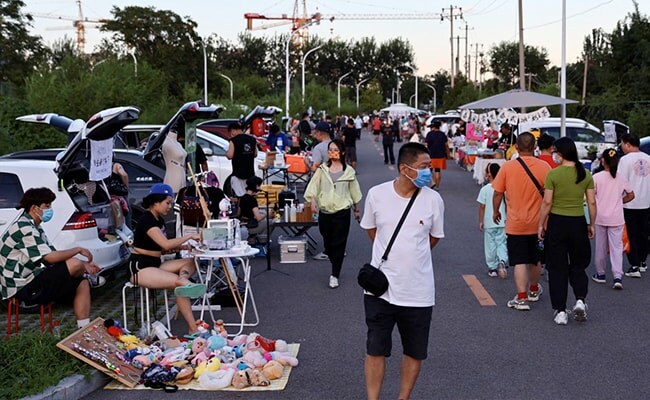
When the COVID-19 pandemic forced Wang Wei to shut his tourism company, the Tianjin native poured his life-savings of 80,000 yuan ($11,785) into selling coffee from the back of his green Suzuki micro van in the Chinese capital Beijing.
Since June, Wang has driven his mobile coffee booth from car boot fair to car boot fair, offering hand-brewed coffee steeped in an assortment of liqueurs.
Once considered too low-status for many, peddling wares on the street has made a comeback as people who lost their jobs or closed down their businesses seek new ways to make a living and work around China's relentless anti-COVID policies.
Hospitality, tourism and after-school tutoring have been particularly hard hit.
Wang, 40, gave up a bricks-and-mortar coffee shop in Tianjin in 2020 when the pandemic first hit. Overseas group tours he used to organise also took a blow that year, with a lucrative trip to see the aurora borealis cancelled, costing him hundreds of thousands of yuan in lost earnings.
This year, the spread of the Omicron variant across China was the final nail in the coffin, making his group tours to the Chinese backcountry impossible.
Wang started running his mobile coffee booth this summer, after car boot fairs emerged in big southern cities like Chengdu, Chongqing and Guangzhou.
Under a canopy extending from Wang's van, customers relax in camping chairs, with soft lights in the evening completing the glamping experience.
"The rising popularity of this car boot sale market has helped me tide over the most difficult of times," said Wang, who reckons he earns about 1,000 yuan a day.
JOBLESS YOUTH
China's economy barely grew in April-June. Youth unemployment has remained high, reaching a record 19.9% in July, the fourth month in which the rate had broken records.
Pan, 25, closed his bar in Shenzhen after a COVID outbreak in March, saddling him with over 100,000 yuan in debts.
"I was pretty down, and one night, my fiancée Annie, wanting to cheer me up, took me to a watering hole in a quiet area with warm, faint lights and soft music," he said.
That was when he saw a couple selling liquor at an outdoor stall, inspiring him to do the same - but from his Tesla.
"My best friend lent me 3,000 yuan, which became the initial investment for our pop-up liquor shop," Pan said.
Pan and Annie ran out of money in their first week, but their determination paid off, with daily revenues since climbing as high as 7,800 yuan.
"In the future, we plan to travel the country with our Tesla and sell liquor from the boot of our car in cities we enjoy the most," said Pan.
'PENNILESS'
Policymakers, in tacit admittance jobs are harder to come by, have encouraged "flexible" employment in the informal economy.
Even Beijing, which has long regarded makeshift market-places as beneath the capital, is closing an eye to car boot sales.
Liu, 30, used to make a living teaching Beijing kids how to solve the Rubik's Cube, but after in person learning was shuttered due to COVID-19, she became "penniless".
She now sells coffee from the back of her small van and hopes her small business will pull her out of her financial straits.
"We are still losing money at this stage, I get less than 100 yuan a day most of the time - not enough for meals and transportation," she said. "But I'm happy just being occupied."
(This story has not been edited by NDTV staff and is auto-generated from a syndicated feed.)

-
Extracting Value From Battery Scrap Could Be Challenging For India | The Reason Why

A discarded lithium-ion battery still contains valuable materials such as lithium, nickel and cobalt. These can be recovered and reused. When such batteries are crushed and shredded, they produce a dark powder called black mass.
-
One El Nino, India Can Handle. Two Could Break The Granary
India's grain stocks can absorb one bad year, but a second El Nino could drain the buffer in two to three years, economists say.
-
India's Troika Of Good Luck | Joining The Dots
As Jensen Huang's exit drags Nvidia down, a cooling AI trade and resilient earnings have revived investor interest in India. A likely RBI rate hike looms.
-
Talking Points This Week: Leadership Shock At Nvidia, Earnings Strength, And The Fog Over Hormuz
The Anthropic IPO pricing and first trading day, Nvidia's upcoming earnings, and any fresh signals from Iran will set the tone for the following week.
-
Signature Play: The Classic Cocktail Is Dead. Or Is It?
Classic cocktails are disappearing from India's cocktail menus. But they're still being ordered, taught to bartenders and borrowed from. So, who's really having the last drink?
-
A New Samvat Wishlist: Inclusive Prosperity And Human Development
India has strengthened its economic foundations through infrastructure, digital access and enterprise. Its next growth chapter must deepen productivity, create better livelihoods and widen participation in prosperity.
-
Love, Sex Aur Dhokha: The Audacious Plot To Spy On Jensen Huang
A Taipei dinner, a Singapore chip buyer and a suspected Chinese asset: inside the alleged spy operation that got close to NVIDIA's Jensen Huang.
-
Ten Things I Learnt This Samvat
Patience can be a trap. Cheap stocks can stay cheap. Leverage can wipe you out. What did Samvat 2082 teach us? Niraj Shah writes on 10 lessons from the year gone by.
-
Talking Points This Week: Tech Nerves, FII Buying, And A Faraway Banking Shock
The global markets are not shining this Diwali. The exception in the large markets is, India.
-
Midterm Rally Lasted A Day. The Hard Reality Of A Divided US May Last Two Years | Opinion
Between a contested AI boom, a debt ceiling that arrives in 2027 and a president with every incentive to act alone, the next two years may prove more volatile than the first day's rally suggests.









