China's Economy Grew 2.3% In 2020, Rebounding To Pre-Pandemic Territory

China's economy recovered to pre-pandemic growth rates in the fourth quarter, propelling it to a stronger than expected full-year expansion of 2.3 per cent and making it the only major one to avoid contraction.
Gross domestic product climbed 6.5 per cent in the final quarter from a year earlier, fueled by stronger-than-expected industrial output, the statistics bureau said Monday. Economists surveyed by Bloomberg had predicted 6.2 per cent growth for the quarter and 2.1 per cent for the full year.
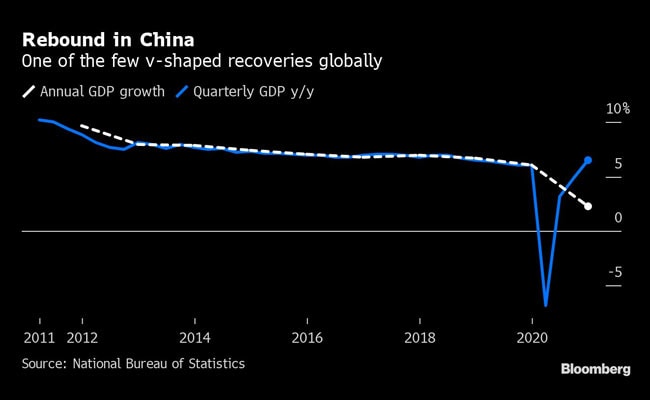
The recovery was aided early on by fiscal and monetary stimulus that boosted investment in infrastructure and real estate. Once China had virus cases under control and factories were able to resume production, growth was spurred by strong overseas consumer demand for Chinese exports, especially medical equipment and work-from-home devices.
Other Key Highlights
- Industrial output rose 7.3 per cent in December from a year earlier, and 2.8 per cent in 2020
- Retail sales growth slowed to 4.6 per cent in December from 5 per cent in November. For the whole of 2020 it shrank 3.9 per cent, led by an almost 17 per cent drop in catering and restaurants
- Fixed-asset investment was 2.9 per cent bigger in 2020 than in 2019
- The economy expanded 2.6 per cent on a quarter-on-quarter basis in the final three months of the year, down from a revised 3 per cent in the July-September period
- The jobless rate was 5.2 per cent at the end of December
"The quarter really seems to have shown the economy ended the year on a strong note, manufacturing is doing well," Cui Li, head of macro research at CCB International Holdings in Hong Kong said in an interview with Bloomberg Television. The softer-than-expected retail sales data in December may reflect the cooler weather and the resurgent virus in northern parts of China as some cities enforce new restrictions to control the outbreak.
The onshore yuan strengthened as much as 0.06 per cent to 6.4779 versus the dollar after the release of GDP growth figures, while the ChiNext Index of small caps gained 1.6 per cent. The yield on the most actively traded contract of 10-year government bonds gained 2 basis points to 3.165 per cent, set for the highest in two weeks.
What Bloomberg Economics Says...
"The Chinese economy accelerated to a strong finish to 2020, though challenges at the start of 2021 could put a damper on growth."
Data for December suggests that the gap between demand and supply is opening up again, and this may reflect the impact on consumption from recent viral outbreaks.
-- Chang Shu, chief Asia economist
Emerging from the pandemic larger than when it started is a capstone to a dramatic year for the world's second largest economy, which began 2020 with a historic first-quarter slump when the coronavirus lockdowns brought most activity to a halt.
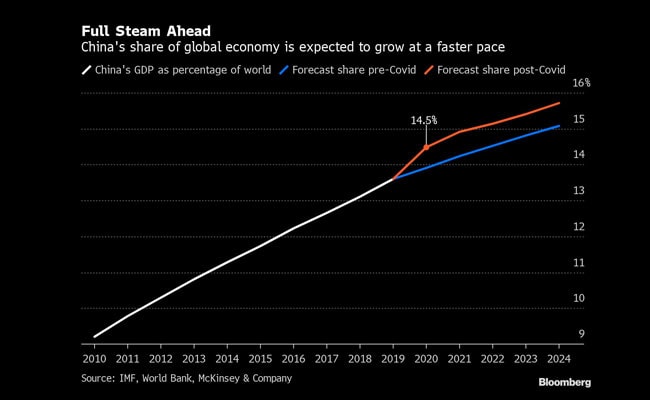
With global output likely contracting 4.2 per cent last year, China's gains mean it increased its share of the world economy to 14.5 per cent, according to World Bank estimates, compared with 22 per cent for the U.S. Based on projections from the International Monetary Fund, China will now overtake the U.S. by 2028, two years earlier than previously predicted, according to Nomura Holdings Inc.
Economists expect China's GDP will expand 8.2 per cent this year, continuing to outpace global peers, even as other large economies begin to recover with vaccines being rolled out.
The ongoing recovery in 2021 will depend on whether China can prevent a large-scale spread of virus infections, and on whether it can pass the baton of spending from local governments and large state companies to smaller businesses and consumers. Household spending and investment by manufacturing companies has lagged overall growth in 2020.
An increasingly tense trade relationship with the U.S. could also weigh on the outlook. In his final weeks in office, President Donald Trump has tightened restrictions on Chinese businesses to curb the nation's dominance in high-tech industries, roiling financial markets. It's still unclear how the incoming administration under Joe Biden will navigate those issues.
Global demand for Chinese-made goods is expected to remain strong as the pandemic continues to keep large parts of the world's population locked down. Already the top exporter, the value of China's goods shipments increased 3.6 per cent in 2020, according to official data. Imports declined 1.1 per cent, resulting in a $535 billion annual trade surplus, the highest since 2015.
The fiscal and monetary stimulus to support the economy through the pandemic has been accompanied by a surge in debt, a development that authorities are now seeking to address as the recovery takes hold. At a December meeting to lay out economic goals for 2021, the ruling Communist Party signaled that stimulus would be gradually withdrawn, although it would avoid any "sharp turns" in policy.
(Except for the headline, this story has not been edited by NDTV staff and is published from a syndicated feed.)

-
Gold Is Rs 22,000 Cheaper Than A Month Ago. Should You Buy Amid The Wedding Season?

Gold's potential slide to $3,500 could save around Rs 4,700 per 10 grams, but a soft inflation print could just as easily push prices back up. One way to split the risk is to buy in parts, some now and the rest after the Fed's Dec. 9 decision.
-
AI Agents Are Gaining Power. Who Governs Them?
Artificial intelligence agents promise to transform productivity by moving machines from assisting decisions to executing them. But as organisations delegate greater authority to these AI-agents, they must first establish who controls that authority and who remains accountable when things go wrong.
-
Why Swapping Your Old Gold Can Trigger A Rs 5 Lakh Tax Bill, And How You Can Avoid It Legally
Swapping old gold for new is taxed as a sale and a fresh purchase. Getting your own gold remade can cut most of that bill, though it has its own costs.
-
The AI Trade is Done. The Real Opportunity for Investors Starts in 2027 | Unhedged Position
As pureplay AI stocks plunge and circular, capex-led financing unwinds, 2027 is set to be a year of reckoning for AI companies. Yet the bust clears the way for a better opportunity for investors in 2027 -- shifting the spotlight from AI builders to the companies using AI.
-
Leadership As Mission: Why The Age Of AI Demands More Human Leadership
Debjani Ghosh examines how AI is changing leadership, arguing that its success must be measured by its impact on people and the accountability of those guiding its use.
-
We May Need Another Tukaram Mundhe To Fight Air Pollution | The Reason Why
Developers may install basic measures such as sprinklers and green nets, resume work, and continue violating rules when this equipment stops working.
-
Extracting Value From Battery Scrap Could Be Challenging For India | The Reason Why
A discarded lithium-ion battery still contains valuable materials such as lithium, nickel and cobalt. These can be recovered and reused. When such batteries are crushed and shredded, they produce a dark powder called black mass.
-
One El Nino, India Can Handle. Two Could Break The Granary
India's grain stocks can absorb one bad year, but a second El Nino could drain the buffer in two to three years, economists say.
-
India's Troika Of Good Luck | Joining The Dots
As Jensen Huang's exit drags Nvidia down, a cooling AI trade and resilient earnings have revived investor interest in India. A likely RBI rate hike looms.
-
Talking Points This Week: Leadership Shock At Nvidia, Earnings Strength, And The Fog Over Hormuz
The Anthropic IPO pricing and first trading day, Nvidia's upcoming earnings, and any fresh signals from Iran will set the tone for the following week.









