China to Inject $33 Billion of 3-month Loans into Banks
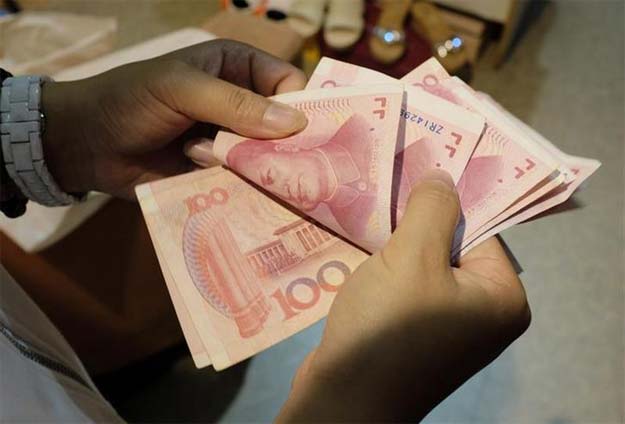
Beijing: China's central bank is set to inject about 200 billion yuan ($32.66 billion) worth of three-month loans into five or six listed banks to keep liquidity ample and support the slowing Chinese economy, four sources with knowledge of the matter said on Friday.
The injection follows signs that Chinese investors are beginning to bet that the PBOC is going to reduce the official deposit rate, now fixed at 3 per cent.
And it came after a 500 billion-yuan injection the People's Bank of China (PBOC) made into China's top banks last month via its standard lending facility (SLF) in the form of three-month loans.
"Banks got the notice this afternoon but perhaps will only receive the funds next week. This injection focuses on listed joint-stock banks," one source said.
Analysts also suspect that recent moves to guide traded short-term rates by lowering the guidance rates for repo contracts may be buttressed by cuts in nominal lending rates. The aim would be to encourage state-owned banks to lower the cost of credit for productive investments.
Central bank officials whom Reuters contacted couldn't immediately confirm the injection plan.
Regulators were concerned by signs of slowing loan growth this summer, but yuan loans picked up in September, relieving worries that demand was slackening. However, the Friday standard lending facility shows the central bank is still engaged in targeted easing to keep cash in the system.
China has injected a net 44 billion yuan for the year through open market operations, compared with 113 billion yuan in 2013. But it has begun to intensify its use of short-term facilities extended directly to banks in 2014, a method which some analysts criticize as being relatively opaque.
The PBOC has so far held back from a deeper across-the-board easing such as a reduction of bank reserve requirement ratios (RRR) that would result in a big, sustained upward adjustment to the base money supply. Some economists question how long it can rely on short-term targeted tools to keep credit flowing.
"There was very weak loan demand in Q3, which would generally indicate lower lending in Q4, but this is likely to be offset by continued monetary loosening and lending support," wrote Oliver Barron of NSBO in a research report on Friday.
"We consider an interest rate cut is likely in Q4, while continued tight liquidity also makes an RRR cut in Q1 15 likely as a way to replace the maturing 500-billion yuan SLF. "
(1$ = 6.1238 Chinese yuan)
Copyright: Thomson Reuters 2014

-
The Curious Case of Equitas Small Finance Bank And A CEO Who Quit For Stock

PN Vasudevan believes persistent investor concerns over a perceived conflict of interest had become a governance overhang on Equitas Small Finance Bank's stock, even as the lender improved profitability and asset quality.
-
Talking Points This Week: AI Cash Burn, A Tiger Comeback And An India That Still Finds Its Own Path
India is not immune to higher oil or tighter global liquidity, yet its earnings base is broader, its domestic policy levers are still available.
-
Foreign Investors Own Half Of HDFC Bank and ICICI Bank. An LTCG Cut Could Matter Most Here
Foreign portfolio investors have US$115 billion parked in HDFC Bank, ICICI Bank. If the government cuts long-term capital gains tax, Jefferies says returning foreign money could land here first.
-
'Never Seen This Level Of Negativity': Sandeep Tandon Says The Next Rally May Be Closer Than You Think
Veteran investor Sandeep Tandon says foreign selling is easing, large-caps are due a comeback and mid-caps are crowded, while he turns positive on gold, power and pharma this Diwali.
-
Indians Stay With Family, Not In Hotels | The Reason Why
India still lacks enough clean, reliable and affordable hotels for budget-conscious travellers.
-
The Economic Imperative: Analysing The Material Driving Force Behind India-Canada Strategic Reset
This economic complementarity is further reinforced by deep institutional investment ties and talent mobility, which form the bedrock of the bilateral framework.
-
Medicine Pricing: Where Must Profit Stop?
India must confront excessive margins, hidden incentives and regulatory gaps that threaten the integrity of medicine.
-
Why Amazon And Flipkart Are Struggling To Beat Meesho In India's Smaller Cities
With 274 million users and lowest-cost logistics, Meesho is defending its value commerce crown against giants like Amazon and Flipkart.
-
High US Salaries, No Green Card Certainty: The Financial Calculation Facing Indian H-1B Families
The suspension of PERM processing at eight technology employers does not cancel existing H-1B visas. What it does is force a question many Indian families have been avoiding: is the US salary worth tying your career and family plans to one employer?
-
Swiggy vs Eternal: Food Delivery's Two Rivals Are No Longer In The Same Race
Eternal is building a private AI assistant, dark.ai. Swiggy is still working out how to make Instamart pay, with an operating loss of Rs 895 crore in the July-September quarter while Blinkit stayed profitable.










