China Slashes Steel Output As Industry Rings Alarm On Demand
Chinese steelmakers slashed output last month as woeful demand forced steep cuts on an industry contending with a collapse in margins.
Steel production in July plunged about 9% on both the month and the year to 82.94 million tonne, the lowest figure reported in 2024, according to the statistics bureau on Thursday. That leaves the total over the first seven months at 613.72 million tonne, 2.2% off last year's pace.
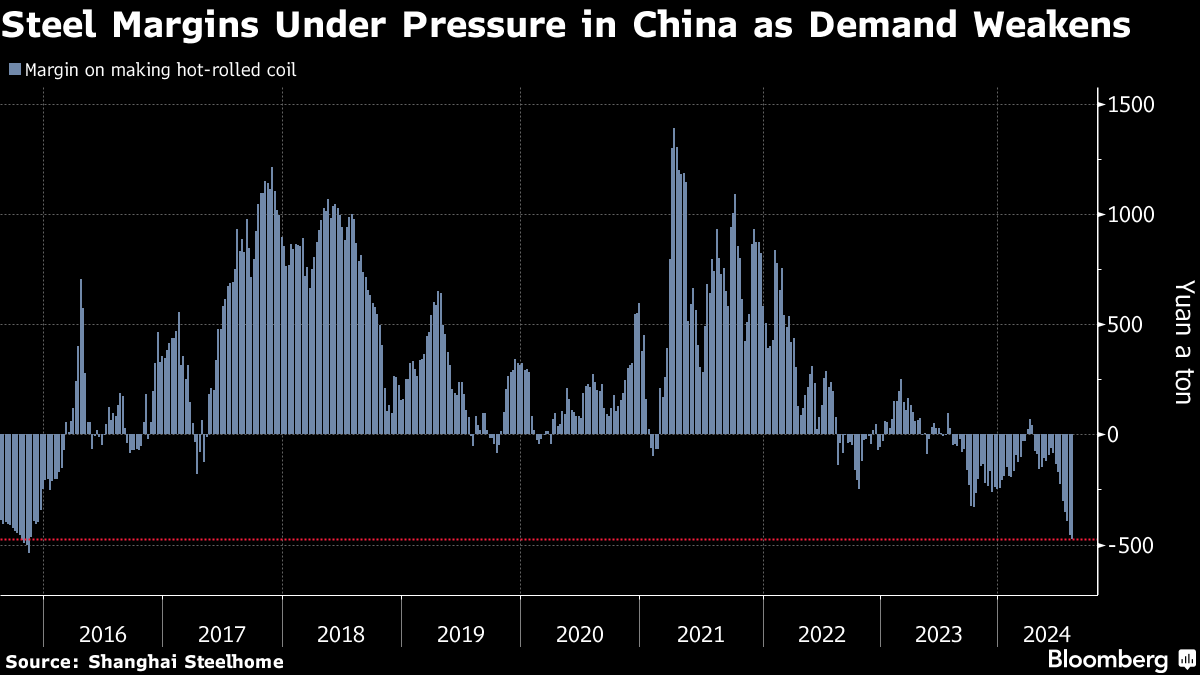
The protracted downturn in the real estate market and shrinking factory activity have pushed domestic prices sharply lower, and inflamed trade tensions by unleashing a flood of Chinese metal onto world markets. The nation's top steelmaker warned on Wednesday that the industry is facing a crisis more severe than the downturns of 2008 and 2015.
“Output usually falls during the summer demand lull, constrained by heat and rains, but July's plunge is steeper-than-expected,” said Xu Xiangchun, an analyst with Mysteel Global, who expects production to drop further in August.
“Market sentiment is really bearish,” he said. “Mills are losing money across the industry, but steel prices are not showing signs of stabilizing.”
There's been little respite from the bad news emanating from the property sector. Construction starts are the steel market's main pillar of demand, but new home sales are in a prolonged funk and foreclosures are mounting, offering few incentives for developers to build afresh. Home prices continued to fall in July, albeit at a slightly slower pace, the statistics bureau said.
At the same time, the government has been unwilling to offset the weakness by ramping up spending on infrastructure, which has helped rescue the market during previous downturns. The upshot is that Chinese steel consumption may contract as much as 3% in 2024 following a similar decline last year, according to Bloomberg Intelligence.
Stricter quality requirements on some products, including rebar used in construction, has probably amplified the cuts to production. The new government standards come into effect on Sept. 25, incentivizing mills to limit output and clear stockpiles of older material before it becomes obsolete.
The steel industry has been plagued by overcapacity for years. In an effort to rein in emissions, Beijing has been trying to cap production at or below the previous year's level after output ballooned in 2020 to well over 1 billion tons. That task is likely to be easier this year as supply discipline is forced on mills looking to buttress their margins. It could also offer some relief to the countries grappling with the impact of cheap Chinese exports on their domestic markets.
Other Commodities Data
China's oil refiners face a similar set of challenges from slowing growth, the property crisis and Beijing's pivot from the old economy to the new. The industry's first-half profits dropped over 90% and segments from plastics to diesel and gasoline are all struggling as demand weakens and the switch to clean energy gathers steam.
- That's pressured refining rates, with output dropping 6.1% year-on-year to 59.06 million tons in July.
- Thermal power dropped for a third consecutive month, falling 4.9% in July, as heavy rains lifted the contribution from hydroelectricity. Growth in wind and solar output slowed. Solar cell production fell for a second month after a plunge in prices below cost forced more factories to halt operations.
- Aluminum output hit a record for a third straight month after smelters ramped up production in hydro-rich Yunnan province and new capacity was added in Inner Mongolia.
- Coal and natural gas production rose to meet peak summer demand. China's mission to cut its dependence on imports also saw crude oil output increase.
On the Wire
Iron ore hit the lowest level since 2022 on concern that global supply is running ahead of demand, with China's steelmakers mired in a crisis and cutting output just as major miners boost exports.
China's economy failed to pick up and unemployment rose for the first time since February, as slow consumption and disappointing investment drag on growth.
Three Chinese steelmakers, including Baoshan Iron & Steel, were put on a downside 30-day catalyst watch by Citigroup, which is concerned about declining prices and potentially weaker-than-expected performance in the third quarter.
Restrictions on Brazil's chicken exports to China have been dropped for all regions except for the southern state Rio Grande do Sul.
This Week's Diary
(All times Beijing unless noted.)
Thursday, Aug. 15:
- China home prices for July, 09:30
- China industrial output for July, including steel & aluminum; coal, gas & power generation; and crude oil & refining. 10:00
- Retail sales, fixed assets investment, property investment, residential sales, jobless rate
Friday, Aug. 16:
- China weekly iron ore port stockpiles
- Shanghai exchange weekly commodities inventory, ~15:00
- EARNINGS: Hongqiao
--With assistance from Dan Murtaugh, Kathy Chen, Sarah Chen and Winnie Zhu.
©2024 Bloomberg L.P.

-
The Curious Case of Equitas Small Finance Bank And A CEO Who Quit For Stock

PN Vasudevan believes persistent investor concerns over a perceived conflict of interest had become a governance overhang on Equitas Small Finance Bank's stock, even as the lender improved profitability and asset quality.
-
Talking Points This Week: AI Cash Burn, A Tiger Comeback And An India That Still Finds Its Own Path
India is not immune to higher oil or tighter global liquidity, yet its earnings base is broader, its domestic policy levers are still available.
-
Foreign Investors Own Half Of HDFC Bank and ICICI Bank. An LTCG Cut Could Matter Most Here
Foreign portfolio investors have US$115 billion parked in HDFC Bank, ICICI Bank. If the government cuts long-term capital gains tax, Jefferies says returning foreign money could land here first.
-
'Never Seen This Level Of Negativity': Sandeep Tandon Says The Next Rally May Be Closer Than You Think
Veteran investor Sandeep Tandon says foreign selling is easing, large-caps are due a comeback and mid-caps are crowded, while he turns positive on gold, power and pharma this Diwali.
-
Indians Stay With Family, Not In Hotels | The Reason Why
India still lacks enough clean, reliable and affordable hotels for budget-conscious travellers.
-
The Economic Imperative: Analysing The Material Driving Force Behind India-Canada Strategic Reset
This economic complementarity is further reinforced by deep institutional investment ties and talent mobility, which form the bedrock of the bilateral framework.
-
Medicine Pricing: Where Must Profit Stop?
India must confront excessive margins, hidden incentives and regulatory gaps that threaten the integrity of medicine.
-
Why Amazon And Flipkart Are Struggling To Beat Meesho In India's Smaller Cities
With 274 million users and lowest-cost logistics, Meesho is defending its value commerce crown against giants like Amazon and Flipkart.
-
High US Salaries, No Green Card Certainty: The Financial Calculation Facing Indian H-1B Families
The suspension of PERM processing at eight technology employers does not cancel existing H-1B visas. What it does is force a question many Indian families have been avoiding: is the US salary worth tying your career and family plans to one employer?
-
Swiggy vs Eternal: Food Delivery's Two Rivals Are No Longer In The Same Race
Eternal is building a private AI assistant, dark.ai. Swiggy is still working out how to make Instamart pay, with an operating loss of Rs 895 crore in the July-September quarter while Blinkit stayed profitable.










