China Seen Cutting Banks’ Reserve Ratio In August To Add Cash
(Bloomberg) -- China's central bank may cut the reserve-requirement ratio for major banks as soon as this month in an effort to boost lending and revive momentum for the economic recovery.
That's according to several analysts who've pointed to the mounting value of policy loans maturing this month and through the rest of the year as reason for the People's Bank of China to unleash more liquidity.
“There is a large liquidity gap in August,” wrote Ming Ming, chief economist at Citic Securities Co. in a note this week. “Under such environment the possibility of an RRR cut cannot be ruled out,” Ming said, referring to the reserve-requirement ratio, or the amount of cash lenders have to keep in reserve.
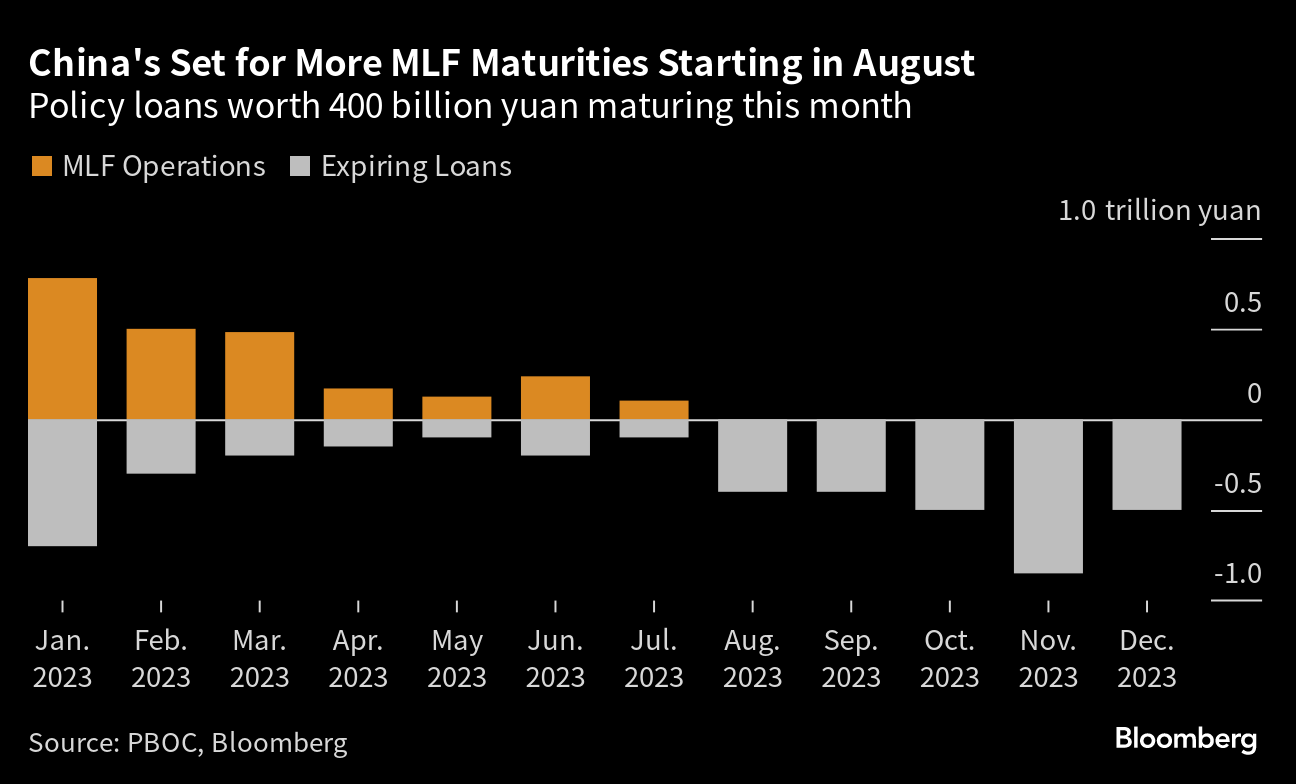
Policy loans worth some 400 billion yuan ($55.6 billion) are set to mature on August 15 — the highest amount since January. When those loans mature, the nation's lenders will need to repay the PBOC, leaving them with less cash unless the central bank takes action to add liquidity to the interbank market.
While rolling over maturing loans can free up liquidity, so can cutting the reserve ratio — a step that's advantageous as it unleashes a lot of liquidity at once at a cheaper cost for banks.
Through the rest of 2023, a total of 2.65 trillion yuan worth of the central bank's one-year medium-term lending facilities will come due. That's significantly more than the 1.75 trillion yuan that matured in the first seven months, according to Bloomberg calculations.
Analysts from HSBC Holdings Plc and Minsheng Securities also foresee an RRR reduction this month. An additional injection of liquidity would coincide with efforts by regulators to urge local governments to speed up the sale of bonds to fund infrastructure spending as part of a larger pro-growth push.
The central bank this week also encouraged lenders to cut mortgage rates to revive the struggling property market, noted Jingyang Chen, Asia FX strategist at HSBC. She added that another round of monetary easing could add pressure on the yuan, which has declined 4% this year to become the second worst performer in Asia after the yen.
The dovish tone signaled last week by the ruling Communist Party's Politburo — the top governing body led by President Xi Jinping — has lifted market sentiment in recent days. Though the outlook remains fragile, with the impact of recent announcements of support yet to be realized and fresh data this week pointing to slumping manufacturing activity and home sales.
Central bank officials signaled recently that an RRR cut is on the way at a press briefing and told reporters that a variety of tools will be used to ensure ample liquidity in the banking system.
The central bank last cut the ratio in March, lowering it by 25 basis points for almost all banks.
--With assistance from Yujing Liu.
More stories like this are available on bloomberg.com
©2023 Bloomberg L.P.

-
Signature Play: The Classic Cocktail Is Dead. Or Is It?

Classic cocktails are disappearing from India's cocktail menus. But they're still being ordered, taught to bartenders and borrowed from. So, who's really having the last drink?
-
A New Samvat Wishlist: Inclusive Prosperity And Human Development
India has strengthened its economic foundations through infrastructure, digital access and enterprise. Its next growth chapter must deepen productivity, create better livelihoods and widen participation in prosperity.
-
Love, Sex Aur Dhokha: The Audacious Plot To Spy On Jensen Huang
A Taipei dinner, a Singapore chip buyer and a suspected Chinese asset: inside the alleged spy operation that got close to NVIDIA's Jensen Huang.
-
Ten Things I Learnt This Samvat
Patience can be a trap. Cheap stocks can stay cheap. Leverage can wipe you out. What did Samvat 2082 teach us? Niraj Shah writes on 10 lessons from the year gone by.
-
Talking Points This Week: Tech Nerves, FII Buying, And A Faraway Banking Shock
The global markets are not shining this Diwali. The exception in the large markets is, India.
-
Midterm Rally Lasted A Day. The Hard Reality Of A Divided US May Last Two Years | Opinion
Between a contested AI boom, a debt ceiling that arrives in 2027 and a president with every incentive to act alone, the next two years may prove more volatile than the first day's rally suggests.
-
Blue Wave Will Derail the AI Trade but Won't Dismantle the AI Era | Unhedged Position
The Democrats' sweep of the US Congress will see politics collide with economic forces both over the long and short term.
-
It's Time To Take The GST Council's Bet On Trust Global
Payment records can prove India's services exports, and clear, proportionate rules can bring foreign digital sellers into the tax net.
-
Opinion | India at 38: From Innovation Overperformer to Innovation Powerhouse
India now has 453 VC-backed deep science startups, 18 of them late-stage, after 117 percent growth since 2020. Laurus Labs, at USD 9.3 billion, is the most valuable deep science company in any middle-income economy outside China.









