China’s Solar Firms Set To Lower Annual Growth Targets As Profits Crumble
(Bloomberg) -- China's solar industry is likely to set lower expansion targets in 2024, as financial stresses and grid constraints make it challenging to match last year's explosive growth.
The China Photovoltaic Industry Association gathers in Beijing for its annual conference on Wednesday, with firms being forced to balance dwindling profits against the government's relentless push for ever more clean energy. Although panel prices have dropped steeply, lowering the cost to developers, manufacturers are getting squeezed by overcapacity. Consolidation, including bankruptcies, are on the cards.
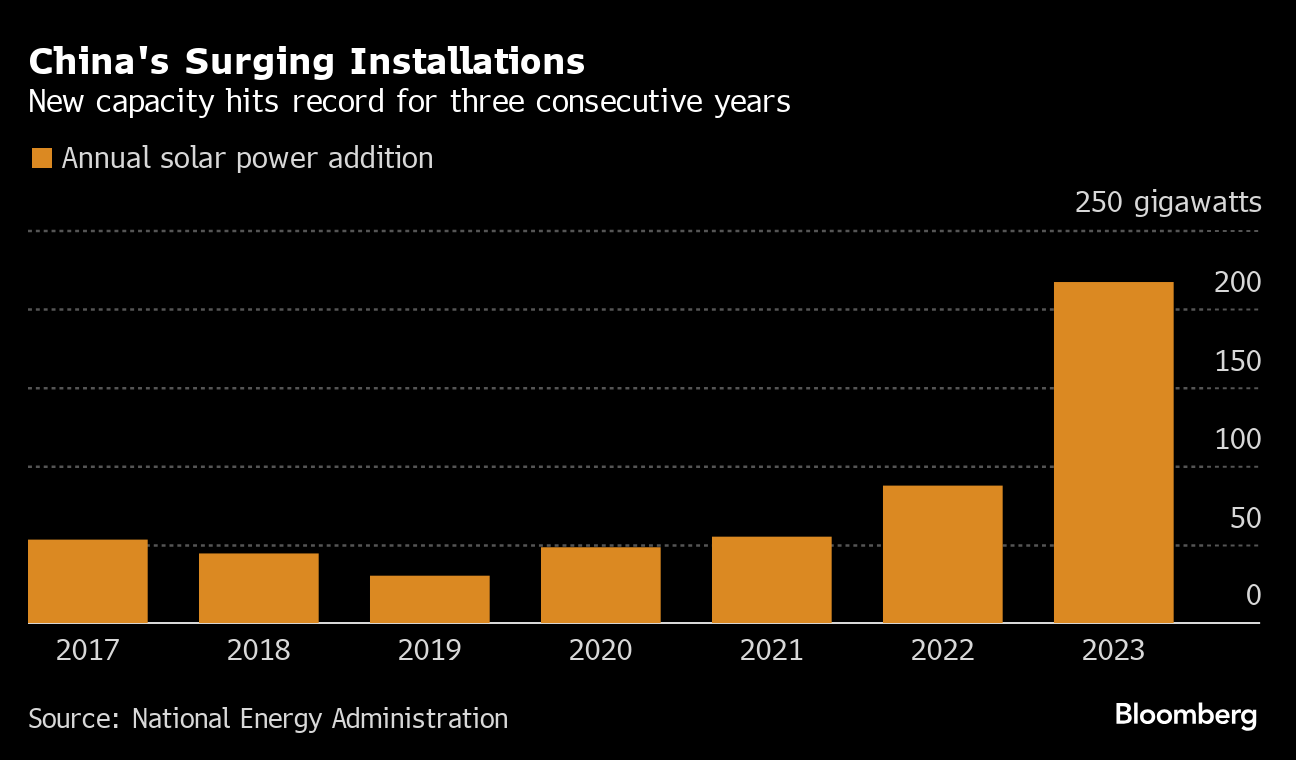
China installed 217 gigawatts of capacity last year, more than all the solar panels in the US, after initial predictions that the figure could be as low as 95 gigawatts. That would still have been a record, but twice during the year the association was forced to raise its forecasts to keep pace with the flood of new additions, which have set China well on the way to its goal of tripling renewable power by the end of the decade.
China is also struggling to ensure that electricity grids and markets are capable of absorbing all of the extra clean power. BloombergNEF forecasts solar additions to rise just 7% this year.
The centerpieces of the expansion mandated by President Xi Jinping are the massive renewables hubs being constructed in the desert interior. A rush to meet deadlines for the first batch drove much of the gangbusters growth in solar last year.
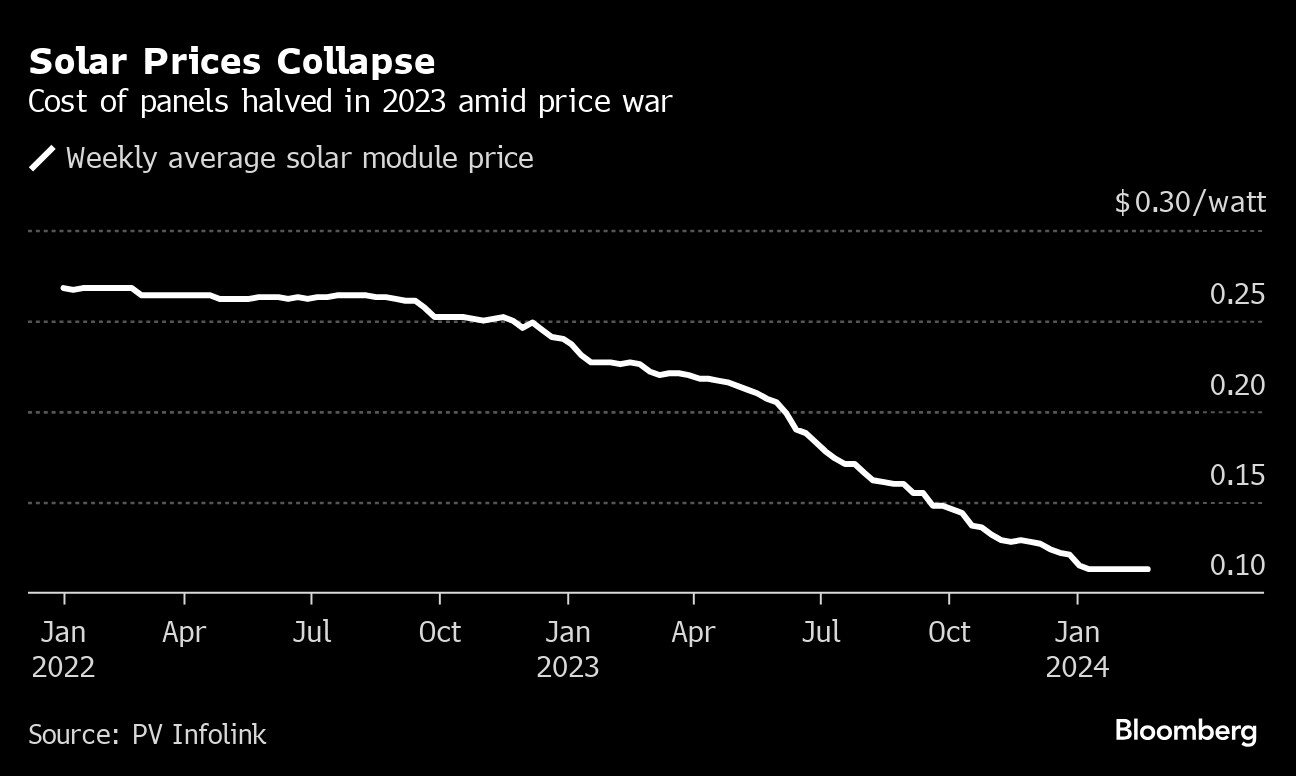
The industry is now being forced to reckon with the consequences. Excess capacity and intense competition have driven panel prices to record lows. The average price of polysilicon, a key raw material, fell 74% last year, according to BNEF.
The price war is hitting earnings, forcing some companies to cut production to support margins. But that could ultimately work against their interests as firms can only survive by keeping up sales, despite cratering profits, in order to maintain their customer bases for when prices recover, BNEF said.
Fierce domestic rivalry has forced many companies to seek relief in markets outside China, where prices are higher. Progress on overseas expansion and new opportunities abroad are slated for discussion at the association's meeting.
However, manufacturers have faced growing scrutiny in recent years, especially from the US, due to anti-dumping concerns and allegations of human rights violations in their supply chains, which Beijing has repeatedly denied.
Trade barriers have led firms to set up shop overseas, including in the US. Some of the biggest panel makers such as Longi Green Energy Technology Co. and Trina Solar Co. have announced plans for American factories, where generous government subsidies are available as part of the Biden administration's push to develop renewable power. Longi's Ohio plant started production in January.
Leading polysilicon producer GCL Technology Holdings Ltd., meanwhile, has said it will open its first overseas factory in Saudi Arabia.
On the Wire
Brazil says China has removed anti-dumping fees on its poultry.
Chinese copper smelters are facing a collapse in margins after processing fees plunged to their lowest in more than a decade and plants fail to respond by cutting enough output.
China aims to boost its capabilities for energy storage, peak-shaving generation, and demand-response to help balance its growing share of intermittent renewable electricity.
The Week's Diary
(All times Beijing unless noted.)
Wednesday, Feb. 28:
- China Photovoltaic Industry Association review and outlook seminar in Beijing, 09:00
- CNPC's research unit publishes annual report
- Briefing in Beijing from 14:30
- CCTD's weekly online briefing on Chinese coal, 15:00
- Finnish embassy hosts sustainability event in Beijing, 17:00
- EARNINGS: Xinyi Solar, Daqo New Energy
- EARNINGS: HKEX
- China's official PMIs for February, 09:30
- Caixin's China factory PMI for February, 09:45
- China weekly iron ore port stockpiles
- Shanghai exchange weekly commodities inventory, ~15:30
Thursday, Feb. 29:
Friday, March 1:
More stories like this are available on bloomberg.com
©2024 Bloomberg L.P.

-
AI Agents Are Gaining Power. Who Governs Them?

Artificial intelligence agents promise to transform productivity by moving machines from assisting decisions to executing them. But as organisations delegate greater authority to these AI-agents, they must first establish who controls that authority and who remains accountable when things go wrong.
-
Why Swapping Your Old Gold Can Trigger A Rs 5 Lakh Tax Bill, And How You Can Avoid It Legally
Swapping old gold for new is taxed as a sale and a fresh purchase. Getting your own gold remade can cut most of that bill, though it has its own costs.
-
The AI Trade is Done. The Real Opportunity for Investors Starts in 2027 | Unhedged Position
As pureplay AI stocks plunge and circular, capex-led financing unwinds, 2027 is set to be a year of reckoning for AI companies. Yet the bust clears the way for a better opportunity for investors in 2027 -- shifting the spotlight from AI builders to the companies using AI.
-
Leadership As Mission: Why The Age Of AI Demands More Human Leadership
Debjani Ghosh examines how AI is changing leadership, arguing that its success must be measured by its impact on people and the accountability of those guiding its use.
-
We May Need Another Tukaram Mundhe To Fight Air Pollution | The Reason Why
Developers may install basic measures such as sprinklers and green nets, resume work, and continue violating rules when this equipment stops working.
-
Extracting Value From Battery Scrap Could Be Challenging For India | The Reason Why
A discarded lithium-ion battery still contains valuable materials such as lithium, nickel and cobalt. These can be recovered and reused. When such batteries are crushed and shredded, they produce a dark powder called black mass.
-
One El Nino, India Can Handle. Two Could Break The Granary
India's grain stocks can absorb one bad year, but a second El Nino could drain the buffer in two to three years, economists say.
-
India's Troika Of Good Luck | Joining The Dots
As Jensen Huang's exit drags Nvidia down, a cooling AI trade and resilient earnings have revived investor interest in India. A likely RBI rate hike looms.
-
Talking Points This Week: Leadership Shock At Nvidia, Earnings Strength, And The Fog Over Hormuz
The Anthropic IPO pricing and first trading day, Nvidia's upcoming earnings, and any fresh signals from Iran will set the tone for the following week.
-
Signature Play: The Classic Cocktail Is Dead. Or Is It?
Classic cocktails are disappearing from India's cocktail menus. But they're still being ordered, taught to bartenders and borrowed from. So, who's really having the last drink?









