China’s LGFVs Plan Early Debt Payment As Beijing Offers More Aid

(Bloomberg) -- China's local government financing vehicles are increasingly offering to redeem their bonds before maturity, tapping Beijing's support to lower financing costs while seeking to sustain investors' interest.
As of Oct. 27, there were 33 LGFV bonds, worth about 15 billion yuan, that had been planned for early payment, according to data from Wanlian Securities Co. It was the highest monthly total for the year and up from 25 in September and 19 in August.
LGFVs — used by provinces and cities for public infrastructure projects, like roads and ports — have been emboldened by a central government program, reported by Bloomberg News in August, that allows local governments to issue about 1 trillion yuan of bonds to repay LGFV debt and other off-balance sheet issuers.
LGFVs' early redemptions and a surge in special refinancing bonds are “correlated,” said Li Yong, chief fixed-income analyst at Soochow Securities Co.
Early payments will likely soothe investors who are concerned about their returns amid China's economic downturn and property market troubles. But even with lower financing costs for LGFVs, the refinancing mechanism will likely raise more questions about whether the quest to reform the heavily indebted sector is being addressed with lasting solutions.
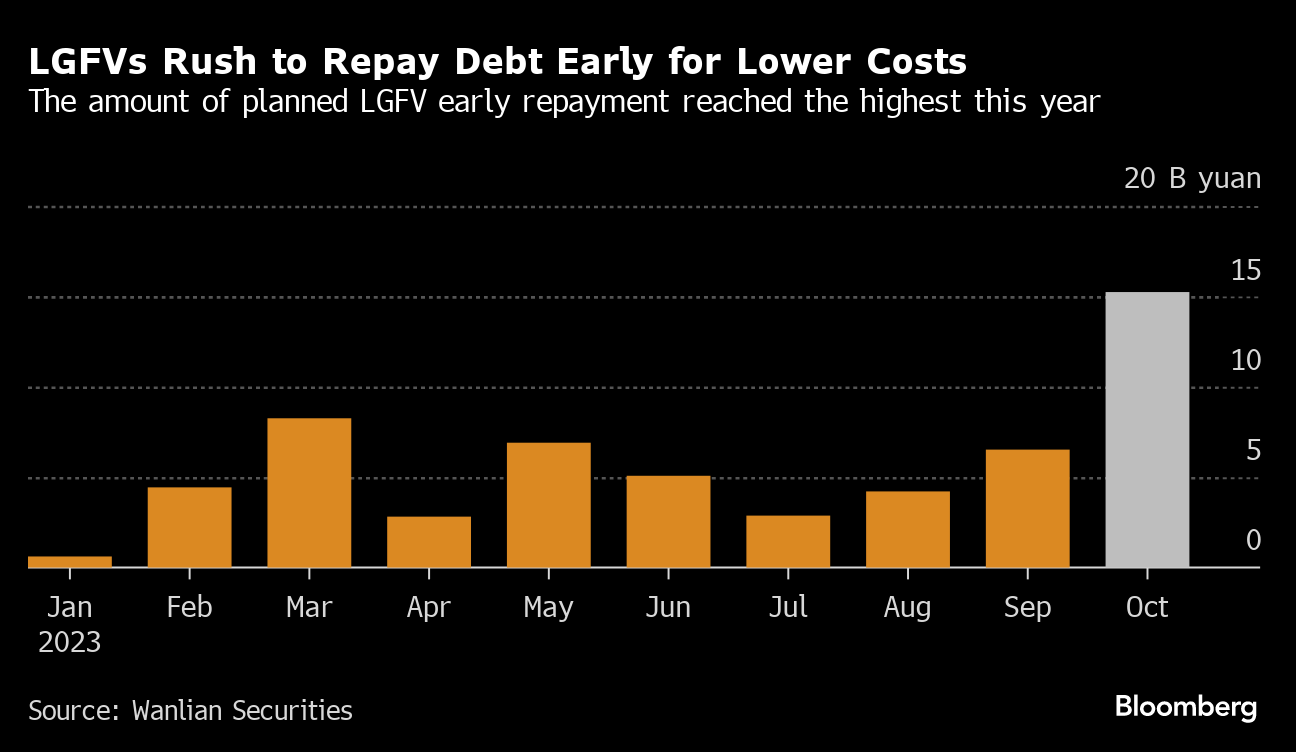
Special refinancing bonds aren't new. But their popularity is surging after Beijing's new bond program and other support measures announced earlier in the year to address mounting local debt.
As of Oct. 27, there were 24 provinces in China that disclosed a total of more than 1.04 trillion yuan of planned special refinancing bonds, according to a report by Tianfeng Securities Co.
Even financially struggling regions, like Guizhou, are partaking in the trend. Guizhou Water Investment Group Co., an LGFV, said it plans to fully repay early a 1 billion yuan bond, due to mature in 2025.
A hike in special refinancing bond issues often is followed by large-scale early redeeming of LGFV bonds, Li said, citing a similar trend that unfolded in 2021.
LGFVs' early repayments are hardly a reflection of their financial soundness. They on average recorded a loss of 58 million yuan for the first half, the most since 2014, according to a CICC report.
Other signs of stress are also emerging. While there has been no public default by an LGFV, some have struggled to make last-minute payments. The average LGFV bond maturity has declined by half a year from the beginning of the year as they increasingly sell debt maturing in a year or less, indicating that investors remain concerned about their long-term financial health.
But the refinancing bonds likely will reinforce Chinese investors' conviction that the Chinese government will always come to LGFVs' rescue when they are in trouble.
The special refinancing bonds are to “recharge faith in LGFVs,” said Zhao Guojun, credit analysis director at Wanlian Securities.
More stories like this are available on bloomberg.com
©2023 Bloomberg L.P.

-
Talking Points This Week: Leadership Shock At Nvidia, Earnings Strength, And The Fog Over Hormuz

The Anthropic IPO pricing and first trading day, Nvidia's upcoming earnings, and any fresh signals from Iran will set the tone for the following week.
-
Signature Play: The Classic Cocktail Is Dead. Or Is It?
Classic cocktails are disappearing from India's cocktail menus. But they're still being ordered, taught to bartenders and borrowed from. So, who's really having the last drink?
-
A New Samvat Wishlist: Inclusive Prosperity And Human Development
India has strengthened its economic foundations through infrastructure, digital access and enterprise. Its next growth chapter must deepen productivity, create better livelihoods and widen participation in prosperity.
-
Love, Sex Aur Dhokha: The Audacious Plot To Spy On Jensen Huang
A Taipei dinner, a Singapore chip buyer and a suspected Chinese asset: inside the alleged spy operation that got close to NVIDIA's Jensen Huang.
-
Ten Things I Learnt This Samvat
Patience can be a trap. Cheap stocks can stay cheap. Leverage can wipe you out. What did Samvat 2082 teach us? Niraj Shah writes on 10 lessons from the year gone by.
-
Talking Points This Week: Tech Nerves, FII Buying, And A Faraway Banking Shock
The global markets are not shining this Diwali. The exception in the large markets is, India.
-
Midterm Rally Lasted A Day. The Hard Reality Of A Divided US May Last Two Years | Opinion
Between a contested AI boom, a debt ceiling that arrives in 2027 and a president with every incentive to act alone, the next two years may prove more volatile than the first day's rally suggests.
-
Blue Wave Will Derail the AI Trade but Won't Dismantle the AI Era | Unhedged Position
The Democrats' sweep of the US Congress will see politics collide with economic forces both over the long and short term.
-
It's Time To Take The GST Council's Bet On Trust Global
Payment records can prove India's services exports, and clear, proportionate rules can bring foreign digital sellers into the tax net.
-
Opinion | India at 38: From Innovation Overperformer to Innovation Powerhouse
India now has 453 VC-backed deep science startups, 18 of them late-stage, after 117 percent growth since 2020. Laurus Labs, at USD 9.3 billion, is the most valuable deep science company in any middle-income economy outside China.









