China Orders Government, State Firms To Dump Foreign PCs
(Bloomberg) -- China has ordered central government agencies and state-backed corporations to replace foreign-branded personal computers with domestic alternatives within two years, marking one of Beijing's most aggressive efforts so far to eradicate key overseas technology from within its most sensitive organs.
Staff were asked after the week-long May break to turn in foreign PCs for home-made alternatives that run on operating software developed domestically, people familiar with the plan said. The exercise, which was mandated by central government authorities, is likely to eventually replace at least 50 million PCs on a central-government level alone, they said, asking to remain anonymous discussing a sensitive matter.
The decision advances China's decade-long campaign to replace imported technology with local alternatives, a sweeping effort to reduce its dependence on geopolitical rivals such as the U.S. for everything from semiconductors to servers and phones. It's likely to directly affect sales by HP Inc. and Dell Technologies Inc., the country's biggest PC brands after local champion Lenovo Group Ltd.
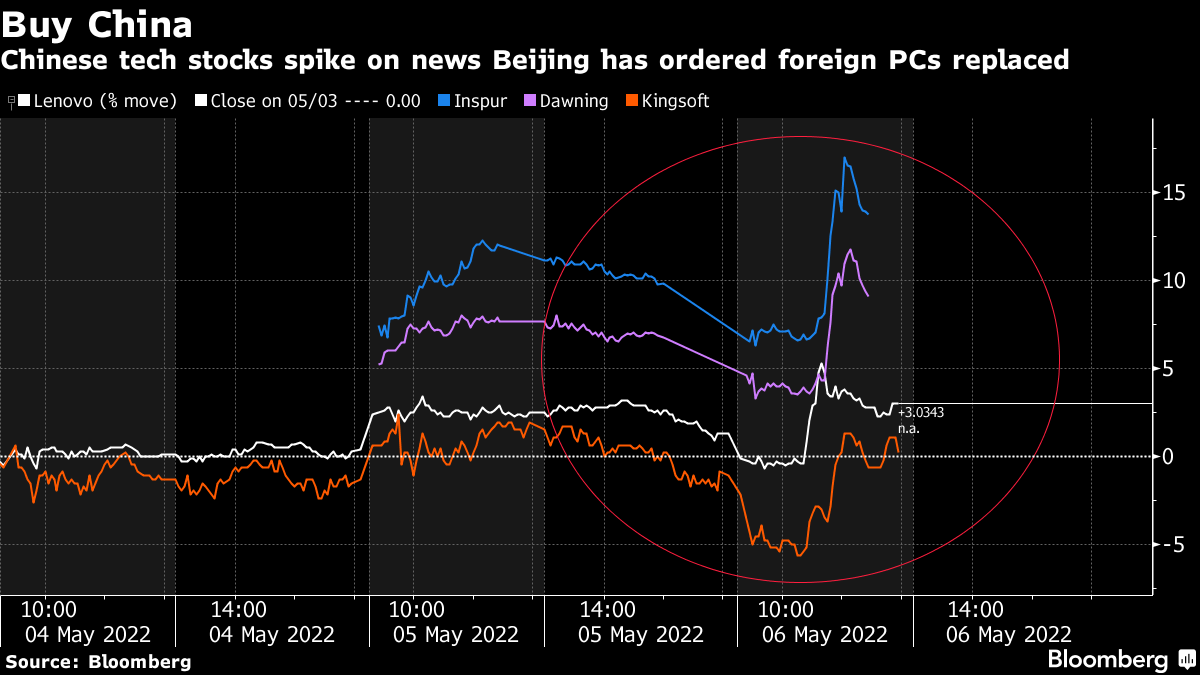
Lenovo erased losses to climb as much as 5% on Friday in Hong Kong, while software developer Kingsoft Corp. also recouped its earlier decline to gain 3.3%. On mainland Chinese exchanges, Inspur Electronic Information Industry Co., a server maker, gained 6% while peer Dawning Information Industry Co. jumped more than 4%. Inspur Software Co., an affiliate of the Inspur group, and China National Software & Service Co. both soared their daily 10% limits.
The push to replace foreign suppliers is part of a longstanding effort to wean China off its reliance on American technology -- a vulnerability exposed after sanctions against companies like Huawei Technologies Co. hammered local firms and businesses. That initiative has accelerated since 2021, when the Chinese central government quietly empowered a secretive government-backed organization to vet and approve local suppliers in sensitive areas from cloud to semiconductors.
The latest PC replacement project also reflects Beijing's growing concerns around information security as well as a confidence in homegrown hardware: the world's biggest laptop and server makers today include Lenovo, Huawei and Inspur Ltd., while local developers such as Kingsoft and Standard Software have made rapid strides in office software against the likes of Microsoft Corp. and Adobe Inc.
The campaign will be extended to provincial governments later and also abide by the two-year timeframe, the people said. The Ministry of Industry and Information Technology and State Council Information Office didn't respond to faxed requests for comment.
What Bloomberg Intelligence Says
Lenovo could dramatically boost sales on Beijing's order that central government agencies and state-backed companies replace foreign-branded computers, as reported by Bloomberg News. This would amount to more than 50 million PCs over the next two years. The nation's No. 1 PC maker relies on U.S. chips, but has set up its own chip-making unit and invested in at least 15 semiconductor design firms.
- Nathan Naidu, analyst
Click here for the research.
Read more: Secretive Chinese Committee Draws Up List to Replace U.S. Tech
China has been encouraging use of home-made IT products in government agencies for at least a decade, regularly barring certain products from official procurement lists. In response, U.S. IT giants such as Hewlett Packard Enterprise Co. and Microsoft have set up joint ventures with firms backed by the Chinese government, to secure orders from the richest state-owned companies.
That process has long been dogged by inadequacies in Chinese-developed software and circuitry, forcing users to rely on imported equipment. That changed in recent years, as local champions such as Inspur and Lenovo gained global market share, though their products still rely on cutting-edge American components such as semiconductors from Intel Corp. or Advanced Micro Devices Inc. As of Friday, HP-branded machines were still available for purchase on a website used by central government procurement bodies, though it's unclear if transactions would go through.
The latest government directive is likely to cover only PC brands and software, and exclude hard-to-replace components, including microprocessors, the people said. China will mostly encourage Linux-based operating systems to replace Microsoft's Windows. Shanghai-based Standard Software is one of the top providers of such tools, one person said.
Certain agencies, including state-owned media and cybersecurity bodies, may continue to buy advanced foreign equipment under special permits as they always have, one of the people said. But that permit system could be tightened in future, the person said.
How Huawei Landed at the Center of Global Tech Tussle: QuickTake
(Updates with analyst's comment and shares from the fourth paragraph)
More stories like this are available on bloomberg.com
©2022 Bloomberg L.P.

-
Signature Play: The Classic Cocktail Is Dead. Or Is It?

Classic cocktails are disappearing from India's cocktail menus. But they're still being ordered, taught to bartenders and borrowed from. So, who's really having the last drink?
-
A New Samvat Wishlist: Inclusive Prosperity And Human Development
India has strengthened its economic foundations through infrastructure, digital access and enterprise. Its next growth chapter must deepen productivity, create better livelihoods and widen participation in prosperity.
-
Love, Sex Aur Dhokha: The Audacious Plot To Spy On Jensen Huang
A Taipei dinner, a Singapore chip buyer and a suspected Chinese asset: inside the alleged spy operation that got close to NVIDIA's Jensen Huang.
-
Ten Things I Learnt This Samvat
Patience can be a trap. Cheap stocks can stay cheap. Leverage can wipe you out. What did Samvat 2082 teach us? Niraj Shah writes on 10 lessons from the year gone by.
-
Talking Points This Week: Tech Nerves, FII Buying, And A Faraway Banking Shock
The global markets are not shining this Diwali. The exception in the large markets is, India.
-
Midterm Rally Lasted A Day. The Hard Reality Of A Divided US May Last Two Years | Opinion
Between a contested AI boom, a debt ceiling that arrives in 2027 and a president with every incentive to act alone, the next two years may prove more volatile than the first day's rally suggests.
-
Blue Wave Will Derail the AI Trade but Won't Dismantle the AI Era | Unhedged Position
The Democrats' sweep of the US Congress will see politics collide with economic forces both over the long and short term.
-
It's Time To Take The GST Council's Bet On Trust Global
Payment records can prove India's services exports, and clear, proportionate rules can bring foreign digital sellers into the tax net.
-
Opinion | India at 38: From Innovation Overperformer to Innovation Powerhouse
India now has 453 VC-backed deep science startups, 18 of them late-stage, after 117 percent growth since 2020. Laurus Labs, at USD 9.3 billion, is the most valuable deep science company in any middle-income economy outside China.









