China Blasts ‘Selfish’ Japan For Claiming Vast Area Of Pacific Near Taiwan
(Bloomberg) -- China blasted Japan for a “selfish” claim over an area of the Pacific Ocean larger than France, reigniting a longstanding territorial fight between Asia's two largest economies.
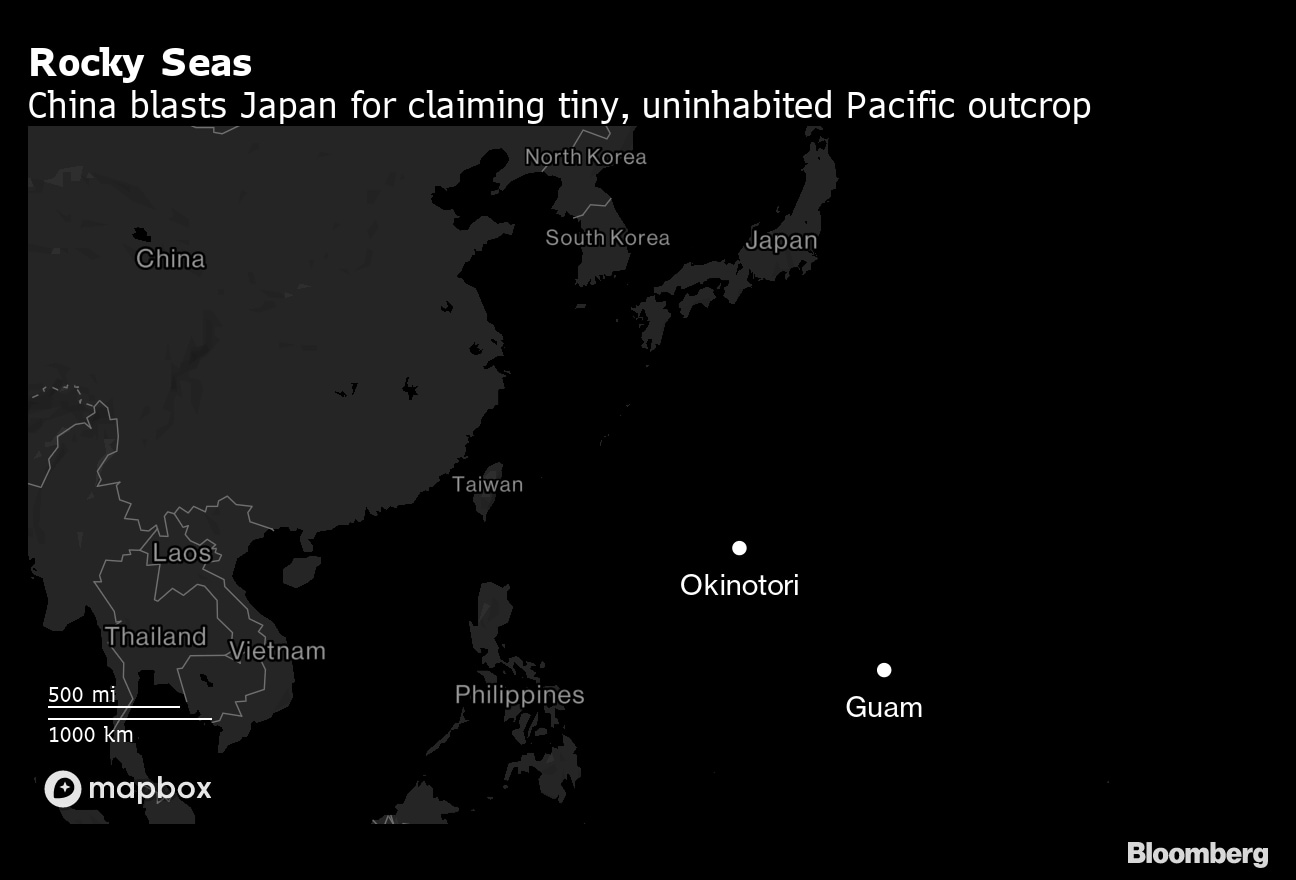
Japan has long claimed Okinotori, which is approximately halfway between Taiwan and Guam, as its southernmost island. China says it's merely a reef, and doesn't entitle Japan to benefits such as a 200 nautical-mile radius exclusive economic zone or continental shelf that would apply to an island under international law.
“Japan, in pursuit of selfish interest, has illegally staked claim to nearly 700,000 square kilometers of jurisdictional waters based on the tiny reef,” Chinese Foreign Ministry Spokesperson Zhao Lijian said Tuesday, adding that this “undermines the overall interests of the international community.”
The uninhabited territory consists of low-lying rocks that have been augmented with concrete by Japan, in a precursor to similar but more ambitious projects undertaken by China in the South China Sea.
Tokyo's local government, which administers Okinotori, says the associated exclusive economic zone amounts to 420,000 square kilometers (162,000 square miles), larger than Japan's total land mass.
Recognition of Japan's claims could potentially constrain China's naval activities in the area. Beijing has stepped up surveys of surrounding waters and its scholars recently published a number of reports disputing Japan's analysis, according to the Sankei newspaper.
“China might feel that it's got the international law on its side,” said Euan Graham, a senior fellow at the International Institute of Strategic Studies, who called Japan's claims over the waters around Okinotori “laughable.”
“Clearly it is cherry picking the things that embarrass the countries that it wants to embarrass and there is a clear double standard with what it's doing in the South China Sea,” he added, referring to China.
China Sea Claims Dashed by Court as Xi Suffers Prestige Blow
According to the United Nations Convention on the Law of the Sea, rocks which cannot sustain human habitation or economic life of their own bring no entitlement to an exclusive economic zone or continental shelf. Artificial islands do not have a territorial sea of their own under UNCLOS.
An international tribunal ruled in 2016 that China's own efforts to assert control over the South China Sea, partly through territorial claims stemming from artificial islands, exceeded its legal rights under the UN Law of the Sea. China refused to accept the ruling on procedural grounds.
In response to questions about China's scientific reports on Okinotori, Japanese Chief Cabinet Secretary Hirokazu Matsuno said May 30 the country's 2008 application to the Unclos Commission on the Limits of the Continental Shelf was based on plentiful scientific evidence. South Korea and Taiwan also dispute Japan's claims.
More stories like this are available on bloomberg.com
©2022 Bloomberg L.P.

-
Talking Points This Week: Leadership Shock At Nvidia, Earnings Strength, And The Fog Over Hormuz

The Anthropic IPO pricing and first trading day, Nvidia's upcoming earnings, and any fresh signals from Iran will set the tone for the following week.
-
Signature Play: The Classic Cocktail Is Dead. Or Is It?
Classic cocktails are disappearing from India's cocktail menus. But they're still being ordered, taught to bartenders and borrowed from. So, who's really having the last drink?
-
A New Samvat Wishlist: Inclusive Prosperity And Human Development
India has strengthened its economic foundations through infrastructure, digital access and enterprise. Its next growth chapter must deepen productivity, create better livelihoods and widen participation in prosperity.
-
Love, Sex Aur Dhokha: The Audacious Plot To Spy On Jensen Huang
A Taipei dinner, a Singapore chip buyer and a suspected Chinese asset: inside the alleged spy operation that got close to NVIDIA's Jensen Huang.
-
Ten Things I Learnt This Samvat
Patience can be a trap. Cheap stocks can stay cheap. Leverage can wipe you out. What did Samvat 2082 teach us? Niraj Shah writes on 10 lessons from the year gone by.
-
Talking Points This Week: Tech Nerves, FII Buying, And A Faraway Banking Shock
The global markets are not shining this Diwali. The exception in the large markets is, India.
-
Midterm Rally Lasted A Day. The Hard Reality Of A Divided US May Last Two Years | Opinion
Between a contested AI boom, a debt ceiling that arrives in 2027 and a president with every incentive to act alone, the next two years may prove more volatile than the first day's rally suggests.
-
Blue Wave Will Derail the AI Trade but Won't Dismantle the AI Era | Unhedged Position
The Democrats' sweep of the US Congress will see politics collide with economic forces both over the long and short term.
-
It's Time To Take The GST Council's Bet On Trust Global
Payment records can prove India's services exports, and clear, proportionate rules can bring foreign digital sellers into the tax net.
-
Opinion | India at 38: From Innovation Overperformer to Innovation Powerhouse
India now has 453 VC-backed deep science startups, 18 of them late-stage, after 117 percent growth since 2020. Laurus Labs, at USD 9.3 billion, is the most valuable deep science company in any middle-income economy outside China.









