China Crisis Covers Tracks of Japan
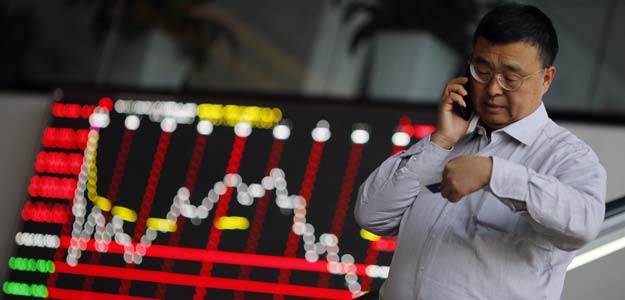
Singapore: As China's stock markets have lurched wildly, seeding dramatic falls across the world, some have drawn parallels with the global financial crisis of 2008 or the Asian version a decade earlier. They are weak comparisons.
The abrupt end of Japan's boom in the 1990s, complete with stock crash and property bust, offers the most striking similarities, and the most valuable lessons.
China's stocks ran up gains of 150 per cent in about a year before the mid-June crash, supercharged by margin lending and ignoring the drumbeat of disappointing economic data.
That makes for facile comparisons with 2008, the most recent example of a credit-fuelled bubble.
But there was no trigger like US authorities' shock decision to let Lehman Brothers, at the heart of the global banking system, collapse in 2008.
"If you look at the extremes in the equity market they are almost comparable with the Lehman days. In those days we had a trigger, a real event, something clearly defined," said Christian Lenk, rate strategist at DZ Bank in Frankfurt, on Tuesday.
"What we saw yesterday was ongoing fears about China ... but there was no trigger, so we see a bit of normalisation today."
And it was no surprise that China's stock bull run, like its property bubble a year earlier, came to an end, Japanese Finance Minister Taro Aso said this week.
The anatomy of the Asian financial crisis was also quite different, as hot money deserted a region with high foreign debt and trade deficits and currencies they couldn't support.
"There are few similarities to the Asian crisis in 1997 and 1998, which was driven more by large deficits in trade accounts," said John Vail, chief global strategist at Nikko Asset Management in New York.
"What we're seeing now is more of a rapid change in sentiment around the world," he said.
The comparisons between China now and Japan in the 1990s, however, are striking.
Like Japan then, China was trying to cool frothy property and equity markets.
Both economies were powered by massive investment, huge trade surpluses and overvalued currencies and were liberalising their financial sectors. China's share of the global economy now is roughly the same as Japan's was in 1990, about 12 per cent.
Avoiding Japan's mistakes
Japan's real GDP growth averaged 5 per cent in the run-up to the crash, while China's averaged 10 per cent over the past decade.
Credit growth was explosive in both, and the market crashes were triggered in part by efforts to temper exuberance.
Policy response was stop-and-go in both cases, with China seesawing on IPO policies, market liquidity operations and its treatment of shadow banking loans.
Chinese policymakers fear falling into the trap of deflation and stagnation that has gripped Japan ever since.
"They aren't a single bit interested in Japan's successes. Their biggest interest is in Japan's mistakes," one China-based Japanese source in touch with Chinese regulators told Reuters in March.
"Japanese and Chinese economies do share many similarities, so I assume there is quite a lot to learn from our experiences."
Global investors will also see some threatening differences. Global growth is weak, and China accounts for two fifths of that. It also accounts for most of the growth of many multinationals.
As the largest consumer of commodities, its slowdown is hammering the price of fuel resources and metals, unleashing deflationary pressure across the world.
Japan's woes coincided with robust global growth and had fewer international consequences.
"Japan's collapse in the 90s was very much reflected into itself with just some knock-on effect into the rest of Asia," said Adam Slater, lead economist at UK-based Oxford Economics.
"The impact of China's slowdown will ... leave us in a very disappointing growth phase for the next year or two for the world as a whole."
Some important differences, and lessons learned from Japan's experience, will be welcome to global investors and Chinese policymakers alike.
China's stock market is much smaller relative to GDP than Japan's was - 40 percent versus 140 percent - so should have less economic impact. Per capita it is still a middle-income nation with only 55 per cent urbanisation, so has plenty of scope for infrastructure spending to support the economy.
While Japan was slow to act - monetary easing came too little, too late, fiscal stimulus was withdrawn early - and its capital markets at the mercy of international flows, while China, with tight control of its capital account, has been proactive to a fault.
Its frequent monetary interventions and constant regulatory tinkering, whether in the stock or housing markets or in local government lending, are not always effective and sometimes counterproductive, but it rarely fiddles while Beijing burns.

-
Getting To Work Costs Women More | The Reason Why

It is not just about women paying more than men. It is about women paying much more in cities than in villages.
-
AI Bias In Investing Cannot Be Eliminated, But It Can Be Governed
Framing is a particularly important example as identical financial information presented in terms of gains rather than losses can lead an LLM to reach a different assessment.
-
Joining The Dots | Dark Skies, Steady Diya: Why Hope Holds This Diwali
With war, a weak rupee and foreign outflows weighing on sentiment, policymakers at the NDTV World Summit and market veterans at NDTV Profit Ignite: Diwali Edition offered the same advice: stay invested and filter out the noise.
-
The Curious Case of Equitas Small Finance Bank And A CEO Who Quit For Stock
PN Vasudevan believes persistent investor concerns over a perceived conflict of interest had become a governance overhang on Equitas Small Finance Bank's stock, even as the lender improved profitability and asset quality.
-
Talking Points This Week: AI Cash Burn, A Tiger Comeback And An India That Still Finds Its Own Path
India is not immune to higher oil or tighter global liquidity, yet its earnings base is broader, its domestic policy levers are still available.
-
Foreign Investors Own Half Of HDFC Bank and ICICI Bank. An LTCG Cut Could Matter Most Here
Foreign portfolio investors have US$115 billion parked in HDFC Bank, ICICI Bank. If the government cuts long-term capital gains tax, Jefferies says returning foreign money could land here first.
-
'Never Seen This Level Of Negativity': Sandeep Tandon Says The Next Rally May Be Closer Than You Think
Veteran investor Sandeep Tandon says foreign selling is easing, large-caps are due a comeback and mid-caps are crowded, while he turns positive on gold, power and pharma this Diwali.
-
Indians Stay With Family, Not In Hotels | The Reason Why
India still lacks enough clean, reliable and affordable hotels for budget-conscious travellers.
-
The Economic Imperative: Analysing The Material Driving Force Behind India-Canada Strategic Reset
This economic complementarity is further reinforced by deep institutional investment ties and talent mobility, which form the bedrock of the bilateral framework.
-
Medicine Pricing: Where Must Profit Stop?
India must confront excessive margins, hidden incentives and regulatory gaps that threaten the integrity of medicine.










