Card Payment Network RuPay Sees Boost From Government Banking Scheme
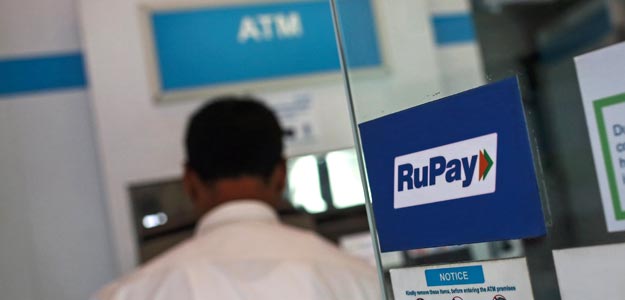
Mumbai: A government drive to expand banking services in India is giving a boost to home-grown card payment network RuPay, which expects to quadruple the number of users by March and make debit cards more acceptable in a nation where cash is still king.
Started in 2012 by a company owned by 10 local and foreign banks, RuPay competes with global payment firms Visa Inc and MasterCard Inc for the few customers in Asia's third largest economy able to afford a debit or credit card.
As of July, banks issued just under 435 million payment cards in India, a nation of 1.3 billion people. Most were debit cards.
RuPay's share of daily card transactions, however, remains small compared to the global firms, which are more established, offer both debit and credit cards and are accepted by more retailers. RuPay currently offers only debit cards.
RuPay users account for just 1.5 per cent of daily card transactions of almost one million at retailers, said A.P. Hota, chief executive of the National Payments Corp of India (NPCI), which runs RuPay.
Hota told Reuters the payments network was set to grow rapidly from the government's so-called financial inclusion scheme, which aims to ensure the majority of households has a bank account within months.
Under the scheme launched late in August, Indians who open a bank account for the first time automatically get a RuPay card.
Hota said the number of RuPay users has now almost doubled from 23 million at the end of July.
By March next year, he expects that number to rise to 160 million, with more than 60 per cent of the increase coming from the government scheme.
"Jan Dhan itself would provide a big opportunity for the domestic card brand to be a formidable force," said Hota, referring to the financial inclusion scheme, Jan Dhan Yojana, which means People's Wealth Scheme.
"(RuPay Card transactions are) just a drop in the ocean at the moment. But drop by drop we are increasing our size."
NPCI is also trying to lure more customers by charging banks lower fees than Visa and MasterCard, Hota added.
Visa and MasterCard did not reply to Reuters' requests seeking comment.
NPCI's shareholders include India's biggest bank, the State Bank of India, and foreign lenders Citibank and HSBC. The Reserve Bank of India bank has a nominee on its board.
The organisation plans to launch RuPay cards that will be accepted overseas through a partnership with Discover Financial Services, Hota said, and is also in talks with Japanese card network JCB about a partnership.
RuPay had aimed to issue credit cards by March 2015, but those plans have now been delayed by the government scheme, Hota said. "Rural acceptance of the Jan Dhan cards will be our priority," he added.
Copyright: Thomson Reuters 2014

-
Indians Are Travelling, But Not Every Journey Is A Holiday | The Week In Whys

Pilgrims, patients and working women are the real travellers, and the system hasn't quite caught up with them.
-
Getting To Work Costs Women More | The Reason Why
It is not just about women paying more than men. It is about women paying much more in cities than in villages.
-
AI Bias In Investing Cannot Be Eliminated, But It Can Be Governed
Framing is a particularly important example as identical financial information presented in terms of gains rather than losses can lead an LLM to reach a different assessment.
-
Joining The Dots | Dark Skies, Steady Diya: Why Hope Holds This Diwali
With war, a weak rupee and foreign outflows weighing on sentiment, policymakers at the NDTV World Summit and market veterans at NDTV Profit Ignite: Diwali Edition offered the same advice: stay invested and filter out the noise.
-
The Curious Case of Equitas Small Finance Bank And A CEO Who Quit For Stock
PN Vasudevan believes persistent investor concerns over a perceived conflict of interest had become a governance overhang on Equitas Small Finance Bank's stock, even as the lender improved profitability and asset quality.
-
Talking Points This Week: AI Cash Burn, A Tiger Comeback And An India That Still Finds Its Own Path
India is not immune to higher oil or tighter global liquidity, yet its earnings base is broader, its domestic policy levers are still available.
-
Foreign Investors Own Half Of HDFC Bank and ICICI Bank. An LTCG Cut Could Matter Most Here
Foreign portfolio investors have US$115 billion parked in HDFC Bank, ICICI Bank. If the government cuts long-term capital gains tax, Jefferies says returning foreign money could land here first.
-
'Never Seen This Level Of Negativity': Sandeep Tandon Says The Next Rally May Be Closer Than You Think
Veteran investor Sandeep Tandon says foreign selling is easing, large-caps are due a comeback and mid-caps are crowded, while he turns positive on gold, power and pharma this Diwali.
-
Indians Stay With Family, Not In Hotels | The Reason Why
India still lacks enough clean, reliable and affordable hotels for budget-conscious travellers.
-
The Economic Imperative: Analysing The Material Driving Force Behind India-Canada Strategic Reset
This economic complementarity is further reinforced by deep institutional investment ties and talent mobility, which form the bedrock of the bilateral framework.










