Budget 2023: India's Buzzing Economic Activity Belies Fears Of A Slowdown

India's economy picked up speed in December as business conditions improved, marking a rebound for the South Asian nation that had showed signs of a slowdown the preceding month.
The needle indicating so-called animal spirits moved right after holding steady for five straight months - indicating stronger overall economic activity as 2022 drew to a close. Consumer spending boosted tax collection and manufacturers signaled optimism about the future, while services sector saw expansion of new businesses.
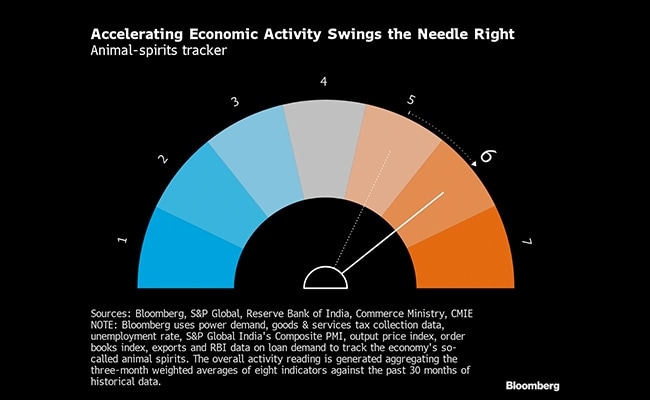
The reading comes ahead of the unveiling of India's budget on Feb. 1, when Finance Minister Nirmala Sitharaman is set to highlight India's potential to grow at a world-beating pace in the year beginning April. The performance of Asia's third-largest economy contrasts with that of many developed nations, which face recessions this year.
India still has some vulnerabilities on the path ahead. Exports contracted in two of the past three months, leaving several companies struggling to secure new work from key overseas markets. Prices of finished products rose as firms passed on higher input costs and business expenses. Among the eight indicators tracked by Bloomberg, India's unemployment inched up and banks witnessed lower demand for credit.
Bloomberg's animal spirits barometer uses a three-month weighted average to smooth out volatility in single-month readings. Below are more details:
Business Activity
A purchasing managers' survey reflected robust activity in both manufacturing and services in December. The composite index climbed to an 11-year high. Output rose sharply. New orders in manufacturing also climbed the fastest since February 2021, while services firms saw new businesses increasing for the seventeenth straight month in December.
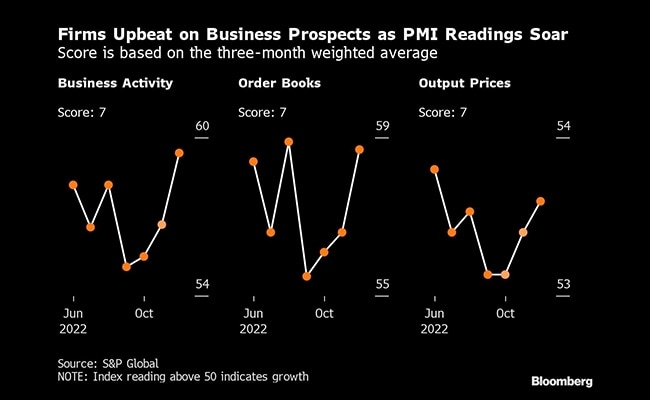
"While some may question the resilience of the Indian manufacturing industry in 2023 amid a deteriorating outlook for the global economy, manufacturers were strongly confident in their ability to lift production," said Pollyanna De Lima, Economics Associate Director at S&P Global Market Intelligence.
Exports
Exports fell 12.2% in December compared to a year ago, but at $34.5 billion were still at a three-month high in value terms, data released by the trade ministry showed. Exports remain competitive despite global headwinds, Commerce Secretary Sunil Barthwal said.
Imports fell 3.46% from the previous year, narrowing the trade gap for the second month to $23.76 billion. Moderating commodity prices and a broader weakening of the dollar have helped lower India's import bill, but a continued weakness in exports could hinder recovery from a record-high current account gap seen during the July-September quarter.
Consumer Activity
Liquidity in the banking system tightened, and bank credit slowed to 14.9% in December, from 17.2% in November. The Reserve Bank of India's 225 basis points increase dampened demand for housing, automobiles and consumer goods. Still, double-digit loan growth was a vast improvement over the single-digit expansion observed between September 2019 and March 2022.
Goods and services tax collection, which helps measure consumption in the economy, rose 15%. Revenue collection has stood at more than 1.4 trillion rupees for 10 straight months. New vehicle registrations rose 8.2% in the month, according to data from the Federation of Automobile Dealers Associations.
Market Sentiment
Electricity consumption, a widely used proxy to measure demand in industrial and manufacturing sectors, rose from the previous month. Peak demand at the end of December rose to 171 gigawatt from 162 gigawatt a month ago. And India's unemployment rate climbed to a 16-month high of 8.3% as job creation failed to keep pace with a growing workforce.

-
Indians Are Travelling, But Not Every Journey Is A Holiday | The Week In Whys

Pilgrims, patients and working women are the real travellers, and the system hasn't quite caught up with them.
-
Getting To Work Costs Women More | The Reason Why
It is not just about women paying more than men. It is about women paying much more in cities than in villages.
-
AI Bias In Investing Cannot Be Eliminated, But It Can Be Governed
Framing is a particularly important example as identical financial information presented in terms of gains rather than losses can lead an LLM to reach a different assessment.
-
Joining The Dots | Dark Skies, Steady Diya: Why Hope Holds This Diwali
With war, a weak rupee and foreign outflows weighing on sentiment, policymakers at the NDTV World Summit and market veterans at NDTV Profit Ignite: Diwali Edition offered the same advice: stay invested and filter out the noise.
-
The Curious Case of Equitas Small Finance Bank And A CEO Who Quit For Stock
PN Vasudevan believes persistent investor concerns over a perceived conflict of interest had become a governance overhang on Equitas Small Finance Bank's stock, even as the lender improved profitability and asset quality.
-
Talking Points This Week: AI Cash Burn, A Tiger Comeback And An India That Still Finds Its Own Path
India is not immune to higher oil or tighter global liquidity, yet its earnings base is broader, its domestic policy levers are still available.
-
Foreign Investors Own Half Of HDFC Bank and ICICI Bank. An LTCG Cut Could Matter Most Here
Foreign portfolio investors have US$115 billion parked in HDFC Bank, ICICI Bank. If the government cuts long-term capital gains tax, Jefferies says returning foreign money could land here first.
-
'Never Seen This Level Of Negativity': Sandeep Tandon Says The Next Rally May Be Closer Than You Think
Veteran investor Sandeep Tandon says foreign selling is easing, large-caps are due a comeback and mid-caps are crowded, while he turns positive on gold, power and pharma this Diwali.
-
Indians Stay With Family, Not In Hotels | The Reason Why
India still lacks enough clean, reliable and affordable hotels for budget-conscious travellers.
-
The Economic Imperative: Analysing The Material Driving Force Behind India-Canada Strategic Reset
This economic complementarity is further reinforced by deep institutional investment ties and talent mobility, which form the bedrock of the bilateral framework.










