Budget 2022: 6 Things Salaried Class Wants
The Covid-19 pandemic has led to a dramatic loss of human life worldwide and poses an unprecedent challenge to public health, employment and economic progress. Policymakers have a tough task on their hand to bring the economy back on track and start building a future of work that is safer and more effective in mitigating the consequences of the crisis on jobs and income of taxpayers.
Amidst this crisis, individual taxpayers, who contribute almost 35-40% of direct tax revenues, have higher expectations from Budget 2022 in terms of rationalisation of provisions, ease of compliance etc., as these will help them to cushion the economic damage caused by the pandemic.
1. Increase threshold under eligible investments to claim deduction: Currently, deduction to the extent of Rs 150,000 on investments made in eligible categories are allowed. Given the multitude of provisions – life insurance premium, deferred annuity, contributions to provident fund, subscription to certain mutual funds, equity shares or debentures, expense as tuition fees, etc. – it is only fair to individuals to have this cap increased to Rs 250,000.
2. Revision of threshold to tax interest income on Provident Fund: The preceding budget introduced to tax interest arising on PF contributions made that is upwards of Rs 250,000 a year (in case of employer contribution). To encourage social security savings, it would be a fair ask to up the thresholds to Rs 400,00 a year.
3. Clarity on Crypto taxation: Considering cryptocurrency as an investment medium has gained huge traction in India, it is essential that the Budget clarifies the ambiguity regarding taxation of crypto and clearly spells out the provisions relating to new age investments or carrying-out business transactions. This will provide the much-needed clarity to millions of investors/businesses in India and may also pave the way for new-age technological advancements in the country.
4. Changes to be made to the new tax regime under Section 115BAC: It is undeniable that the government has provided significantly slashed tax slab rates under the new regime. However, all the significant/major/recurring exemptions and deductions allowed under the old regime – HRA, LTA, standard deduction, Chapter VI-A deductions, etc. – have been denied to the individuals opting for the new tax regime.
It would be a significant move for the salaried demography if the government amends provisions to include one/few of these major exemptions/deductions, evaluating whether providing even one significant incentive to such individuals opting for the new tax regime is substantiable. This would attract a big part of the salaried demography into the tax paying initiative.
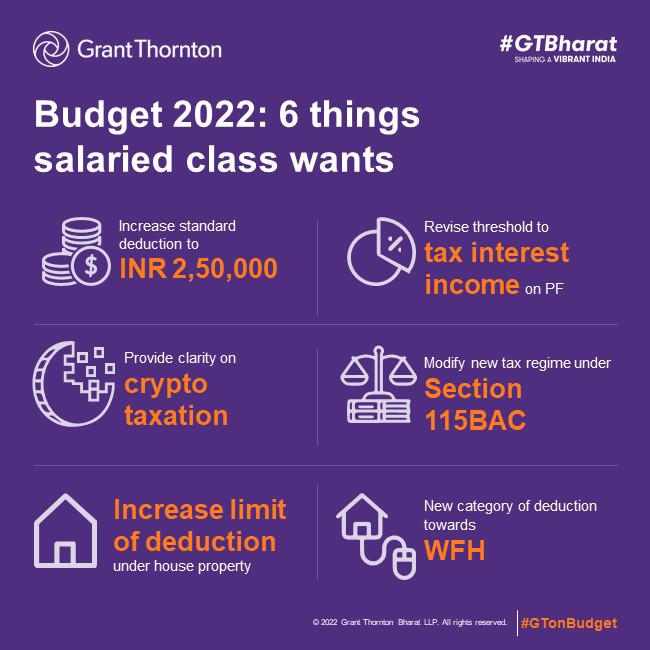
5. Deduction from income under ‘house property': At present, the loss arising on claiming interest deduction from house property income can be set off against other heads of income (such as salary, capital gains, professional income or income from other sources) up to Rs 200,000. Further, any carried forward loss cannot be set off in subsequent years against other heads of income except the income from house property. This results into lapse of such carried forward losses due to higher interest payment in subsequent years as well. Hence, the government should increase the maximum limit of such deduction from Rs 200,000 to Rs 350,000 per annum.
Further, the existing provisions don't allow the deduction of maintenance charges paid to society etc. It is recommended to insert a new provision to allow such deduction against the rental income earned so that only real income is taxed in the hands of taxpayers.
6. New category of deduction towards work from home (WFH): It's been a continuous ask from employee's working from home incurring expenses for setting-up a home office space to be eligible for a WFH deduction of Rs 50,000 annually irrespective of tax regime opted. Just to give perspective, the UK government has provided a flat rate of GBP 6 per week of tax relief towards additional household cost to people WFH.
Budget 2022 has managed to grab every person's attention as there aren't any wrought-down, concrete changes that is expected for the common man and it is mostly a guessing game at this point. It will be exciting to see the changes that will be presented this time.
(Disclaimer: These are the personal opinions of the author.)

-
Signature Play: The Classic Cocktail Is Dead. Or Is It?

Classic cocktails are disappearing from India's cocktail menus. But they're still being ordered, taught to bartenders and borrowed from. So, who's really having the last drink?
-
A New Samvat Wishlist: Inclusive Prosperity And Human Development
India has strengthened its economic foundations through infrastructure, digital access and enterprise. Its next growth chapter must deepen productivity, create better livelihoods and widen participation in prosperity.
-
Love, Sex Aur Dhokha: The Audacious Plot To Spy On Jensen Huang
A Taipei dinner, a Singapore chip buyer and a suspected Chinese asset: inside the alleged spy operation that got close to NVIDIA's Jensen Huang.
-
Ten Things I Learnt This Samvat
Patience can be a trap. Cheap stocks can stay cheap. Leverage can wipe you out. What did Samvat 2082 teach us? Niraj Shah writes on 10 lessons from the year gone by.
-
Talking Points This Week: Tech Nerves, FII Buying, And A Faraway Banking Shock
The global markets are not shining this Diwali. The exception in the large markets is, India.
-
Midterm Rally Lasted A Day. The Hard Reality Of A Divided US May Last Two Years | Opinion
Between a contested AI boom, a debt ceiling that arrives in 2027 and a president with every incentive to act alone, the next two years may prove more volatile than the first day's rally suggests.
-
Blue Wave Will Derail the AI Trade but Won't Dismantle the AI Era | Unhedged Position
The Democrats' sweep of the US Congress will see politics collide with economic forces both over the long and short term.
-
It's Time To Take The GST Council's Bet On Trust Global
Payment records can prove India's services exports, and clear, proportionate rules can bring foreign digital sellers into the tax net.
-
Opinion | India at 38: From Innovation Overperformer to Innovation Powerhouse
India now has 453 VC-backed deep science startups, 18 of them late-stage, after 117 percent growth since 2020. Laurus Labs, at USD 9.3 billion, is the most valuable deep science company in any middle-income economy outside China.









