Budget 2014: Can Jaitley Replicate Chidambaram's Magic?
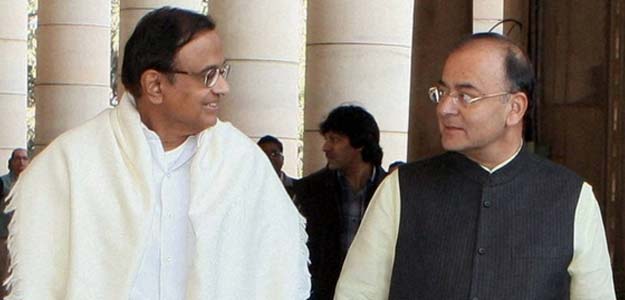
Finance Minister Arun Jaitley is up against history and a truck-load of market expectations when he delivers his maiden budget on July 10. Mr Jaitley's budget will certainly be compared with his predecessor P. Chidambaram's 1997 budget, often called the "dream budget".
"The upcoming budget could be important because of where India is placed cyclically, what the mandate for the government implies, and given that this is the first non-Congress government in a decade," says Ridham Desai of Morgan Stanley.
The 1997 budget is remembered for rationalisation of income and corporate taxes and the launch of a voluntary disclosure scheme for black money. It was the precursor of one of the biggest post-budget rallies in Indian stocks, with the Sensex rising over 9 per cent in just 15 days, Morgan Stanley's research shows.
The market rally after P. Chidambaram's 1997 budget is remarkable considering that the Sensex has corrected by an average 2.6 per cent 15 days post-budget over the last 21 years, according to Morgan Stanley. The only other time Indian markets rallied more in a 15-day period post-budget was in 1999, but those gains were not attributed to budget announcements alone.
"The budget leaves a trail of underperformance in the month after. Save for 1997, it is difficult to attribute market's performance to the budget," Mr Desai said.
Meeting markets' expectations will perhaps be Mr Jaitley's biggest challenge next month. The BSE Sensex has not corrected despite a record-setting rally and every fall or dip has been bought into by investors.
In fact, the Nifty is up over 20 per cent year-to-date and just 1.6 per cent away from its record high of 7,700 despite concerns of a poor monsoon and rising oil pricing that threaten to derail India's current account and fiscal deficit targets.
The El Nino-led deficient monsoon can shave off 50-75 basis points from India's GDP and send inflation higher by 200-300 basis points, Bank of America estimates. A 5 per cent spike in crude could add 50-75 basis points to inflation, the investment bank estimated.
The recent headwinds add to the list of deep-seated economic woes like high inflation, stagnant investment and weak growth, presenting a formidable challenge for Mr Jaitley.
Acknowledging the challenges ahead, Mr Jaitley, who also holds the defence portfolio, said finance ministry is a challenging job in view of the economic slowdown in the last two years.
But the railway fare hike announced on Friday has strengthened beliefs that Mr Jaitley's first budget will be reformist.
"We are now even more hopeful of the government biting the bullet on subsidies in the budget. We believe that the government may move beyond diesel and towards LPG price rationalization and maybe even kerosene," said Abhay Laijawala of Deutsche Bank.
Jyotivardhan Jaipuria of Bank of America says the budget may contain announcements on kick-starting the investment cycle, liberalising foreign direct investment, resolving the Vodafone tax issue and reducing subsidies.
Mr Jaitley has repeatedly affirmed that the government needs to act to fix the health of its economy, which is growing at the longest spell of sub-par growth since the 1980s. If he comes up with bold measures in budget, markets would be rewriting history.

-
Gold Is Rs 22,000 Cheaper Than A Month Ago. Should You Buy Amid The Wedding Season?

Gold's potential slide to $3,500 could save around Rs 4,700 per 10 grams, but a soft inflation print could just as easily push prices back up. One way to split the risk is to buy in parts, some now and the rest after the Fed's Dec. 9 decision.
-
AI Agents Are Gaining Power. Who Governs Them?
Artificial intelligence agents promise to transform productivity by moving machines from assisting decisions to executing them. But as organisations delegate greater authority to these AI-agents, they must first establish who controls that authority and who remains accountable when things go wrong.
-
Why Swapping Your Old Gold Can Trigger A Rs 5 Lakh Tax Bill, And How You Can Avoid It Legally
Swapping old gold for new is taxed as a sale and a fresh purchase. Getting your own gold remade can cut most of that bill, though it has its own costs.
-
The AI Trade is Done. The Real Opportunity for Investors Starts in 2027 | Unhedged Position
As pureplay AI stocks plunge and circular, capex-led financing unwinds, 2027 is set to be a year of reckoning for AI companies. Yet the bust clears the way for a better opportunity for investors in 2027 -- shifting the spotlight from AI builders to the companies using AI.
-
Leadership As Mission: Why The Age Of AI Demands More Human Leadership
Debjani Ghosh examines how AI is changing leadership, arguing that its success must be measured by its impact on people and the accountability of those guiding its use.
-
We May Need Another Tukaram Mundhe To Fight Air Pollution | The Reason Why
Developers may install basic measures such as sprinklers and green nets, resume work, and continue violating rules when this equipment stops working.
-
Extracting Value From Battery Scrap Could Be Challenging For India | The Reason Why
A discarded lithium-ion battery still contains valuable materials such as lithium, nickel and cobalt. These can be recovered and reused. When such batteries are crushed and shredded, they produce a dark powder called black mass.
-
One El Nino, India Can Handle. Two Could Break The Granary
India's grain stocks can absorb one bad year, but a second El Nino could drain the buffer in two to three years, economists say.
-
India's Troika Of Good Luck | Joining The Dots
As Jensen Huang's exit drags Nvidia down, a cooling AI trade and resilient earnings have revived investor interest in India. A likely RBI rate hike looms.
-
Talking Points This Week: Leadership Shock At Nvidia, Earnings Strength, And The Fog Over Hormuz
The Anthropic IPO pricing and first trading day, Nvidia's upcoming earnings, and any fresh signals from Iran will set the tone for the following week.









