Budding Israel-India Romance Tested by Modi's Balancing Act
(Bloomberg) -- Before setting off for New Delhi late Saturday, Israeli Prime Minister Benjamin Netanyahu received an unwelcome reminder of the maneuvering Indian counterpart Narendra Modi must perform as their countries deepen ties.
In early January, Israel confirmed that India called off a $500 million missile deal. In December, New Delhi backed a United Nations resolution condemning President Donald Trump's new Israel-friendly policy on Jerusalem.
While Israel is charging headlong into warmer ties with New Delhi, India is engaged in a balancing act, in deference to its historical support for the Palestinians and alliances with Israeli rivals, including Iran.
“The maturing relationship with Israel does make strategic sense for India,” said Nirupama Rao, India's former ambassador to the U.S. and China. “But India is also not bereft of the realization that it has important interests in the Gulf and West Asia to protect because these interests involve its many people who live and work in that region, as well as its energy security.”
Netanyahu landed in New Delhi on Sunday and was greeted at the airport by Modi in a last-minute change to the protocol. “I appreciate the gesture very much,” Netanyahu said in a text message. Modi tweeted that Netanyahu's “historic and special” visit will “further cement the close friendship between our nations.”
Trade Ties
Tiny Israel needs large markets for its export-driven economy. India, with its 1.3 billion people, colossal military budget and widespread poverty, has needs Israel can fill.
Bilateral trade, excluding defense, grew to at least $4 billion in 2016 from just $200 million in 1992, the year the two nations established full diplomatic relations. Israel Aerospace Industries Ltd. won nearly $2 billion in contracts from India last year alone.
Netanyahu's office said during his visit the nations would sign agreements to strengthen cooperation on energy exploration, aviation and technology, including cyber security.
Modi's Hindu nationalist Bharatiya Janata Party has been more willing than previous administrations to break with the accepted wisdom that closer ties with Israel would alienate India's Muslim minority. During a historic first trip by an Indian prime minister to Israel last year, Modi didn't travel the several miles to the West Bank to meet Palestinian Authority President Mahmoud Abbas, as visiting leaders usually do.
For more on Modi's July 2017 visit to Israel, click here
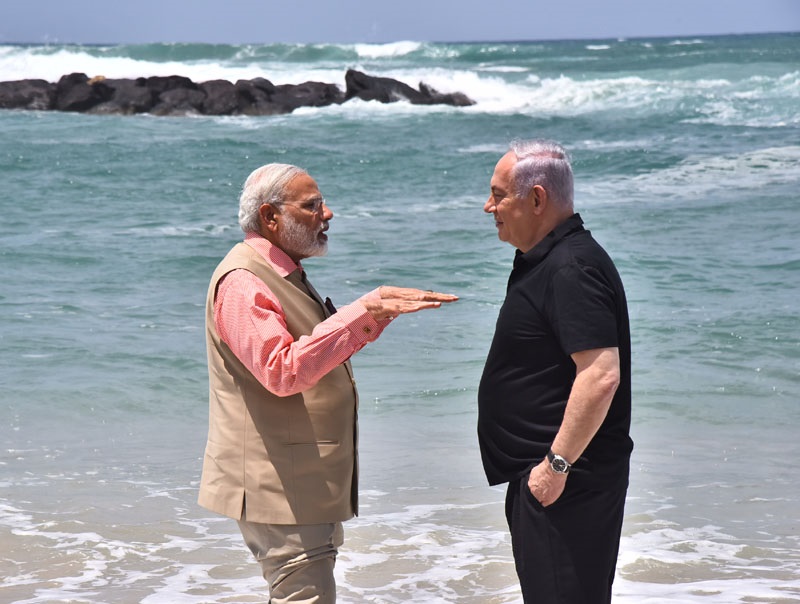
A Netanyahu-Modi bromance was carefully choreographed during that visit, complete with shots of them walking barefoot together through the Mediterranean surf.
“India, more than most countries, is making it clear they can engage with Israel without having to package that relationship to the Palestinian cause,” said Arthur Lenk, who served as an Israeli diplomat in India in the late 1990s. “It's India saying, ‘What's in it for us?'”
Clashing Interests
“What's in it for us” doesn't always align with Israel's interests. New Delhi is helping Netanyahu's nemesis, Iran, develop its southeastern Chabahar port. It has consistently backed the Palestinian quest for statehood and, in December, was among 128 nations to denounce Trump's recognition of Jerusalem as Israel's capital.
“What we did with Jerusalem is exactly what our policy has been,” said Anil Trigunayat, a retired Indian diplomat and former ambassador to Libya and Jordan.
Click here to learn more about India's priorities vis-a-vis Israel
Netanyahu said the UN vote wouldn't hurt ties.
“I would have preferred another vote, to be frank, but I don't think it materially changes the tremendous flowering of relations between India and Israel,” he told journalists Wednesday. “I think you're going to see an expansion of economic and other ties, regardless of this or that deal,” he said, commenting on the cancellation of the missile agreement with state-run Rafael Advanced Defense Systems Ltd.
R&D Fund
During the Jan. 14-19 visit, Israel and India will announce deals and joint investments in areas ranging from defense to renewable energy, Gilad Cohen, deputy director-general in charge of Asia at Israel's Foreign Ministry, said in a briefing Wednesday.
Netanyahu will be accompanied by about 130 businesspeople from the cyber, defense, agriculture and healthcare industries.
“India has become a more sophisticated market in recent years,” said delegation member Benjamin Grossman, head of the Indian practice at the Amit, Pollak, Matalon & Co. law firm in Tel Aviv. “India became aware that if they want to bring technology, they had to change their mindset and reduce the red tape. It also helps that the sentiment between the governments has been really positive.”
--With assistance from Michael S. Arnold
To contact the reporters on this story: David Wainer in Tel Aviv at dwainer3@bloomberg.net, Iain Marlow in New Delhi at imarlow1@bloomberg.net.
To contact the editors responsible for this story: Alaa Shahine at asalha@bloomberg.net, Amy Teibel, Ruth Pollard
©2018 Bloomberg L.P.

-
India's Troika Of Good Luck | Joining The Dots

A weaker Trump, a cooling AI trade and resilient earnings have put Indian markets back in favour. Rising inflation could spoil the party.
-
Talking Points This Week: Leadership Shock At Nvidia, Earnings Strength, And The Fog Over Hormuz
The Anthropic IPO pricing and first trading day, Nvidia's upcoming earnings, and any fresh signals from Iran will set the tone for the following week.
-
Signature Play: The Classic Cocktail Is Dead. Or Is It?
Classic cocktails are disappearing from India's cocktail menus. But they're still being ordered, taught to bartenders and borrowed from. So, who's really having the last drink?
-
A New Samvat Wishlist: Inclusive Prosperity And Human Development
India has strengthened its economic foundations through infrastructure, digital access and enterprise. Its next growth chapter must deepen productivity, create better livelihoods and widen participation in prosperity.
-
Love, Sex Aur Dhokha: The Audacious Plot To Spy On Jensen Huang
A Taipei dinner, a Singapore chip buyer and a suspected Chinese asset: inside the alleged spy operation that got close to NVIDIA's Jensen Huang.
-
Ten Things I Learnt This Samvat
Patience can be a trap. Cheap stocks can stay cheap. Leverage can wipe you out. What did Samvat 2082 teach us? Niraj Shah writes on 10 lessons from the year gone by.
-
Talking Points This Week: Tech Nerves, FII Buying, And A Faraway Banking Shock
The global markets are not shining this Diwali. The exception in the large markets is, India.
-
Midterm Rally Lasted A Day. The Hard Reality Of A Divided US May Last Two Years | Opinion
Between a contested AI boom, a debt ceiling that arrives in 2027 and a president with every incentive to act alone, the next two years may prove more volatile than the first day's rally suggests.
-
Blue Wave Will Derail the AI Trade but Won't Dismantle the AI Era | Unhedged Position
The Democrats' sweep of the US Congress will see politics collide with economic forces both over the long and short term.
-
It's Time To Take The GST Council's Bet On Trust Global
Payment records can prove India's services exports, and clear, proportionate rules can bring foreign digital sellers into the tax net.









