Brokers Confident on Modi Win, Predict Monster Rally
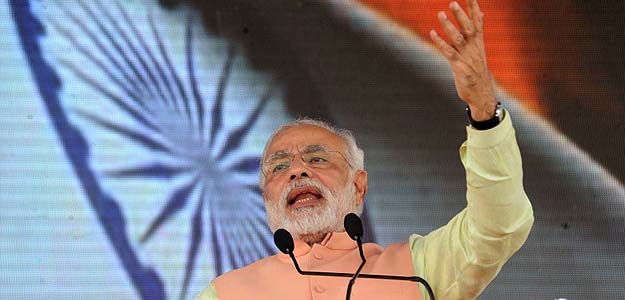
Indian stock markets are on a roll on hopes that a stable government post elections in May would pull out all stops to bring the country's sluggish economy on track. Analysts expect a revival in investment cycle and fast-tracking of reforms under the new regime.
Over the last few months, such a regime seems to have become coterminus with a Narendra Modi-led regime and the term "hope rally" has changed to "Modi rally."
So much so, that when talking about the recent bull run in Indian markets, analysts tend to calculate the Sensex's return since September 13, when Mr Modi was anointed as the BJP's prime ministerial candidate.
The BSE Sensex has rallied over 22 per cent since then, hitting a record high above 24,000 on Tuesday, a day after exit pills predicted a clear majority for Mr Modi-led National Democratic Alliance. Most of the gains have come on the back of strong buying by foreign investors, who have pumped in over $5 billion year-to-date. (Read: Exit poll euphoria: Why investors should be cautious)
Over the last four days alone, the Sensex has gained around 1,500 points or 8 per cent and FIIs have bought equity shares worth over Rs 6,000 crore. After such a sharp run, markets are expected to consolidate, but bulls are not ready to throw in the towel yet. (Track markets)
According to options data, the maximum buildup in May series is accumulated at 7500 call options, which indicates that market participants are preparing for upsides till 7,500 in the event of a positive outcome.
Independent analyst Saumil Trivedi says there's a very high probability of an exponential rise in markets and if the NDA gets 340 seats as forecast by one exit poll, markets may exceed the 10 per cent circuit on May 16.
"A paradigm shift has taken place about India's potential going ahead particularly on the back of the kind of leadership that is possible," he said.
Mr Trivedi says India is now in a structural bull market and his Nifty target of 12,000 by Q1 2016 factors in a 70 per cent upside from current levels.
On Tuesday, Japan-based Nomura raised its year-end target on Sensex by 10 per cent from 24,700 to 27,200 citing increased chances of a Modi-led government.
In justifying the solid move in markets and optimism ahead, particular attention has been given to Mr Modi's track record in Gujarat, where he has been chief minister since October 2001.
According to Standard Chartered Research, Gujarat's GDP growth averaged 8.9 per cent from FY01-FY13, much higher than the national average of 7.2 per cent.
It's not only about high growth. Gujarat government has halved its fiscal deficit to 2.6 per cent of gross state domestic product (GSDP) in FY12 from 5.2 per cent in FY02, the report notes.
Prabhat Awasthi of Nomura says markets have come to believe that a Modi-led government's key comparative advantage lies in its superior managerial and execution ability, which will reverse a debilitating policy paralysis and jumpstart the weak investment cycle.
Marketmen say investors, especially foreign funds that have invested billions of dollars in the country, are ready to give a sufficiently long rope to Mr Modi as far as the economy goes.
Sameer Arora, one of India's best known fund managers, told NDTV that investors will give the new government 6-9 months to turn things around. (Watch Mr Arora's interview)
"Look at what has happened to Infosys. At every negative news, the stock has not really fallen because they have a new management. The same should be viewed at the country level... Negative news will not be as important as positive news will be rewarded," he said.
In the run up to the elections, the BJP has often talked about a "Modi wave" sweeping across the country. While, the veracity of the BJP's theory will be tested only when actual results are announced on May 16, most investors on the Dalal Street seem to have made up their minds about who the likely winner is.
"I think there will be a complete confusion if it is a non-Modi as a PM... Forget about the stock markets, the country will not accept it. That will be viewed as a bad outcome because it will create uncertainty and anger in India," Mr Arora said.

-
AI Bias In Investing Cannot Be Eliminated, But It Can Be Governed

Framing is a particularly important example as identical financial information presented in terms of gains rather than losses can lead an LLM to reach a different assessment.
-
Joining The Dots | Dark Skies, Steady Diya: Why Hope Holds This Diwali
With war, a weak rupee and foreign outflows weighing on sentiment, policymakers at the NDTV World Summit and market veterans at NDTV Profit Ignite: Diwali Edition offered the same advice: stay invested and filter out the noise.
-
The Curious Case of Equitas Small Finance Bank And A CEO Who Quit For Stock
PN Vasudevan believes persistent investor concerns over a perceived conflict of interest had become a governance overhang on Equitas Small Finance Bank's stock, even as the lender improved profitability and asset quality.
-
Talking Points This Week: AI Cash Burn, A Tiger Comeback And An India That Still Finds Its Own Path
India is not immune to higher oil or tighter global liquidity, yet its earnings base is broader, its domestic policy levers are still available.
-
Foreign Investors Own Half Of HDFC Bank and ICICI Bank. An LTCG Cut Could Matter Most Here
Foreign portfolio investors have US$115 billion parked in HDFC Bank, ICICI Bank. If the government cuts long-term capital gains tax, Jefferies says returning foreign money could land here first.
-
'Never Seen This Level Of Negativity': Sandeep Tandon Says The Next Rally May Be Closer Than You Think
Veteran investor Sandeep Tandon says foreign selling is easing, large-caps are due a comeback and mid-caps are crowded, while he turns positive on gold, power and pharma this Diwali.
-
Indians Stay With Family, Not In Hotels | The Reason Why
India still lacks enough clean, reliable and affordable hotels for budget-conscious travellers.
-
The Economic Imperative: Analysing The Material Driving Force Behind India-Canada Strategic Reset
This economic complementarity is further reinforced by deep institutional investment ties and talent mobility, which form the bedrock of the bilateral framework.
-
Medicine Pricing: Where Must Profit Stop?
India must confront excessive margins, hidden incentives and regulatory gaps that threaten the integrity of medicine.
-
Why Amazon And Flipkart Are Struggling To Beat Meesho In India's Smaller Cities
With 274 million users and lowest-cost logistics, Meesho is defending its value commerce crown against giants like Amazon and Flipkart.










