BQuick On Jan. 14: Top 10 Stories In Under 10 Minutes
This is a roundup of the day's top stories in brief.
1. Retail Inflation At 18-Month Low
Consumer price inflation fell to its lowest in 18 months in December following a persistent decline in food prices and a drop in fuel costs.
- Retail inflation fell to 2.19 percent compared with 2.3 percent in November, government data released on Monday showed.
- A Bloomberg poll of 36 economists had estimated inflation at 2.2 percent for December.
- Retail inflation has fallen to its lowest level since June 2017 and is just above the lower end of India's inflation target of 4 (+/-2) percent.
- WPI Inflation, released earlier on Monday, fell to 3.8 percent compared to 4.64 percent in November 2018.
2. Three Fund Managers Who Defied The Rout
A handful of wealth managers beat the benchmarks even as small and mid-cap rout dragged India's top portfolio management firms into losses in 2018.
- DMZ Partners Investment Management Ltd., Multi-Act Equity Consultancy Pvt. Ltd. and IIFL Wealth Management Ltd. were among the managers which returned gains more the Sensex and Nifty last year.
- The three outpaced the benchmarks when 50 portfolio managers with equity assets worth Rs 1,03,253 crore ($14.75 billion)—more than 88 percent of the money managed by the category—lost 6.7 percent on an average in 2018, according to data compiled by BloombergQuint from disclosures to the market regulator.
- By contrast, the Sensex rose 5.9 percent and Nifty ended 3.2 percent higher.
While the strategies they followed were disparate, the focus on quality was the common theme.
3. Nifty's Three-Day Losing Streak; Dow Drops
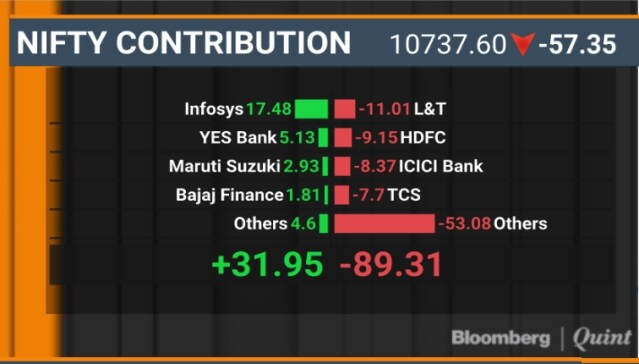
Indian equity benchmarks fell for third day in a row led by declines in Larsen & Toubro Ltd., HDFC Ltd. and ICICI Bank Ltd.
- The S&P BSE Sensex Index fell 0.43 percent or 156 points to 35,853.
- The NSE Nifty 50 Index dropped 0.53 percent or 57 points to 10,738.
- Seventeen of 19 sector gauges compiled by BSE ended lower led by S&P BSE Capital Goods Index's 1.93 percent decline.
- On the flipside, S&P BSE Healthcare Index was the top gainer, up 0.38 percent
Follow the day's trading action here.
U.S. stocks declined and Treasuries rose as weak Chinese trade data and troubling signals in bank earnings weighed on investor confidence.
- The S&P 500 fell after rising for a third straight week Friday, as financials dragged on the index in the wake of Citigroup's report that showed revenue from fixed-income trading -- the bank's largest securities business -- declined 21 percent.
- The 10-year Treasury yield dropped after slumping Chinese exports fueled concerns about the growing impact of the U.S.-China trade war on global growth.
- The Bloomberg Commodity Index decreased 0.1 percent.
Get your daily fix of global markets.
4. Insider Trading: New Rules Of The Game
Starting April this year, listed companies will have to deal with a narrower definition of unpublished price sensitive information and they'll be able to share such information for board-determined legitimate purposes but only if the disclosure is in the best interest of the company.
- Market regulator SEBI has recently notified amendments, approved in September last year, to its insider trading regulations. The changes were prompted by the recommendations of the Fair Market Conduct Committee chaired by TK Viswanathan.
- So far, in describing the scope of UPSI, SEBI regulations listed information relating to:
- Financial results.
- Dividends, change in capital structure.
- Mergers, de-mergers, acquisitions, delistings, disposals and expansion of business and such other transactions.
- Changes in key managerial personnel.
- Material events in accordance with the listing agreement.
The new rules have now put the onus on company boards.
5. India's Infrastructure Scars
The scars of the last credit cycle, where indiscriminate lending to infrastructure projects led to a surge in defaults, continue to haunt the Indian economy.
- The poor track record in recovering infrastructure debt had led Indian lenders to tighten approval and appraisal processes and push up interest rates for such loans.
- The risk aversion from lenders, together with the paucity of new infrastructure projects, has taken the share of infrastructure loans in total bank credit to a nine-year low.
- Data from rating agency CRISIL and the Reserve Bank of India shows that loans to the infrastructure sector as a share of total bank credit has been declining for four financial years since 2014-15. In 2017-18, this fell to 11.5 percent. It slipped further this year to just under 10 percent based on outstanding credit data available till November.
Is the credit pick-up driven by refinancing?
6. BQView: The Economy Under Modi - Big Ideas, Small Successes
From GST, demonetisation and the Mudra Scheme to Swachh Bharat and Ayushman Bharat, Prime Minister Modi has pitched big ideas of change for the economy.
- Some of these ideas have drawn praise; others derision.
- Few have resulted in any large dividends for the Indian economy yet.
- The two defining moments, demonetisation and GST, failed to play out exactly how the government had hoped.
Modi government's smartly branded schemes broadly fall into two buckets.
7. Budget 2019: Gujarat's SME Stress Test
In October last year, Bhavin Chaudhary lost a potential client from Singapore for nylon made at his factory because a Rs 30-lakh loan to buy new equipment took longer than usual. Chaudhary, 25, had started the unit 18 months ago to expand his family business.
- Delayed loan approvals and lack of credit was the common grouse of the three small businesses BloombergQuint spoke to in Gujarat—Prime Minister Narendra Modi's home and India's third-most industrialised state after Tamil Nadu and Maharashtra.
- Flow of credit to such 6.3 crore so-called micro, small and medium enterprises in the country is crucial as, according to government estimates, they employ 11.1 crore people and contribute about 30 percent to India's $2.7-trillion GDP.
But credit shortage is not a new problem.
8. Flipkart Co-founder Backs Ola
Ride-hailing platform Ola will raise Rs 650 crore (about $93 million) from Flipkart co-founder Sachin Bansal, two people privy to the development told BloombergQuint.
- Bansal had already invested Rs 149 crore in the cab-hailing company as part of the Series-J transaction, the company's filings with the Registrar of Companies showed.
- Bansal has so far received 70,588 preference shares at a subscription price of Rs 21,240 per share, according to documents.
- The rest of the money will come in separate tranche.
Bansal also registered a new venture BAC Acquisitions Pvt. Ltd. in December.
9. Fake News: Misguided Policymaking To Counter Misinformation
While ostensibly prompted by the need to address the epidemic of disinformation plaguing the country, it is unlikely that the government's draft intermediary guidelines as they stand today suitably address the issue at hand, writes Yesha Tshering Paul
- Instead, they raise larger questions of censorship and surveillance of our activity online.
- The guidelines come in the absence of any privacy legislation which can set parameters for their operation, and for the protection of users' interests.
- While moderating content may be easier on public-facing platforms, expecting ISPs and cyber cafes to observe the same level of diligence is unrealistic.
The draft rules fail to address ostensible concerns about disinformation or ‘fake news'.
Samsung's Cheap New Smartphones
Samsung Electronics Co. unveiled a new range of inexpensive smartphones for India, seeking to win back customers in the world's fastest-growing smartphone market and regain ground lost to Xiaomi Corp. and other Chinese rivals.
- The three M series devices, all priced below Rs 20,000 ($283) apiece, will launch on Feb. 5 on the Samsung India online store as well as Amazon India, the South Korean manufacturer said.
- The cheapest of the range will sell for less than Rs 10,000.
- The company will later take the devices to other markets.
As the West saturates, India is becoming every phonemaker's dream market.

-
Indians Are Travelling, But Not Every Journey Is A Holiday | The Week In Whys

Pilgrims, patients and working women are the real travellers, and the system hasn't quite caught up with them.
-
Getting To Work Costs Women More | The Reason Why
It is not just about women paying more than men. It is about women paying much more in cities than in villages.
-
AI Bias In Investing Cannot Be Eliminated, But It Can Be Governed
Framing is a particularly important example as identical financial information presented in terms of gains rather than losses can lead an LLM to reach a different assessment.
-
Joining The Dots | Dark Skies, Steady Diya: Why Hope Holds This Diwali
With war, a weak rupee and foreign outflows weighing on sentiment, policymakers at the NDTV World Summit and market veterans at NDTV Profit Ignite: Diwali Edition offered the same advice: stay invested and filter out the noise.
-
The Curious Case of Equitas Small Finance Bank And A CEO Who Quit For Stock
PN Vasudevan believes persistent investor concerns over a perceived conflict of interest had become a governance overhang on Equitas Small Finance Bank's stock, even as the lender improved profitability and asset quality.
-
Talking Points This Week: AI Cash Burn, A Tiger Comeback And An India That Still Finds Its Own Path
India is not immune to higher oil or tighter global liquidity, yet its earnings base is broader, its domestic policy levers are still available.
-
Foreign Investors Own Half Of HDFC Bank and ICICI Bank. An LTCG Cut Could Matter Most Here
Foreign portfolio investors have US$115 billion parked in HDFC Bank, ICICI Bank. If the government cuts long-term capital gains tax, Jefferies says returning foreign money could land here first.
-
'Never Seen This Level Of Negativity': Sandeep Tandon Says The Next Rally May Be Closer Than You Think
Veteran investor Sandeep Tandon says foreign selling is easing, large-caps are due a comeback and mid-caps are crowded, while he turns positive on gold, power and pharma this Diwali.
-
Indians Stay With Family, Not In Hotels | The Reason Why
India still lacks enough clean, reliable and affordable hotels for budget-conscious travellers.
-
The Economic Imperative: Analysing The Material Driving Force Behind India-Canada Strategic Reset
This economic complementarity is further reinforced by deep institutional investment ties and talent mobility, which form the bedrock of the bilateral framework.










