BP Caps Big Oil Earnings Season With Focus on Cash for Investors
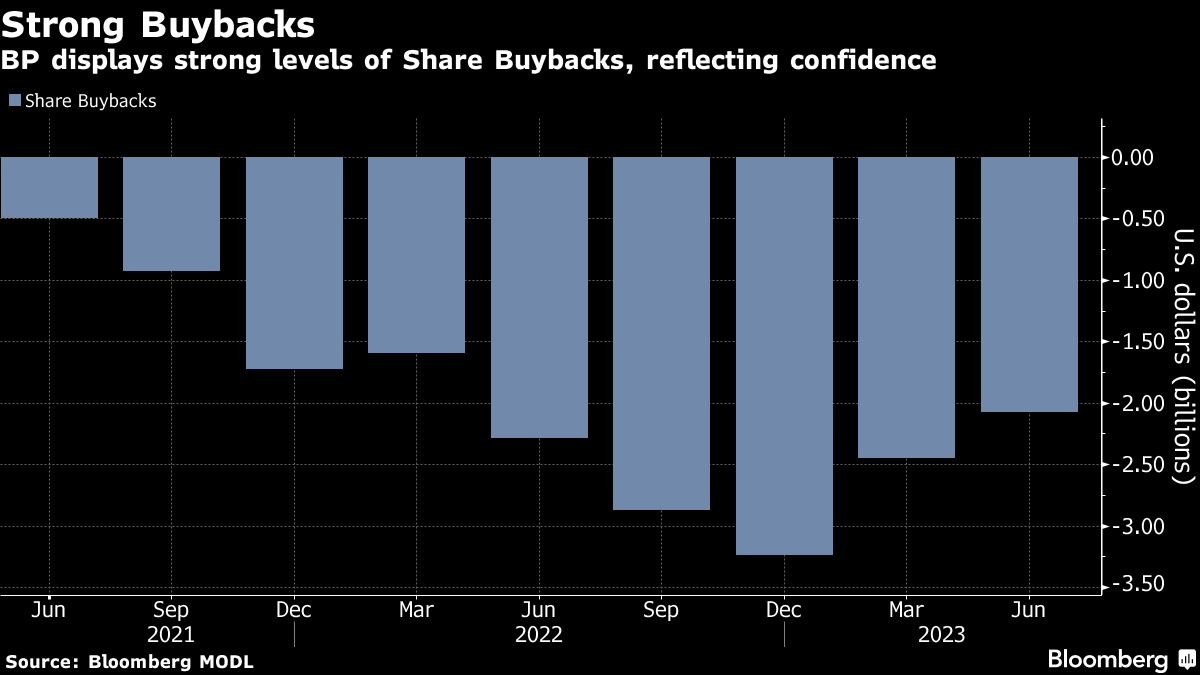
(Bloomberg) -- BP Plc hiked its dividend and promised to buy back more shares, capping a second-quarter earnings season that has seen Big Oil continue to prioritize returns to investors.
The London-based company raised its dividend by 10% and said it would buy back another $1.5 billion of shares, even as its profit fell by more than expected. It was following the pattern set by Shell Plc, TotalEnergies SE, ExxonMobil Corp. and Chevron Corp., all of which have kept the cash flowing back to their shareholders even as the surge in energy prices that spurred last year's record earnings has abated.
BP's returns are now well in excess of the company's guidance. It had previously indicated that it expected to buy back about $4 billion of shares and raise the dividend by 4% each year, assuming the price of Brent crude was about $60 a barrel. Over the past 4 quarters the company has repurchased $10 billion of shares and increased its dividend by a fifth.
“This is surprising given the weaker underlying result and an increase in net debt,” Redburn analyst Stuart Joyner said in a note on Tuesday. “But with the sector increasingly trading on yield again, it could boost the shares this morning.”
Shares of the company rose to pence as of in London.
These large cash payouts have drawn some criticism at a time when many countries are grappling with a cost-of-living crisis and the world needs huge amounts of investment into low-carbon energy to tackle climate change. BP has pledged to boost spending on both oil and gas and renewables.
BP's second-quarter adjusted net income was $2.59 billion, down from $8.45 billion a year earlier and below the average analyst estimate of $3.51 billion.
“The miss is concentrated in refining,” Chief Executive Officer Bernard Looney said in an interview with Bloomberg. “Margins were quite weak, particularly in diesel” in Europe and at its Whiting refinery in the US.
BP also “had a lot of maintenance that we planned to do this quarter” and oil trading profit was weaker, Looney said.
The buyback and dividend increase against a backdrop of weaker earnings had one important side effect — higher debt. Net debt rose more than $2 billion from the previous quarter to $23.7 billion, although that's still much lower than a few years ago.
BP is sticking to its plan for capital expenditure of $16 billion to $18 billion this year. So far it's spent $7.9 billion, putting it on pace to reach the lower end of this range.
“BP's 10% dividend increase and $1.5 billion buyback tranche for the third quarter (versus $1.75 billion in the second quarter) are positive surprises that will bolster confidence in the payout for the second half.” — Will Hares, BI global energy analyst
Gas trading had another “exceptional” quarter, although earnings dropped a little from the first three months of the year due to declining volatility, Looney said in an interview with Bloomberg TV. Europe's gas market looks like it will be in a better place in the coming winter, although the region is “not out of the woods yet,” he said.
Oil demand has been “incredibly resilient” and OPEC+ is sticking to its pledged production cuts, giving a strong outlook for crude prices in the coming months, Looney said.
--With assistance from Will Kennedy.
More stories like this are available on bloomberg.com
©2023 Bloomberg L.P.

-
Signature Play: The Classic Cocktail Is Dead. Or Is It?

Classic cocktails are disappearing from India's cocktail menus. But they're still being ordered, taught to bartenders and borrowed from. So, who's really having the last drink?
-
A New Samvat Wishlist: Inclusive Prosperity And Human Development
India has strengthened its economic foundations through infrastructure, digital access and enterprise. Its next growth chapter must deepen productivity, create better livelihoods and widen participation in prosperity.
-
Love, Sex Aur Dhokha: The Audacious Plot To Spy On Jensen Huang
A Taipei dinner, a Singapore chip buyer and a suspected Chinese asset: inside the alleged spy operation that got close to NVIDIA's Jensen Huang.
-
Ten Things I Learnt This Samvat
Patience can be a trap. Cheap stocks can stay cheap. Leverage can wipe you out. What did Samvat 2082 teach us? Niraj Shah writes on 10 lessons from the year gone by.
-
Talking Points This Week: Tech Nerves, FII Buying, And A Faraway Banking Shock
The global markets are not shining this Diwali. The exception in the large markets is, India.
-
Midterm Rally Lasted A Day. The Hard Reality Of A Divided US May Last Two Years | Opinion
Between a contested AI boom, a debt ceiling that arrives in 2027 and a president with every incentive to act alone, the next two years may prove more volatile than the first day's rally suggests.
-
Blue Wave Will Derail the AI Trade but Won't Dismantle the AI Era | Unhedged Position
The Democrats' sweep of the US Congress will see politics collide with economic forces both over the long and short term.
-
It's Time To Take The GST Council's Bet On Trust Global
Payment records can prove India's services exports, and clear, proportionate rules can bring foreign digital sellers into the tax net.
-
Opinion | India at 38: From Innovation Overperformer to Innovation Powerhouse
India now has 453 VC-backed deep science startups, 18 of them late-stage, after 117 percent growth since 2020. Laurus Labs, at USD 9.3 billion, is the most valuable deep science company in any middle-income economy outside China.









