BOJ Watchers See No Further Policy Shift In 2023 After Yield Curve Control Tweak

(Bloomberg) -- Bank of Japan watchers don't expect any further change from the central bank this year, after the BOJ surprised investors around the world by tweaking its yield curve control program last week, according to a Bloomberg survey conducted Monday.
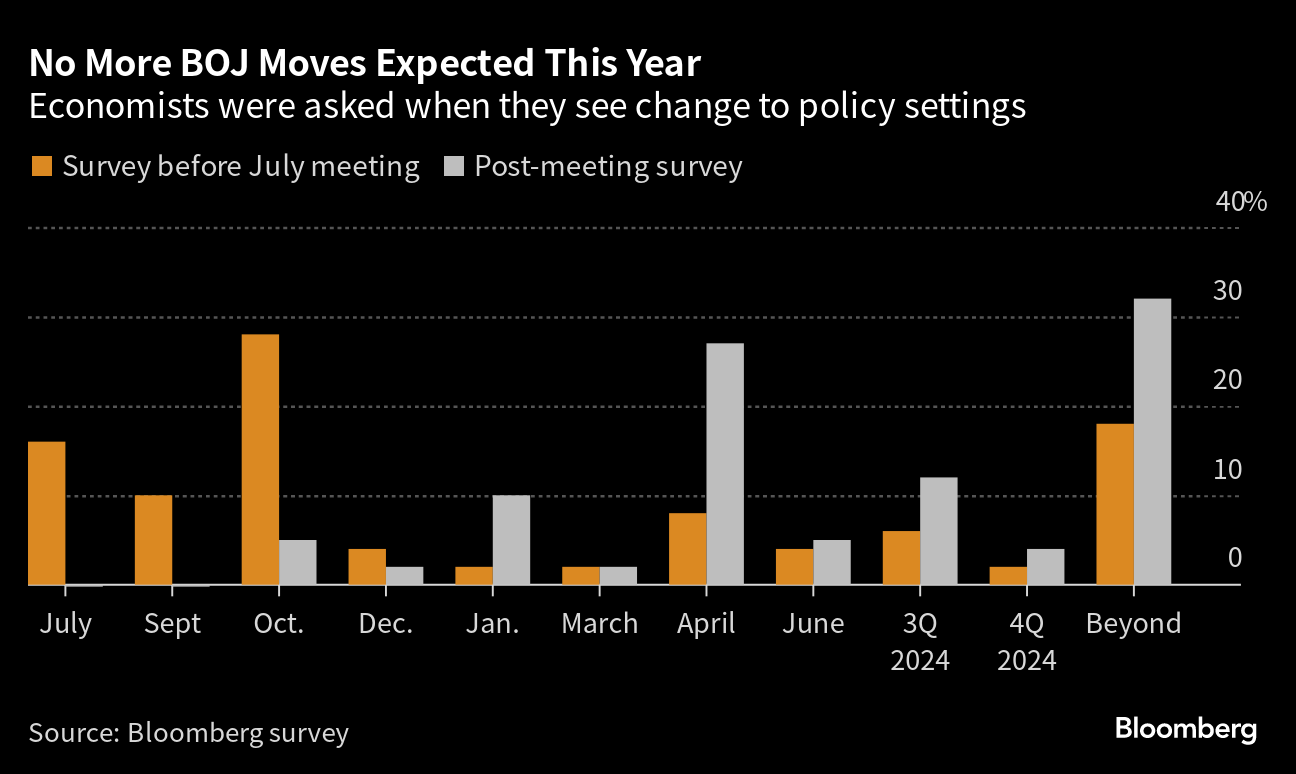
More than 90% of 41 economists don't anticipate any further moves this year, following Friday's decision that effectively raised the tolerated ceiling for 10-year yields. Economists now see April as the most likely month for the next policy shift, chosen by 26% of respondents.
Click here to read the full results.
Following Friday's surprise move, scrapping YCC is the most likely next step, according to 78% of economists, followed by 59% saying raising the negative interest rate is likely to be the next step from the central bank. The question allowed multiple answers from respondents.
Governor Kazuo Ueda jolted global financial markets last week by essentially allowing 10-year yields to rise to 1%, in his first surprise move after taking over the bank's helm in April. While market players are still digesting the meaning of the change, 38% said that it effectively marks the end of YCC, with 55% saying it doesn't.
The BOJ decided to control yields with “greater flexibility” after it had rigidly kept long-term yields below 0.5% with the aim of stimulating the economy and sparking inflation.
Asked where 10-year bond yields will likely settle after Friday's decision, economists had a median forecast of 0.7%, the poll showed. The yield jumped to a nine-year high above 0.6% on Monday, prompting the central bank to launch unscheduled bond-buying operations.
“The latest revision can be seen as a de facto increase in the YCC ceiling,” said Mari Iwashita, chief market economist at Daiwa Securities Co. While it's difficult to foresee the next move from the central bank, “for now it seems that the need for a further adjustment of YCC has subsided.”
At a post-meeting press conference last week, Ueda explained that a key reason behind the move was a need to prepare for upside inflation risks. The BOJ sharply raised its inflation forecast for this fiscal year and it sees risks on the upside for this year and next.
When Ueda's predecessor Haruhiko Kuroda widened the yield band in December, about 70% of economists saw a problem with BOJ communication. Ueda got a favorable review, with 62% of economists saying his communication is either good or very good.
“So far the BOJ's moves under Ueda have been pretty cunning,” said Yasunari Ueno, chief market economist at Mizuho Securities. “That said, in order to end negative rates the BOJ needs to be a lot more certain that sustainable, stable 2% inflation will be achieved. That hurdle is still reasonably high.”
More stories like this are available on bloomberg.com
©2023 Bloomberg L.P.

-
Signature Play: The Classic Cocktail Is Dead. Or Is It?

Classic cocktails are disappearing from India's cocktail menus. But they're still being ordered, taught to bartenders and borrowed from. So, who's really having the last drink?
-
A New Samvat Wishlist: Inclusive Prosperity And Human Development
India has strengthened its economic foundations through infrastructure, digital access and enterprise. Its next growth chapter must deepen productivity, create better livelihoods and widen participation in prosperity.
-
Love, Sex Aur Dhokha: The Audacious Plot To Spy On Jensen Huang
A Taipei dinner, a Singapore chip buyer and a suspected Chinese asset: inside the alleged spy operation that got close to NVIDIA's Jensen Huang.
-
Ten Things I Learnt This Samvat
Patience can be a trap. Cheap stocks can stay cheap. Leverage can wipe you out. What did Samvat 2082 teach us? Niraj Shah writes on 10 lessons from the year gone by.
-
Talking Points This Week: Tech Nerves, FII Buying, And A Faraway Banking Shock
The global markets are not shining this Diwali. The exception in the large markets is, India.
-
Midterm Rally Lasted A Day. The Hard Reality Of A Divided US May Last Two Years | Opinion
Between a contested AI boom, a debt ceiling that arrives in 2027 and a president with every incentive to act alone, the next two years may prove more volatile than the first day's rally suggests.
-
Blue Wave Will Derail the AI Trade but Won't Dismantle the AI Era | Unhedged Position
The Democrats' sweep of the US Congress will see politics collide with economic forces both over the long and short term.
-
It's Time To Take The GST Council's Bet On Trust Global
Payment records can prove India's services exports, and clear, proportionate rules can bring foreign digital sellers into the tax net.
-
Opinion | India at 38: From Innovation Overperformer to Innovation Powerhouse
India now has 453 VC-backed deep science startups, 18 of them late-stage, after 117 percent growth since 2020. Laurus Labs, at USD 9.3 billion, is the most valuable deep science company in any middle-income economy outside China.









