BOJ Far From Exiting One Of World's Longest-Running Negative Rate Regimes: Deputy Governor
(Bloomberg) -- Deputy Governor Shinichi Uchida said the Bank of Japan is far from reaching an exit from its current policy framework — and from raising its negative interest rate — after the bank jolted global financial markets last week by adjusting its yield curve control program.
“Needless to say, we do not have an exit from monetary easing in mind,” Uchida said in a speech to local business leaders in Chiba, Japan on Wednesday. “In sum, the bank's decision to conduct yield curve control with greater flexibility aims at patiently continuing with monetary easing.”
Uchida's remarks come as market players are still trying to figure out the intention behind the BOJ's surprise move Friday of effectively allowing 10-year bond yields to rise. While there is now growing attention on the timing for when the BOJ might end its negative rate policy, Uchida said there's still a long way to go before the bank gets there.
“Given current developments in economic activity and prices in Japan, the bank assesses that there is still a long way to go before such decisions are made,” Uchida said as he explained such a move would mean the BOJ is in a state where it needs to cool the economy to address high inflation.
Japan's key inflation gauge has stayed above the BOJ's 2% target for more than a year, although the bank's view is that inflation has mainly been driven by cost-push factors. The price gains are expected to subside later this year, and attention is on both the slowdown pace, and when inflation may pick up again after the deceleration.
Following the YCC revision on Friday, almost no BOJ watchers expect further policy action this year, according to a Bloomberg survey conducted this week. The largest number of analysts predicts the next policy change will come in April. Scrapping the YCC is the most likely next step, and raising negative rates the next most likely, the poll showed.
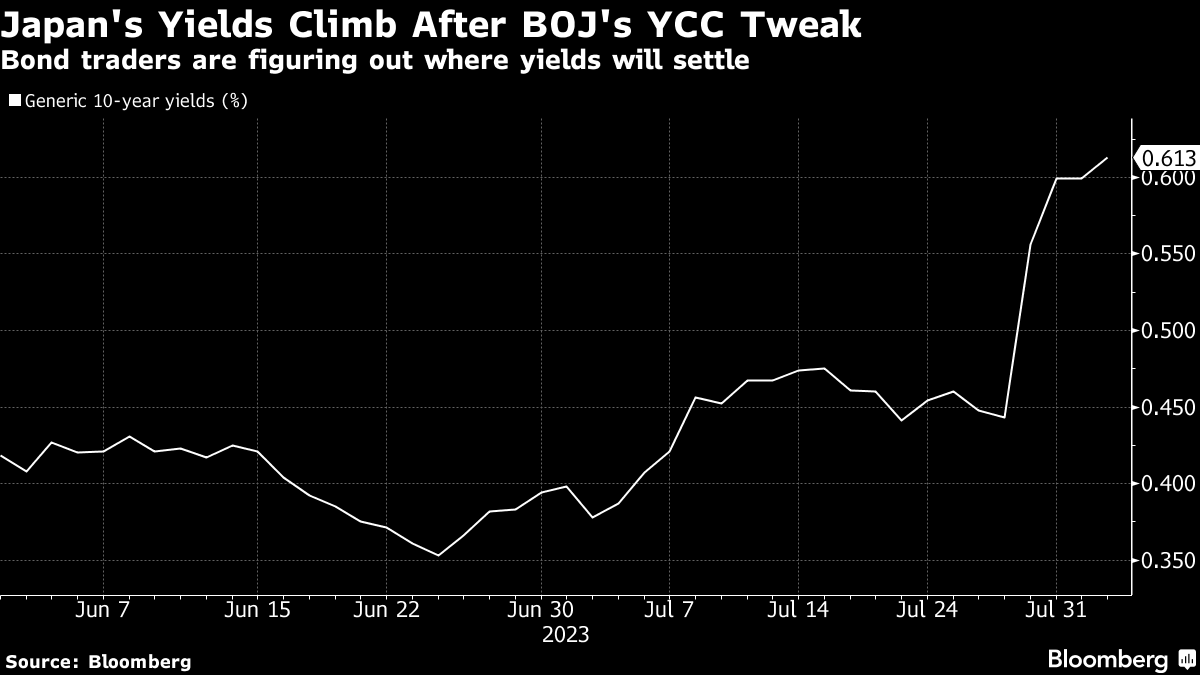
Japan's 10-year yields continued to climb on Wednesday, reaching the highest in nine years. Traders are still in the process of assessing what conditions are most likely to prompt the BOJ to step into the market with purchases aimed at capping increases in yields.
Speaking to reporters after the speech, Uchida didn't offer any clues on that question.
“There is no specific level in my mind at this stage. I mean I wouldn't say it even if there was one,” Uchida told reporters. “We will of course step in to stop yields depending on the speed” of their ascent when they approach 1%, he said.
BOJ watchers expect 10-year yields will settle down around 0.7%, according to the median forecast in the Bloomberg survey.
(Updates with further details from Uchida's press conference, a chart.)
More stories like this are available on bloomberg.com
©2023 Bloomberg L.P.

-
Signature Play: The Classic Cocktail Is Dead. Or Is It?

Classic cocktails are disappearing from India's cocktail menus. But they're still being ordered, taught to bartenders and borrowed from. So, who's really having the last drink?
-
A New Samvat Wishlist: Inclusive Prosperity And Human Development
India has strengthened its economic foundations through infrastructure, digital access and enterprise. Its next growth chapter must deepen productivity, create better livelihoods and widen participation in prosperity.
-
Love, Sex Aur Dhokha: The Audacious Plot To Spy On Jensen Huang
A Taipei dinner, a Singapore chip buyer and a suspected Chinese asset: inside the alleged spy operation that got close to NVIDIA's Jensen Huang.
-
Ten Things I Learnt This Samvat
Patience can be a trap. Cheap stocks can stay cheap. Leverage can wipe you out. What did Samvat 2082 teach us? Niraj Shah writes on 10 lessons from the year gone by.
-
Talking Points This Week: Tech Nerves, FII Buying, And A Faraway Banking Shock
The global markets are not shining this Diwali. The exception in the large markets is, India.
-
Midterm Rally Lasted A Day. The Hard Reality Of A Divided US May Last Two Years | Opinion
Between a contested AI boom, a debt ceiling that arrives in 2027 and a president with every incentive to act alone, the next two years may prove more volatile than the first day's rally suggests.
-
Blue Wave Will Derail the AI Trade but Won't Dismantle the AI Era | Unhedged Position
The Democrats' sweep of the US Congress will see politics collide with economic forces both over the long and short term.
-
It's Time To Take The GST Council's Bet On Trust Global
Payment records can prove India's services exports, and clear, proportionate rules can bring foreign digital sellers into the tax net.
-
Opinion | India at 38: From Innovation Overperformer to Innovation Powerhouse
India now has 453 VC-backed deep science startups, 18 of them late-stage, after 117 percent growth since 2020. Laurus Labs, at USD 9.3 billion, is the most valuable deep science company in any middle-income economy outside China.









