Boeing 777X To Slide Into 2027, Driving Billions In Charges
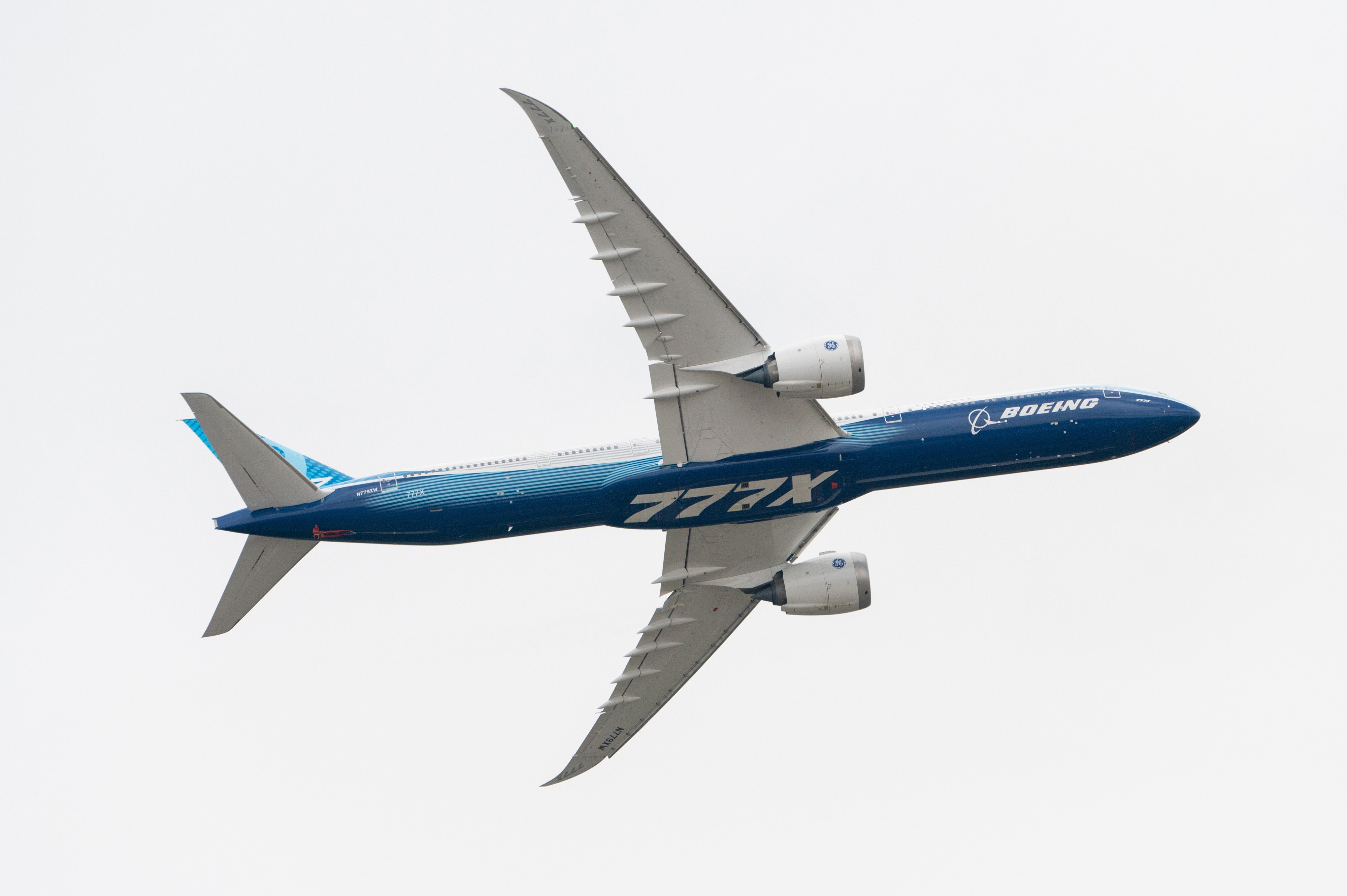
Boeing Co.'s 777X is slated to fly commercially for the first time in early 2027 instead of next year, people familiar with the matter said, a fresh setback to the US planemaker that sets the stage for potentially billions of dollars in accounting charges.
Deutsche Lufthansa AG, the launch customer for the widebody aircraft, is already making plans for such a delay. The German airline isn't including the 777X in its fleet plans until 2027, said one of the people, who asked not to be identified because the matter is confidential. Officials at Emirates, the 777X's biggest customer, have also grown more cautious as it looks at entry into service possibly not before 2027.
Analysts estimate the non-cash accounting charge could run from $2.5 billion to as much as $4 billion, though Boeing has not detailed the extent of the cost. But executives have held meetings with major investors in recent weeks and are charting out damage-control messaging that the financial impact will be spread across the overall jet program, according to one of the people.
The jet, already six years later, is of major strategic and financial importance to Boeing in its duel with Airbus SE for a bigger slice of the lucrative long-haul market. Boeing executives are set to discuss the extent and cost of the latest schedule slip for the hulking jet when Boeing reports earnings on Oct. 29.
A Boeing spokeswoman declined to comment, citing a quiet period ahead of earnings. A spokesman for Lufthansa deferred questions on the delivery schedule to the manufacturer.
Shares in Boeing pared earlier gains on Bloomberg's report, finishing the trading session in New York with a 1% increase. The stock has risen about 23% so far this year.
Last month, Boeing Chief Executive Officer Kelly Ortberg revealed to a Morgan Stanley conference that 777X certification was falling behind schedule, though he didn't provide a new timeline. He attributed the latest setback to a “mountain of work” rather than any new technical issue with the plane or its engines.
“As you know, even a minor schedule delay on the 777 program has a pretty big financial impact because we're in a reach-forward loss situation,” Ortberg said. “So we're looking at that real hard.”
For analysts, Ortberg's comments fit a familiar pattern. The planemaker has often used investor conferences to signal negative news and set expectations for its quarterly earnings. The CEO's reference to program losses under Boeing's arcane accounting methodology indicated the non-cash accounting charge would be substantial.
Another delay to the start of deliveries for Boeing's upgraded 777, which was originally due to fly commercially in 2020, would also crimp cash needed to help the company leave behind years of crises and financial bloodletting.
Boeing expects to start generating cash this year, fueling optimism that the US manufacturer has regained a grip on production under Ortberg, who joined in August 2024.
Boeing has already racked up more than $11 billion in cost overruns for the 777X, which has encountered a string of setbacks and faced tough Federal Aviation Administration scrutiny in the aftermath of two fatal 737 Max crashes last decade.
The program is in a reach forward-loss position, meaning Boeing won't recover its development costs across the first 500 airplanes it builds and sells. The company must immediately book any additional abnormal costs and overruns as a charge to earnings.
Sheila Kahyaoglu, an analyst with Jefferies, predicts Boeing could report a charge as large as $4 billion from the delays. That covers cash payments the manufacturer would have received next year from delivering 18 of the planes, as she'd expected, as well as customer concessions and other costs.
Of the challenges that Boeing currently faces, “I'm sure it's a big priority because it's going to be a big cash drain for them,” Kahyaoglu said of the 777X certification delays.
Ken Herbert, analyst with RBC Capital Markets, predicts the 777X jet's entry into service will slide to the second half of 2027, and that the upcoming charge will be around $2.5 billion, broadly consistent with previous writedowns.
The latest setback is a consequence of the slower-than-anticipated pace of safety certification work on 777X test aircraft with FAA pilots and inspectors aboard, Ortberg said. Emirates, Cathay Pacific and Qatar Airways are among the customers awaiting the 777X, Boeing's successor to its out-of-production 747 jumbo.
Jay Malave, who joined Boeing in August as chief financial officer, is studying the financial ramifications. The CFO transition gives Boeing “an opportunity to re-set both program and expectations,” Herbert said in a Sept. 28 report.
“With better news expected on both the Max and the 787,” he added, referring to steadily rising factory output, “the timing of the 777X charge is not a surprise.”

-
The Economic Imperative: Analysing The Material Driving Force Behind India-Canada Strategic Reset

This economic complementarity is further reinforced by deep institutional investment ties and talent mobility, which form the bedrock of the bilateral framework.
-
Medicine Pricing: Where Must Profit Stop?
India must confront excessive margins, hidden incentives and regulatory gaps that threaten the integrity of medicine.
-
Why Amazon And Flipkart Are Struggling To Beat Meesho In India's Smaller Cities
With 274 million users and lowest-cost logistics, Meesho is defending its value commerce crown against giants like Amazon and Flipkart.
-
High US Salaries, No Green Card Certainty: The Financial Calculation Facing Indian H-1B Families
The suspension of PERM processing at eight technology employers does not cancel existing H-1B visas. What it does is force a question many Indian families have been avoiding: is the US salary worth tying your career and family plans to one employer?
-
Swiggy vs Eternal: Food Delivery's Two Rivals Are No Longer In The Same Race
Eternal is building a private AI assistant, dark.ai. Swiggy is still working out how to make Instamart pay, with an operating loss of Rs 895 crore in the July-September quarter while Blinkit stayed profitable.
-
Where You Live Shapes How You Get To Work | The Reason Why
Two-wheelers are the most popular way to get to work in India, accounting for nearly 43% of workplace commutes.
-
Unhedged Position: Can India See An Indonesia-Style Time Correction?
The Nifty is trading below levels it first clocked in 2024. Is there, then, as I have suggested in the headline, potential that the current time correction drags on painfully for the next three-five, even ten years?
-
Navigating Friction And Energy Realities: An Analysis Of Marco Rubio's October Visit To India
Occurring at a critical juncture marked by stalled trade negotiations and escalating geopolitical pressures over global energy supplies, the visit offers a profound window into modern US-India relations.
-
India Exports Capital. Why Not Export Trusteeship?
The big question, then, is whether India can build an institution that global borrowers, investors, banks, and lawyers can trust, even without an Indian connection.
-
France's Economy & Politics Are In Crisis | The Reason Why
Let's look at how the French economy and politics evolved under Nicolas Sarkozy, Franois Hollande and Emmanuel Macron.










