BJP Wants Expansionary Economic Policy Ahead Of General Elections: Report
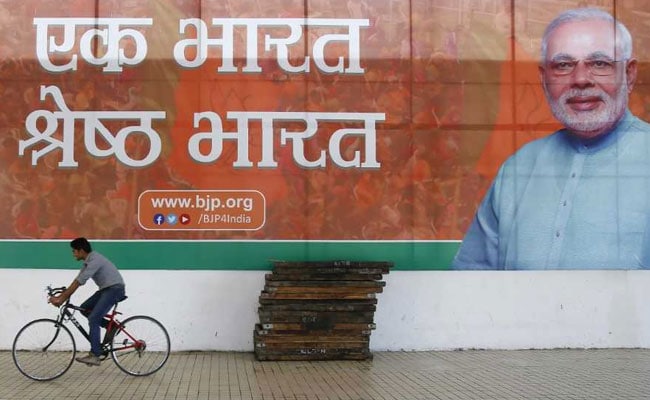
Country's ruling party is in favour of an expansionary economic policy and does not consider the government's plan to keep the fiscal deficit to 3.3 per cent of GDP as "sacrosanct", a party spokesman told Reuters.
Ahead of a general election that must be held by May and after a string of losses in recent state polls, the government run by the Bharatiya Janata Party (BJP) has announced several stimulus measures for the countryside where millions of farmers are grappling with low crop prices. Other fiscal moves have been aimed at helping small businesses.
The measures are likely to be a drain on finances in Asia's third-biggest economy, though the administration is expected to get the Reserve Bank of India to agree to transfer an interim dividend of 30,000-40,000 crore rupees to the government by March, Reuters reported last week quoting sources.
Weak consumer spending and the fragile farm sector have already been a drag on economic growth.
The country lost 11 million jobs last year, with around 83 per cent in rural areas, according to independent think-tank the Centre for Monitoring Indian Economy, as operational costs surged for small businesses. Those costs were boosted by the launch of a national sales tax in 2017 and the economic impact of an earlier ban on high value currency notes.
"There's a demand, there's a debate - all my colleagues are saying what's the need of keeping the fiscal deficit in check when there is a distress in a particular sector," said Gopal Krishna Agarwal, the economic affairs spokesman for the BJP, referring to the farm sector.
"Even think-tanks associated with us are talking in this sense. Very few people domestically are talking about fiscal prudence. Only foreign think-tanks are talking fiscal prudence. I strongly believe an expansionary policy can benefit the party," he said in an interview on Tuesday night.
India's 10-year benchmark bond yield rose 4 basis points to 7.53 per cent after the news, its highest since January 8 on worries about the fiscal deficit. The rupee also weakened to 71.23 to the dollar from its previous close of 71.03.
Agarwal, a chartered accountant who is a director at state-run Bank of Baroda and a member of a government committee on small and medium-sized businesses, said Prime Minister Narendra Modi was aware of his party colleagues' thinking but that no final decision had been taken.
D.S. Malik, a spokesman for the Ministry of Finance, did not respond to calls and emails seeking comment. Finance Minister Arun Jaitley, who is in the United States for a medical check-up, said in a Facebook post on Tuesday that India's "fiscal discipline during the past five years has been amongst the best as compared to any preceding period".
NEED TO REACH LANDLESS
Agarwal said the government understands that farmers are in distress and that directly transferring money to their bank accounts was an option to help them out. He said the government was, however, trying to figure out how to distribute funds to landless tillers to make sure any such transfer programme was effective and didn't just benefit those with land.
The government is studying a programme launched by Odisha under which farmers with landholdings of up to 5 acres would get cash assistance to buy seeds, pesticides, fertilisers and pay for labour. Sharecroppers, who cultivate rented land will also get the benefits, which include life insurance coverage.
Agarwal said Modi and many financial institutions were not in favour of waiving farm loans, as done by states recently won by the Congress party, because doing so mainly helps banks and not so much farmers in duress.
"There's definitely a suggestion to give interest-free loans to farmers. Banks won't have to pay, it has to be incorporated into the budget," he said.
"And what's the so sacrosanct issue about keeping the fiscal deficit at less than 3.5 per cent? If you don't adopt an expansionary economic policy, then the government alone can't create demand by just spending on infrastructure. It has to come from both public and the private sector. The economy will grow only when demand will be created."
He said that increasing the income tax exemption limit for individuals was also being considered for the interim budget to be presented on February 1 by Jaitley.
William Foster, vice president at Moody's Investors Service, said that it expects the country's fiscal deficit to slip to 3.4 of GDP this fiscal year ending March 31 due to revenue shortfalls from goods and services tax, lower excise duty and below-target receipts from sale of government assets.
"Increased expenditure on income transfers, farm loan waivers or other forms of subsidies would weigh further on government finances," Foster told Reuters.

-
AI Bias In Investing Cannot Be Eliminated, But It Can Be Governed

Framing is a particularly important example as identical financial information presented in terms of gains rather than losses can lead an LLM to reach a different assessment.
-
Joining The Dots | Dark Skies, Steady Diya: Why Hope Holds This Diwali
With war, a weak rupee and foreign outflows weighing on sentiment, policymakers at the NDTV World Summit and market veterans at NDTV Profit Ignite: Diwali Edition offered the same advice: stay invested and filter out the noise.
-
The Curious Case of Equitas Small Finance Bank And A CEO Who Quit For Stock
PN Vasudevan believes persistent investor concerns over a perceived conflict of interest had become a governance overhang on Equitas Small Finance Bank's stock, even as the lender improved profitability and asset quality.
-
Talking Points This Week: AI Cash Burn, A Tiger Comeback And An India That Still Finds Its Own Path
India is not immune to higher oil or tighter global liquidity, yet its earnings base is broader, its domestic policy levers are still available.
-
Foreign Investors Own Half Of HDFC Bank and ICICI Bank. An LTCG Cut Could Matter Most Here
Foreign portfolio investors have US$115 billion parked in HDFC Bank, ICICI Bank. If the government cuts long-term capital gains tax, Jefferies says returning foreign money could land here first.
-
'Never Seen This Level Of Negativity': Sandeep Tandon Says The Next Rally May Be Closer Than You Think
Veteran investor Sandeep Tandon says foreign selling is easing, large-caps are due a comeback and mid-caps are crowded, while he turns positive on gold, power and pharma this Diwali.
-
Indians Stay With Family, Not In Hotels | The Reason Why
India still lacks enough clean, reliable and affordable hotels for budget-conscious travellers.
-
The Economic Imperative: Analysing The Material Driving Force Behind India-Canada Strategic Reset
This economic complementarity is further reinforced by deep institutional investment ties and talent mobility, which form the bedrock of the bilateral framework.
-
Medicine Pricing: Where Must Profit Stop?
India must confront excessive margins, hidden incentives and regulatory gaps that threaten the integrity of medicine.
-
Why Amazon And Flipkart Are Struggling To Beat Meesho In India's Smaller Cities
With 274 million users and lowest-cost logistics, Meesho is defending its value commerce crown against giants like Amazon and Flipkart.










