Big Tech’s Year Of Partnering Up With AI Startups
(Bloomberg) -- A new crop of artificial intelligence startups has shaken up Silicon Valley — and the wider business world — throughout this year, but there's one thing that hasn't changed: Big Tech still wields power.
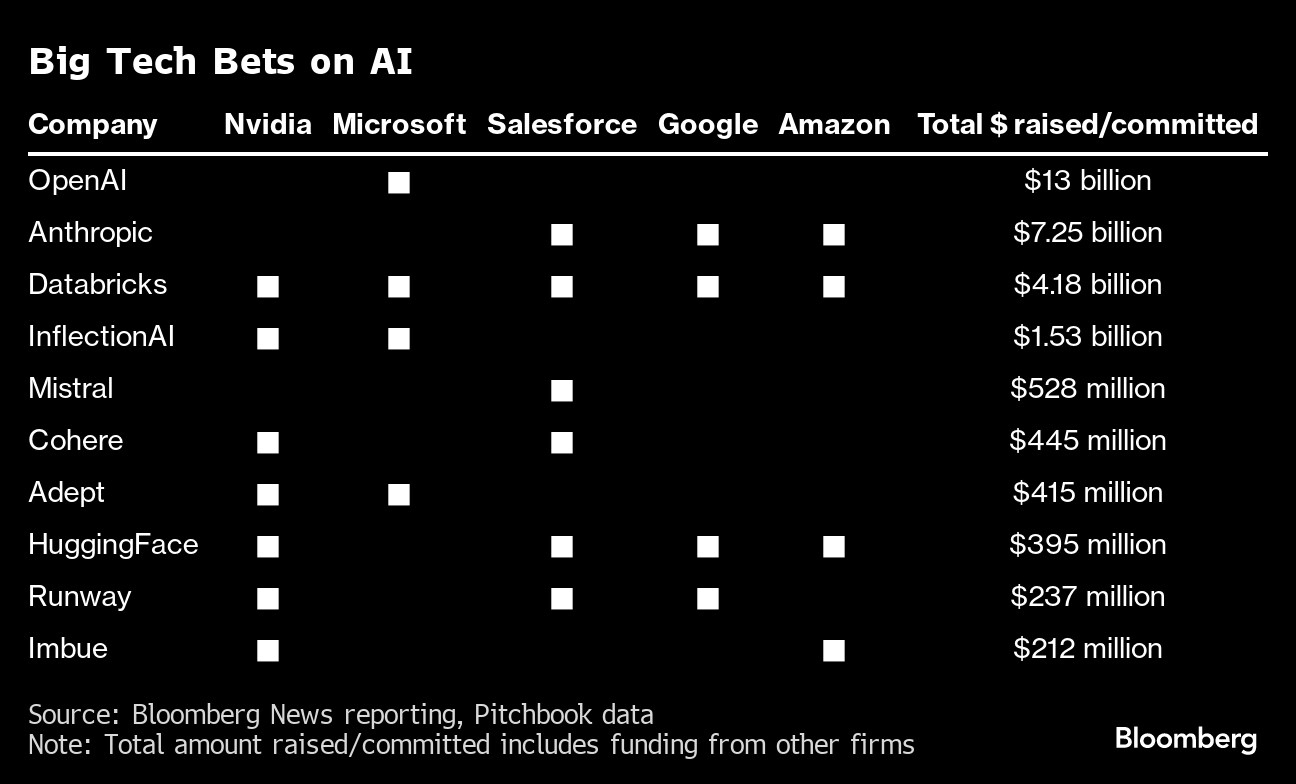
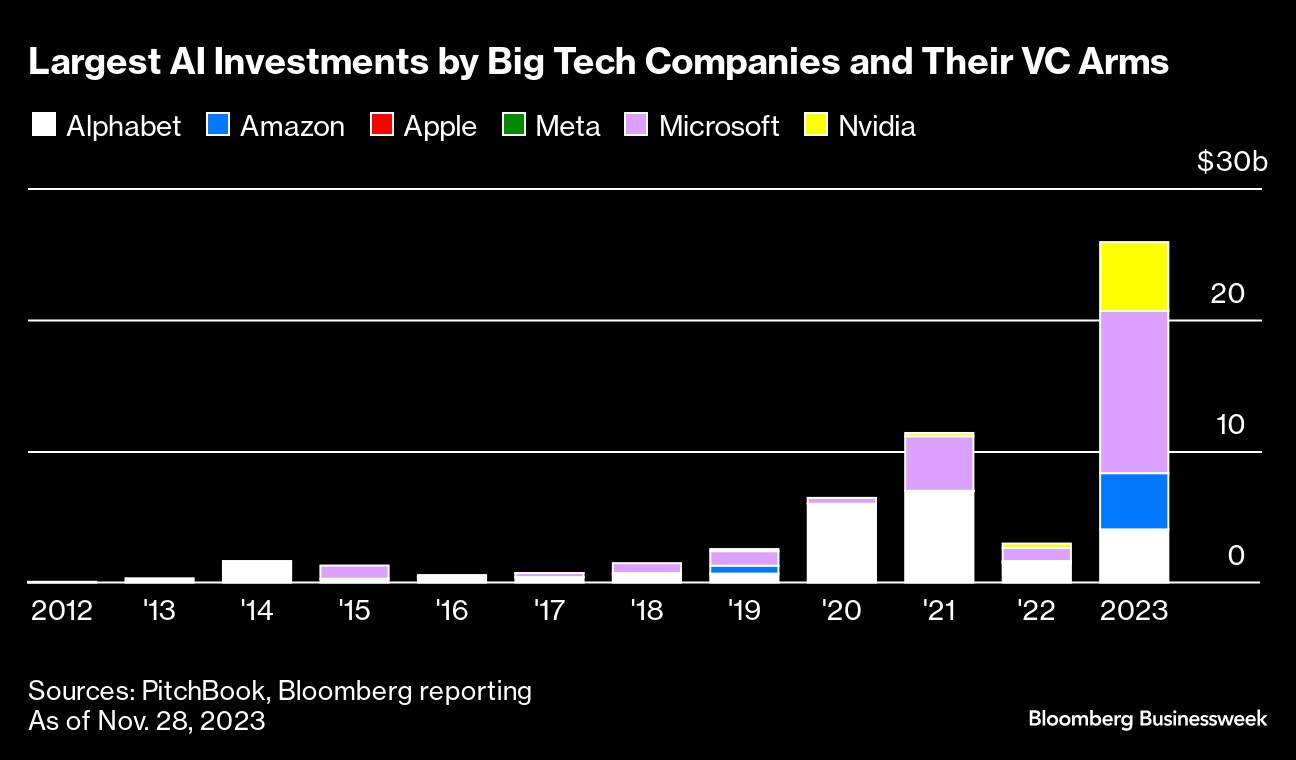
In the wake of Microsoft Corp.'s $10 billion investment in OpenAI in January, other tech giants raced to partner with leading AI startups through funding and cloud computing deals. Salesforce Inc. led a round in Hugging Face at a $4.5 billion valuation. Alphabet Inc. and Amazon.com Inc. invested billions in OpenAI rival Anthropic. And Nvidia Corp. seemed to back almost every AI startup of note.
The net effect is that many of the most promising AI startups now depend heavily on the old guard of dominant tech companies for their financing and infrastructure needs. That dynamic is starting to draw the attention of regulators.
Microsoft's partnership with OpenAI is facing fresh scrutiny from UK and US competition regulators. In the US, the Federal Trade Commission has been tasked by the Biden administration with promoting “a fair, open, and competitive AI ecosystem.” The agency has previously requested public comment about whether large cloud computing contracts are anti-competitive.
“What regulators might be concerned about is that the story of Big Tech's strategic investment in AI startups could have the potential to become the story of Big Tech's AI monopoly,” said Ngor Luong, senior research analyst who focuses on AI investment trends at Georgetown University's Center for Security and Emerging Technology.
For AI companies, these deals with Big Tech can serve as a vital lifeline. It's extremely costly and computationally intensive to build large language models, the technology that underpins AI chatbots like ChatGPT. Large tech companies are in the small camp of businesses with the infrastructure and funds to support these efforts.
For Big Tech companies, these deals can serve as a means to cement their grip on a competitive and rapidly evolving market after some were caught off guard by the massive success of OpenAI's ChatGPT a year ago. These partnerships can also help tech giants bolster demand for their products, whether it's the chips sold by Nvidia or cloud-computing services from Microsoft, Google and Amazon.
In a blog post this month, Nvidia said it has made “more than two dozen investments” this year. “These partnerships stimulate joint innovation, enhance the NVIDIA platform and expand the ecosystem,” the company said.
In addition to OpenAI, Microsoft has invested in Inflection AI and Adept, among other billion-dollar AI startups, but these deals are much smaller than the $13 billion it has committed so far to the ChatGPT-maker.
Microsoft's unique relationship with OpenAI was put on full display in November when Chief Executive Officer Sam Altman was briefly ousted from the startup. Microsoft CEO Satya Nadella played a key role, along with other investors, in forcing the board to reverse its decision. At one point Microsoft said it would hire Altman and his OpenAI colleagues to form a new Microsoft AI unit.
In response to regulators' concerns, Microsoft emphasized that it doesn't own a traditional stake in OpenAI. “It is important to note that Microsoft does not own any portion of OpenAI and is simply entitled to a share of profit distributions,” the company said last week.
While Microsoft, Amazon and Alphabet have all been very active this year in backing AI startups, two other Big Tech companies have largely stayed away from such deals: Apple Corp. and Meta Platforms Inc.
Apple Inc. has built its own large language model called Ajax and rolled out an internal chatbot dubbed “Apple GPT.” Meta, meanwhile, has an open source large language model and has struck partnerships with other Big Tech companies, including Microsoft and Amazon.
More stories like this are available on bloomberg.com
©2023 Bloomberg L.P.

-
Why Swapping Your Old Gold Can Trigger A Rs 5 Lakh Tax Bill, And How You Can Avoid It Legally

Swapping old gold for new is taxed as a sale and a fresh purchase. Getting your own gold remade can cut most of that bill, though it has its own costs.
-
The AI Trade is Done. The Real Opportunity for Investors Starts in 2027 | Unhedged Position
As pureplay AI stocks plunge and circular, capex-led financing unwinds, 2027 is set to be a year of reckoning for AI companies. Yet the bust clears the way for a better opportunity for investors in 2027 -- shifting the spotlight from AI builders to the companies using AI.
-
Leadership As Mission: Why The Age Of AI Demands More Human Leadership
Debjani Ghosh examines how AI is changing leadership, arguing that its success must be measured by its impact on people and the accountability of those guiding its use.
-
We May Need Another Tukaram Mundhe To Fight Air Pollution | The Reason Why
Developers may install basic measures such as sprinklers and green nets, resume work, and continue violating rules when this equipment stops working.
-
Extracting Value From Battery Scrap Could Be Challenging For India | The Reason Why
A discarded lithium-ion battery still contains valuable materials such as lithium, nickel and cobalt. These can be recovered and reused. When such batteries are crushed and shredded, they produce a dark powder called black mass.
-
One El Nino, India Can Handle. Two Could Break The Granary
India's grain stocks can absorb one bad year, but a second El Nino could drain the buffer in two to three years, economists say.
-
India's Troika Of Good Luck | Joining The Dots
As Jensen Huang's exit drags Nvidia down, a cooling AI trade and resilient earnings have revived investor interest in India. A likely RBI rate hike looms.
-
Talking Points This Week: Leadership Shock At Nvidia, Earnings Strength, And The Fog Over Hormuz
The Anthropic IPO pricing and first trading day, Nvidia's upcoming earnings, and any fresh signals from Iran will set the tone for the following week.
-
Signature Play: The Classic Cocktail Is Dead. Or Is It?
Classic cocktails are disappearing from India's cocktail menus. But they're still being ordered, taught to bartenders and borrowed from. So, who's really having the last drink?
-
A New Samvat Wishlist: Inclusive Prosperity And Human Development
India has strengthened its economic foundations through infrastructure, digital access and enterprise. Its next growth chapter must deepen productivity, create better livelihoods and widen participation in prosperity.









