Bengaluru Floods: A Cess Pool Of Corruption, Nexus And Rampant Violation Of Norms; Governments Clueless
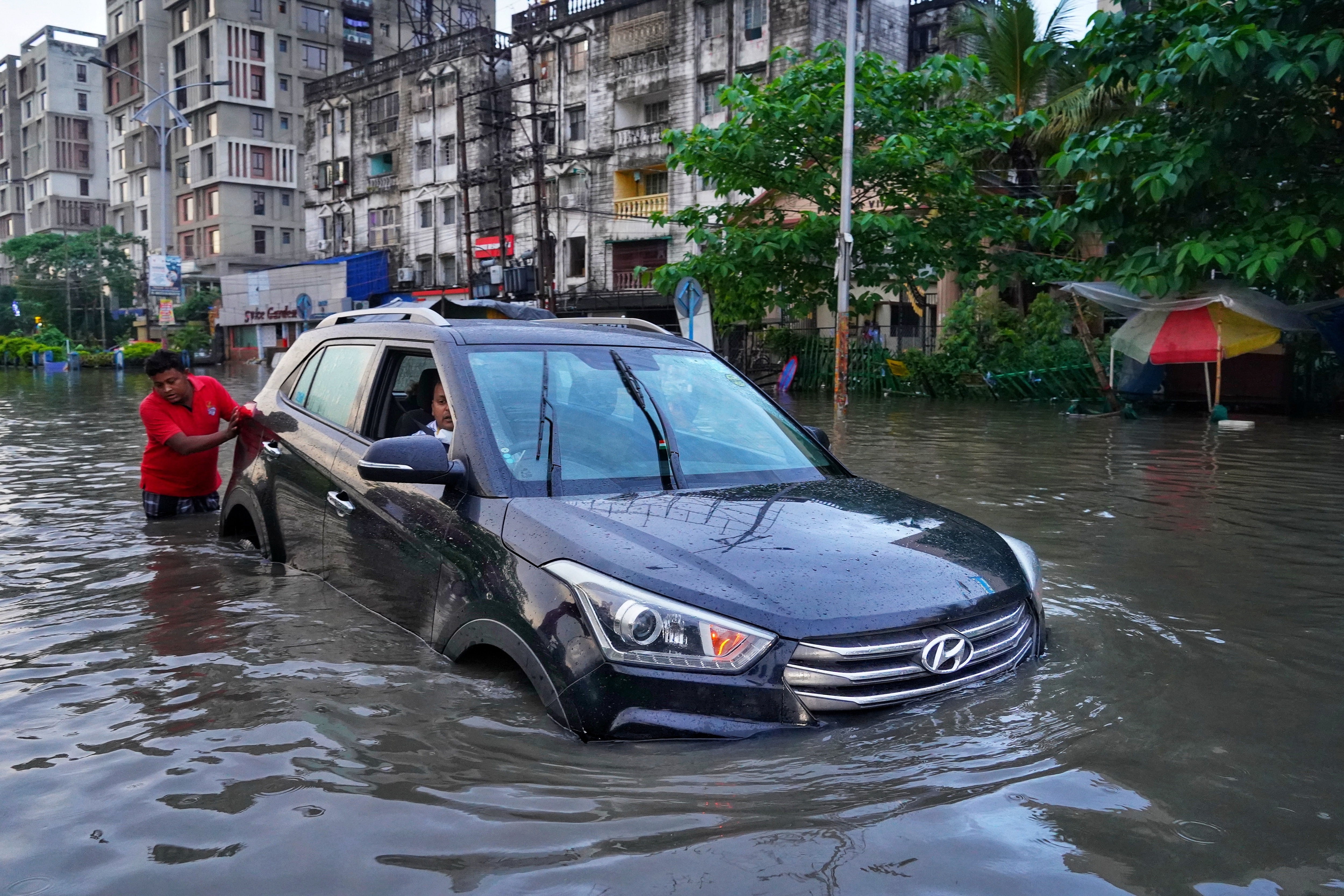
It has been close to a fortnight since the record rains that lashed Bengaluru city left the eastern part of the metropolis drowned. Everyone knew why this part of the city—housing some of the world's leading tech companies, posh apartments, middle-classes houses and slums alike—submerged in waist-high water: unplanned development, encroached drains, covered up lakes, cutting down of trees. All an invitation to disaster. The massive flooding happened following relentless rains that poured on the city starting Sept. 4.
However, unlike the lofty statements made by those in power immediately after the devastation that "no one will be spared", the situation on the ground has not changed much save a few broken pieces of concrete of compound walls, gates of residential buildings etc., built on the Rajakaluves or storm water drains.
Basavaraj Bommai, chief Minister of southern Indian state of Karnataka (whose capital city is Bengaluru), had declared as the disaster struck the city, "all the encroachments will be removed without any mercy. I will personally go and inspect. This time, encroachments will be cleared in a big way. Drive will not stop until the last encroachment is cleared. There will be no discrimination".
But on Sept 14, he sang a different tune: “We will adopt a humane approach. We will see if buildings can be saved if SWDs on which they stand, can be shifted”.
There were allegations from those whose house compound walls were broken down that the government has left the swanky offices of the IT companies and posh villas untouched though they were prime violators. Bulldozers, which stormed the relatively small houses without the Bruhat Bengaluru Mahanagara Palike serving them notice, waited endlessly to enter the gates of guilty glass-fronted offices of software giants.
Bagmane Developers, which owns Bagmane Tech Park, moved the Lokayukta, the corruption watchdog, against the proposed demolition. Mohammed Nalapad, a Congress leader and son of city Member of the Legislative Assembly MA Harris, got into a verbal match with a police officer. His Nalapad Academy, an educational institution, is one of the violators.
These and more slowed down the demolition operations.
Wipro said it would voluntarily remove encroachments. There was no word from the other IT biggies—list of encroachers includes the who's who of Bengaluru's tech world.
While hardly anybody cared or media wrote/showed slums whose dwellers were the worst affected as they lost everything, some affected house owners raised questions for which no one would perhaps have answers. They asked: “We have clearances from all government agencies including from BBMP to build our respective houses, got house plan approvals, received occupancy certificates, paid all taxes and got electricity and water connections, all legally done. The BBMP raised no objection then. Now, suddenly, we are told we have built houses on rajakaluves. How is this possible? We built these houses with bank loans for which we are paying EMIs. Now, if the houses are demolished, we will not only lose our houses, we need to continue paying EMIs”.
Bengaluru, India's Silicon Valley, is home to some 3,500 IT companies and around 80 tech parks. Many of these are situated in the east and south-eastern parts of the city (which inundated unlike other parts of the city). This part saw rapid development over the last two decades but brought with it haphazard growth ignoring the basic needs of civic infrastructure.
After the floods and shortly before the list of big encroachers were made public, the Outer Ring Road Companies Association (ORRCA) members met the authorities to demand a separate municipal zone for the 17-km stretch that comprises the IT corridor. They asked the government to bring out an action plan to decongest the IT corridor and advocated a “zero-tolerance policy” for encroachments.
The encroachment is not a new phenomenon, and there are many cases in the court dating back to 2011. In June 2019, the Karnataka High Court directed the BBMP to conduct survey of SWDs as well as to remove encroachments. But BBMP went into a slumber. The petitioner moved the court saying nothing was done so far to remove them. The court last week directed the BBMP: “Take immediate steps for removal of all encroachments on SWDs and submit up-to-date status report on or before next date of hearing of Oct 12.” In July 2022, the court observed that the building bye-laws were “flouted with impunity by the property owners as well as the engineers concerned responsible for implementation of the bye-laws”. Separately, the Lokayukta is handling at least 400 cases against city's illegal constructions.
According to an estimate, around 85% of the buildings constructed during the 18-month period between January 2020 and June 2021 are said to have violated building byelaws. In some BBMP zones, violations top a shocking 100%.
Time and again, several committees were set up on land encroachments but each time the government turned a deaf ear on their recommendations.
AT Ramaswamy, chairman, Joint Legislature Committee, formed to look into encroachment of government land in and around Bengaluru, found that 34,000 acres of land was encroached upon. A taskforce, which was constituted under retired IAS officer V Balasubramanian, found the total extent of encroachment to be 90,000 acres. The committee under KB Koliwad, former Speaker of the Karnataka Legislature Assembly, found that in Bengaluru district alone, of the 28,000 acres of lake bed of 837 lakes, 4533 acres were encroached. Many of the top IT companies are said to be sitting on these lakebeds.
The BBMP is understood to have found in a survey that of the 201 lakes in Bengaluru, only 20 are fully free from encroachments. The government itself has encroached upon 159 lakes.
Thus, ironically, government itself is encouraging illegality. Over the years, it came up with and refined a scheme regularising illegal buildings and structures built on encroached land. The scheme was called “Akarma-Sakrama” and was first brought in by the BS Yediyurappa government of the BJP in 2010.
The Congress government of Siddaramaiah was no better as he continued it in 2016. Thanks to this, anywhere you go in this India's fast-growing metropolis, you can find these illegal structures/buildings. The builders/owners construct the building with gay abandon, sure that it would one day be regularised under Akarma-Sakrama.
The scheme is seen as a boon to the developers/owners of illegal structures even as honest owners who follow rules feel it is not worth following the rules. However, after a petition questioning this scheme in the Supreme Court by two NGOs, the top court gave a stay in 2019. The government which was so far thinking of pushing ahead with the ill-thought of scheme, is now understood to be abandoning such a move.
With buildings coming up on SWDs, as many as 45% of them are said to be encroached. The city, BBMP says, has 696 SWD encroachments and in 300 of these, permanent structures such as houses and other buildings have come up. A majority of these 300 buildings are situated in east Bengaluru, the IT hub.
Some years ago, an encroachment drive, initially carried out with lofty statements from the government, came to a halt as it reached the house of a popular film hero and a hospital owned by a senior Congress leader.
“Rampant unplanned and uncontrolled development, concretisation and land use changes have increased the incidents of flooding in the city due to an increase in short duration high-intensity precipitation events in recent years”, says India Water Portal, a website that shares knowledge and builds communities around water and related issues.
Writing the article, Aarti Kelkar Khambete offered some solutions:
Put better forecasting mechanisms in place
Set up early warnings and forecasting systems to alert public as well as other stakeholders involved
Improve old drainage systems, including more storm water drains, prevent rainwater from mixing with sewage, ensure regular cleaning up of storm water drains etc
Have better management of solid and liquid wastes, and
Conduct regular desilting and improving connectivity.
One hopes that the government, at least now, gets serious in removing the encroachments considering the havoc that its omissions and commissions have caused over the years.
BS Arun is a senior journalist based in Bengaluru.
The views expressed here are those of the author, and do not necessarily represent the views of BQ Prime or its editorial team.

-
Indians Are Travelling, But Not Every Journey Is A Holiday | The Week In Whys

Pilgrims, patients and working women are the real travellers, and the system hasn't quite caught up with them.
-
Getting To Work Costs Women More | The Reason Why
It is not just about women paying more than men. It is about women paying much more in cities than in villages.
-
AI Bias In Investing Cannot Be Eliminated, But It Can Be Governed
Framing is a particularly important example as identical financial information presented in terms of gains rather than losses can lead an LLM to reach a different assessment.
-
Joining The Dots | Dark Skies, Steady Diya: Why Hope Holds This Diwali
With war, a weak rupee and foreign outflows weighing on sentiment, policymakers at the NDTV World Summit and market veterans at NDTV Profit Ignite: Diwali Edition offered the same advice: stay invested and filter out the noise.
-
The Curious Case of Equitas Small Finance Bank And A CEO Who Quit For Stock
PN Vasudevan believes persistent investor concerns over a perceived conflict of interest had become a governance overhang on Equitas Small Finance Bank's stock, even as the lender improved profitability and asset quality.
-
Talking Points This Week: AI Cash Burn, A Tiger Comeback And An India That Still Finds Its Own Path
India is not immune to higher oil or tighter global liquidity, yet its earnings base is broader, its domestic policy levers are still available.
-
Foreign Investors Own Half Of HDFC Bank and ICICI Bank. An LTCG Cut Could Matter Most Here
Foreign portfolio investors have US$115 billion parked in HDFC Bank, ICICI Bank. If the government cuts long-term capital gains tax, Jefferies says returning foreign money could land here first.
-
'Never Seen This Level Of Negativity': Sandeep Tandon Says The Next Rally May Be Closer Than You Think
Veteran investor Sandeep Tandon says foreign selling is easing, large-caps are due a comeback and mid-caps are crowded, while he turns positive on gold, power and pharma this Diwali.
-
Indians Stay With Family, Not In Hotels | The Reason Why
India still lacks enough clean, reliable and affordable hotels for budget-conscious travellers.
-
The Economic Imperative: Analysing The Material Driving Force Behind India-Canada Strategic Reset
This economic complementarity is further reinforced by deep institutional investment ties and talent mobility, which form the bedrock of the bilateral framework.










