Barclays Axes 19,000 jobs, Reins in Wall Street Ambitions
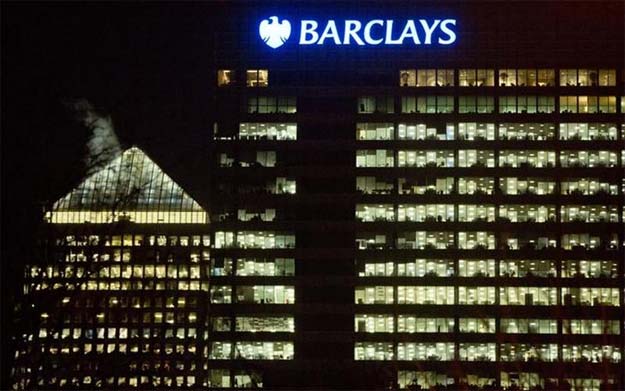
Britain's Barclays reined in its ambitions to be a Wall Street powerhouse on Thursday and signalled a return to its retail roots with a plan to hive off much of its investment bank and axe one in four jobs at the division.
Chief executive Antony Jenkins, in his second strategic review in as many years, will cut 19,000 jobs in the next three years, 7,000 of them at the investment bank, and park 400 billion pounds of assets in a new "bad bank".
A slide in trading revenue due to investor uncertainty and tough post-crisis regulation combined with a string of senior staff departures and a row with shareholders over bonuses have forced Jenkins to take a knife to the investment bank, built up under predecessor Bob Diamond and once the firm's profit engine.
Jenkins said the recent halt in the trading boom was not just a cyclical ebb but was partly permanent, as regulators have tightened the screws on large banks in the past 12 months, making some trading activities too costly to pursue.
"We will refocus and resize our investment bank to bring balance to Barclays," he told analysts and investors. "As currently constituted, it is an unacceptable drag."
Barclays will park some 90 billion euros worth of risk-weighted assets from the investment bank in the bad bank, including some commodities and emerging markets products and some of its derivatives book.
The move echoes UBS, which in 2012 decided to exit the riskiest fixed-income trading areas and set up a non-core division to house around 90 billion Swiss francs of mainly investment banking risk-weighted assets. Since the creation of its in-house bad bank, UBS's shares have risen nearly 40 per cent.
Barclays' investment bank will be left with 120 billion euros of risk-weighted assets and, while significantly smaller than US players such as JP Morgan, will still be the largest investment bank in Europe with more assets than the "core" businesses of Deutsche Bank and Credit Suisse after they also streamlined their operations.
Barclays bought the flagship US brokerage arm of Lehman Brothers when the investment bank collapsed in 2008. Although there were some job losses during the integration into Barclays, the move brought thousands of former Lehman employees into the Barclays Capital business, many at a senior level within the combined firm.
Shares Jump
Barclays shares were the top gainer in Britain's FTSE 100 index and an index of European banking stocks, leaping more than 7 per cent to a near three-month high of 261.20 pence as investors digested the bank's pledge to boost shareholder returns with its more simplified business.
Barclays kept a targeted dividend pay-out ratio of 40 to 50 per cent of net profit and is aiming to deliver a return on equity (RoE) in its core business of over 12 per cent. Its RoE was just 4.5 per cent last year.
Not all investors were impressed, however.
"When you're dealing with Barclays, it's very much a work in progress," said Ed Shing, global equity portfolio manager at BCS Asset Management, who does not hold Barclays in his fund.
"I think they'll concentrate more on equities but the problem is you'll see a lot of revenue shortfall in the other areas as they go through the necessary pruning and withdrawal from the Bob Diamond empire. And I think that's a lot of disruption still in the pipe."
Despite Thursday's share jump, Barclays is the third worst performing banking stock in Europe after HSBC and Deutsche Bank, down over 10 per cent so far this year.
Barclays' investment bank will concentrate on its core markets of the United States and the UK and the top 1,000 clients who generated more than three quarters of revenue last year.
The carve-up means the investment bank will account for no more than 30 per cent of Barclays' risk-weighted assets, down from half now. It gives greater prominence to Barclays' retail operations in Britain, its Barclaycard credit card arm and its African business.
Jenkins is also parking all of Barclays' European retail banking operations in Italy, France, Spain and Portugal, and some corporate and Barclaycard assets in the bad bank. He said parts of the European operations could be sold or floated.
Outside of the investment bank, around half of the job cuts will be from branches in UK, Europe and Africa with most of the remainder slashed from operations and IT.
Challenge
Jenkins, the former head of Barclays' retail business, has set out to turn the group around since taking over as CEO in August 2012 when investment banker Diamond was ousted following a scandal over the rigging of benchmark interest rates.
But Jenkins' plan to drive the bank's returns above its cost of capital - estimated at 11 per cent - has been tripped up by a grim trading environment and uncertainty among staff about his vision for the investment bank, which has prompted the departure of some senior employees.
Jenkins, who had vowed to overhaul Barclays' high-risk, high-reward culture, then got into hot water with investors earlier this year when he raised bonuses for investment bankers despite a fall in profits.
A 41 per cent slide in trading in debt, currencies and commodities in the first quarter, unveiled on Tuesday, put Barclays at the bottom of its peer group and laid bare the challenge he faces.
Since the start of the year, the Federal Reserve has passed tougher rules for foreign banks such as Barclays operating in the United States. The Bank of England has also said it wants British banks to go beyond an international rule on leverage, requiring them to set aside more money to cover future potential loses than foreign rivals.
Bad banks or non-core units have been deployed by a variety of banks in the wake of the financial crisis as a way of drawing a clear line between past business and future direction. They have also been used as a way of hiving off problematic loans, in countries such as Ireland, Spain and, more recently, Italy.
Eric Bommensath, currently co-head of Barclays' investment bank, will run the bad bank. Tom King, Bommensath's co-head, will take over sole responsibility for the investment bank.
As a result of the latest strategic review, Barclays will incur a further 800 million pounds of costs on top of 2.7 billion pounds already announced.
Copyright: Thomson Reuters 2014

-
Indians Are Travelling, But Not Every Journey Is A Holiday | The Week In Whys

Pilgrims, patients and working women are the real travellers, and the system hasn't quite caught up with them.
-
Getting To Work Costs Women More | The Reason Why
It is not just about women paying more than men. It is about women paying much more in cities than in villages.
-
AI Bias In Investing Cannot Be Eliminated, But It Can Be Governed
Framing is a particularly important example as identical financial information presented in terms of gains rather than losses can lead an LLM to reach a different assessment.
-
Joining The Dots | Dark Skies, Steady Diya: Why Hope Holds This Diwali
With war, a weak rupee and foreign outflows weighing on sentiment, policymakers at the NDTV World Summit and market veterans at NDTV Profit Ignite: Diwali Edition offered the same advice: stay invested and filter out the noise.
-
The Curious Case of Equitas Small Finance Bank And A CEO Who Quit For Stock
PN Vasudevan believes persistent investor concerns over a perceived conflict of interest had become a governance overhang on Equitas Small Finance Bank's stock, even as the lender improved profitability and asset quality.
-
Talking Points This Week: AI Cash Burn, A Tiger Comeback And An India That Still Finds Its Own Path
India is not immune to higher oil or tighter global liquidity, yet its earnings base is broader, its domestic policy levers are still available.
-
Foreign Investors Own Half Of HDFC Bank and ICICI Bank. An LTCG Cut Could Matter Most Here
Foreign portfolio investors have US$115 billion parked in HDFC Bank, ICICI Bank. If the government cuts long-term capital gains tax, Jefferies says returning foreign money could land here first.
-
'Never Seen This Level Of Negativity': Sandeep Tandon Says The Next Rally May Be Closer Than You Think
Veteran investor Sandeep Tandon says foreign selling is easing, large-caps are due a comeback and mid-caps are crowded, while he turns positive on gold, power and pharma this Diwali.
-
Indians Stay With Family, Not In Hotels | The Reason Why
India still lacks enough clean, reliable and affordable hotels for budget-conscious travellers.
-
The Economic Imperative: Analysing The Material Driving Force Behind India-Canada Strategic Reset
This economic complementarity is further reinforced by deep institutional investment ties and talent mobility, which form the bedrock of the bilateral framework.










