Banks Wrote Off Bad Loans Worth Over 10 Lakh Crore In Last 5 Financial Years: Minister
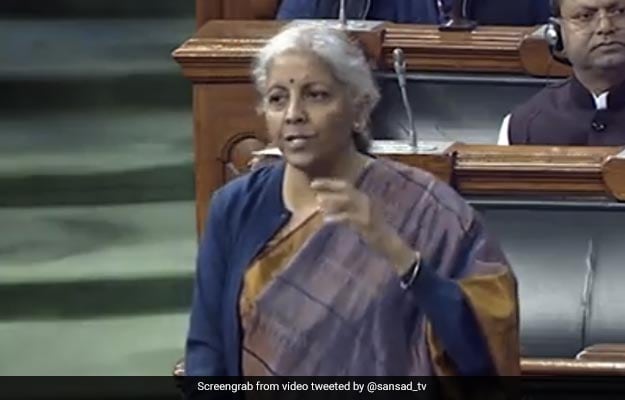
Banks have written off bad loans worth Rs 10,09,511 crore during the last five financial years, Finance Minister Nirmala Sitharaman informed Parliament today.
The non-performing assets (NPAs), including those in respect of which full provisioning has been made on completion of four years, are removed from the balance sheet of the bank concerned by way of write-off, she said in a reply to Rajya Sabha.
"Banks write off NPAs as part of their regular exercise to clean up their balance sheet, avail tax benefit and optimise capital, in accordance with RBI guidelines and policy approved by their boards. As per inputs received from RBI, Scheduled Commercial Banks (SCBs) wrote off an amount of Rs 10,09,511 crore during the last five financial years," she said.
As borrowers of written-off loans continue to be liable for repayment and the process of recovery of dues from the borrower in written-off loan accounts continues, write-off does not benefit the borrower, she said.
Banks continue to pursue recovery actions initiated in written-off accounts through various recovery mechanisms available, such as filing of a suit in civil courts or in Debts Recovery Tribunals, filing of cases under the Insolvency and Bankruptcy Code, 2016 and through sale of non-performing assets.
SCBs have recovered an aggregate amount of Rs 6,59,596 crore, including recovery of Rs 1,32,036 crore from written-off loan accounts during the last five financial years, she said.
In cases where it is prima facie found that officials are responsible for the lapses of non-compliance with the laid down systems and procedures or misconduct or non-adherence to the due-diligence norms, action is initiated against the erring officials under the board-approved staff accountability policy, she said.
As per inputs received from public sector banks, she said, staff accountability in respect of NPA cases has been fixed against 3,312 bank officials (of AGM and above rank) during the last five financial years, and suitable punitive actions have been taken commensurate to their lapses.
Replying to another question, Nirmala Sitharaman said Indian Banks Association (IBA) has informed that at present, only a few banks are using blockchain technology at a small scale.
As such, the issue pertaining to interoperability of such a platform between banks is not present, she said.
Further, she said Indian Banks' Blockchain Infrastructure Company (IBBIC) Private Limited that was incorporated with an objective of providing a platform for exploring, building, and implementing Distributed Ledger Technology (DLT) solutions for the Indian financial services sector, is currently working on scoping the implementation of domestic Letter of Credit (LC) issuance as its first use case through the platform.
The consortium consists of 18 banks comprising leading public and private sector banks of India.
Reserve Bank of India (RBI) has been providing guidance for development of blockchain-based application through its mechanism for testing of innovative technologies, products and services, known as regulatory sandbox.
Blockchain technology has been listed as one of the innovative technologies in this regard, where innovators can apply to test their products through this mechanism, she said.
There is no proposal to set up guidelines or prescribe a model common blockchain technology platform for the banks, she said.
(Except for the headline, this story has not been edited by NDTV staff and is published from a syndicated feed.)

-
We May Need Another Tukaram Mundhe To Fight Air Pollution | The Reason Why

Developers may install basic measures such as sprinklers and green nets, resume work, and continue violating rules when this equipment stops working.
-
Extracting Value From Battery Scrap Could Be Challenging For India | The Reason Why
A discarded lithium-ion battery still contains valuable materials such as lithium, nickel and cobalt. These can be recovered and reused. When such batteries are crushed and shredded, they produce a dark powder called black mass.
-
One El Nino, India Can Handle. Two Could Break The Granary
India's grain stocks can absorb one bad year, but a second El Nino could drain the buffer in two to three years, economists say.
-
India's Troika Of Good Luck | Joining The Dots
As Jensen Huang's exit drags Nvidia down, a cooling AI trade and resilient earnings have revived investor interest in India. A likely RBI rate hike looms.
-
Talking Points This Week: Leadership Shock At Nvidia, Earnings Strength, And The Fog Over Hormuz
The Anthropic IPO pricing and first trading day, Nvidia's upcoming earnings, and any fresh signals from Iran will set the tone for the following week.
-
Signature Play: The Classic Cocktail Is Dead. Or Is It?
Classic cocktails are disappearing from India's cocktail menus. But they're still being ordered, taught to bartenders and borrowed from. So, who's really having the last drink?
-
A New Samvat Wishlist: Inclusive Prosperity And Human Development
India has strengthened its economic foundations through infrastructure, digital access and enterprise. Its next growth chapter must deepen productivity, create better livelihoods and widen participation in prosperity.
-
Love, Sex Aur Dhokha: The Audacious Plot To Spy On Jensen Huang
A Taipei dinner, a Singapore chip buyer and a suspected Chinese asset: inside the alleged spy operation that got close to NVIDIA's Jensen Huang.
-
Ten Things I Learnt This Samvat
Patience can be a trap. Cheap stocks can stay cheap. Leverage can wipe you out. What did Samvat 2082 teach us? Niraj Shah writes on 10 lessons from the year gone by.
-
Talking Points This Week: Tech Nerves, FII Buying, And A Faraway Banking Shock
The global markets are not shining this Diwali. The exception in the large markets is, India.









