Bank Of England Holds Rates, Hints Again At 2018 Rise
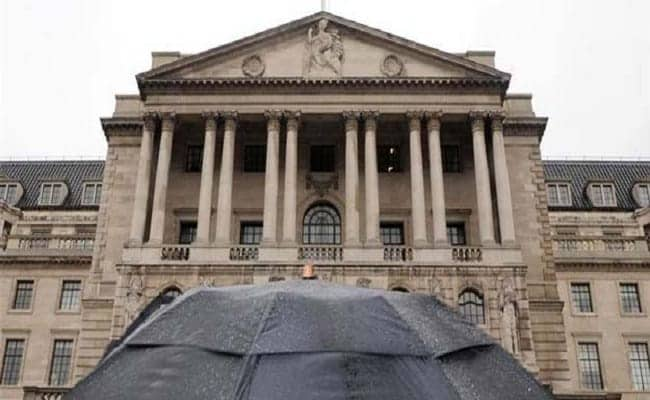
London: The Bank of England kept interest rates at a record low once again on Thursday and trimmed its forecasts for growth in 2017 and 2018 as the impact of Brexit weighed on households' spending power. But BoE Governor Mark Carney and his top officials reiterated their message to financial markets that they might raise borrowing costs by a bit more than investors expect over the next three years, possibly within a year. Faced with uncertainty about the impact of Brexit on the world's fifth-biggest economy, the BoE said its rate-setters voted 6-2 to keep Bank Rate at 0.25 percent, as expected by most economists taking part in a Reuters poll.
The Bank also kept its asset purchase programmes unchanged and said a bank lending scheme would end as previously scheduled in February 2018.
A few weeks ago, investors had begun to price in the chance that the BoE might raise interest rates for the first time in a decade this month.
The speculation was triggered by an unexpectedly close 5-3 vote at the Monetary Policy Committee's last meeting in June when it kept rates on hold.
Since then one of the dissenters, Kristin Forbes, has left the central bank.
At the August meeting, Michael Saunders and Ian McCafferty voted again for a 25 basis point increase in rates.
But BoE Chief Economist Andy Haldane, who said in June that he was likely to back a rate hike in the second half of this year, decided to keep borrowing costs on hold for now.
Reflecting its difficult balancing act - with inflation above its 2 per cent target while growth is slowing - the BoE repeated its message that a rate hike was not off the table.
It said "monetary policy could need to be tightened by a somewhat greater extent over the forecast period than the path implied by the yield curve underlying the August projections", echoing its previous language on rates.
The BoE pointed to expectations in financial markets that rates could start to rise in the third quarter of 2018.
The central bank's message on the economy was similar to the one it gave in May.
The split on the MPC over what to do with interest rates highlights the dilemma facing the central bank.
On the one hand, Britain has avoided the recession that many private sector analysts predicted after the shock referendum decision in June 2016 to leave the European Union, and unemployment is at a four-decade low.
But at the same time, data has shown the economy had its slowest growth since 2012 in the first half of this year and inflation, while still above the 2 per cent target, unexpectedly fell in June.
A series of surveys of Britain's manufacturing, construction and services sectors published this week suggested the economy remained in a low gear in July.
Furthermore, Brexit talks between London and Brussels have made little progress, raising concerns that a messy departure from the bloc in 2019 could hammer the economy.
The BoE said on Thursday it now expected Britain's economy would grow by 1.7 per cent this year, down from its May forecast of 1.9 per cent. It also shaved its growth forecast for next year to 1.6 per cent from 1.7 per cent, but kept 2018 at 1.8 per cent.
In response to painfully slow increases in pay this year, the Bank cut its forecasts for wage growth in 2018 and 2019 to 3 and 3.25 per cent, down by half a percent for each year.
It blamed the downgrade on the uncertain outlook for the economy as Brexit nears and Britain's stubbornly weak productivity.
The BoE lowered by a fraction its forecasts for inflation which it now saw at just under 2.6 per cent in a year's time after peaking at around 3 per cent in October.
British inflation in June stood at 2.6 per cent and the BoE's latest forecasts see it remaining above its 2 per cent target throughout its three-year forecast period.
Helping to offset the squeeze on household spending power, exports were seen growing a bit more strongly than in the BoE's May forecasts. But investment was likely to be weaker than previously expected in 2018 and 2019.
In a nod to the need to rein in some of the huge stimulus push it launched in August last year, shortly after the Brexit vote, the BoE said it would not renew its Term Funding Scheme which encourages banks to lend and is due to expire in February.
However, the ceiling on the TFS scheme was raised to a maximum of 115 billion pounds from 100 billion pounds, reflecting strong demand from banks, the BoE said.

-
Gold Is Rs 22,000 Cheaper Than A Month Ago. Should You Buy Amid The Wedding Season?

Gold's potential slide to $3,500 could save around Rs 4,700 per 10 grams, but a soft inflation print could just as easily push prices back up. One way to split the risk is to buy in parts, some now and the rest after the Fed's Dec. 9 decision.
-
AI Agents Are Gaining Power. Who Governs Them?
Artificial intelligence agents promise to transform productivity by moving machines from assisting decisions to executing them. But as organisations delegate greater authority to these AI-agents, they must first establish who controls that authority and who remains accountable when things go wrong.
-
Why Swapping Your Old Gold Can Trigger A Rs 5 Lakh Tax Bill, And How You Can Avoid It Legally
Swapping old gold for new is taxed as a sale and a fresh purchase. Getting your own gold remade can cut most of that bill, though it has its own costs.
-
The AI Trade is Done. The Real Opportunity for Investors Starts in 2027 | Unhedged Position
As pureplay AI stocks plunge and circular, capex-led financing unwinds, 2027 is set to be a year of reckoning for AI companies. Yet the bust clears the way for a better opportunity for investors in 2027 -- shifting the spotlight from AI builders to the companies using AI.
-
Leadership As Mission: Why The Age Of AI Demands More Human Leadership
Debjani Ghosh examines how AI is changing leadership, arguing that its success must be measured by its impact on people and the accountability of those guiding its use.
-
We May Need Another Tukaram Mundhe To Fight Air Pollution | The Reason Why
Developers may install basic measures such as sprinklers and green nets, resume work, and continue violating rules when this equipment stops working.
-
Extracting Value From Battery Scrap Could Be Challenging For India | The Reason Why
A discarded lithium-ion battery still contains valuable materials such as lithium, nickel and cobalt. These can be recovered and reused. When such batteries are crushed and shredded, they produce a dark powder called black mass.
-
One El Nino, India Can Handle. Two Could Break The Granary
India's grain stocks can absorb one bad year, but a second El Nino could drain the buffer in two to three years, economists say.
-
India's Troika Of Good Luck | Joining The Dots
As Jensen Huang's exit drags Nvidia down, a cooling AI trade and resilient earnings have revived investor interest in India. A likely RBI rate hike looms.
-
Talking Points This Week: Leadership Shock At Nvidia, Earnings Strength, And The Fog Over Hormuz
The Anthropic IPO pricing and first trading day, Nvidia's upcoming earnings, and any fresh signals from Iran will set the tone for the following week.









