Bangladesh Can’t Afford to Let Chaos Reign
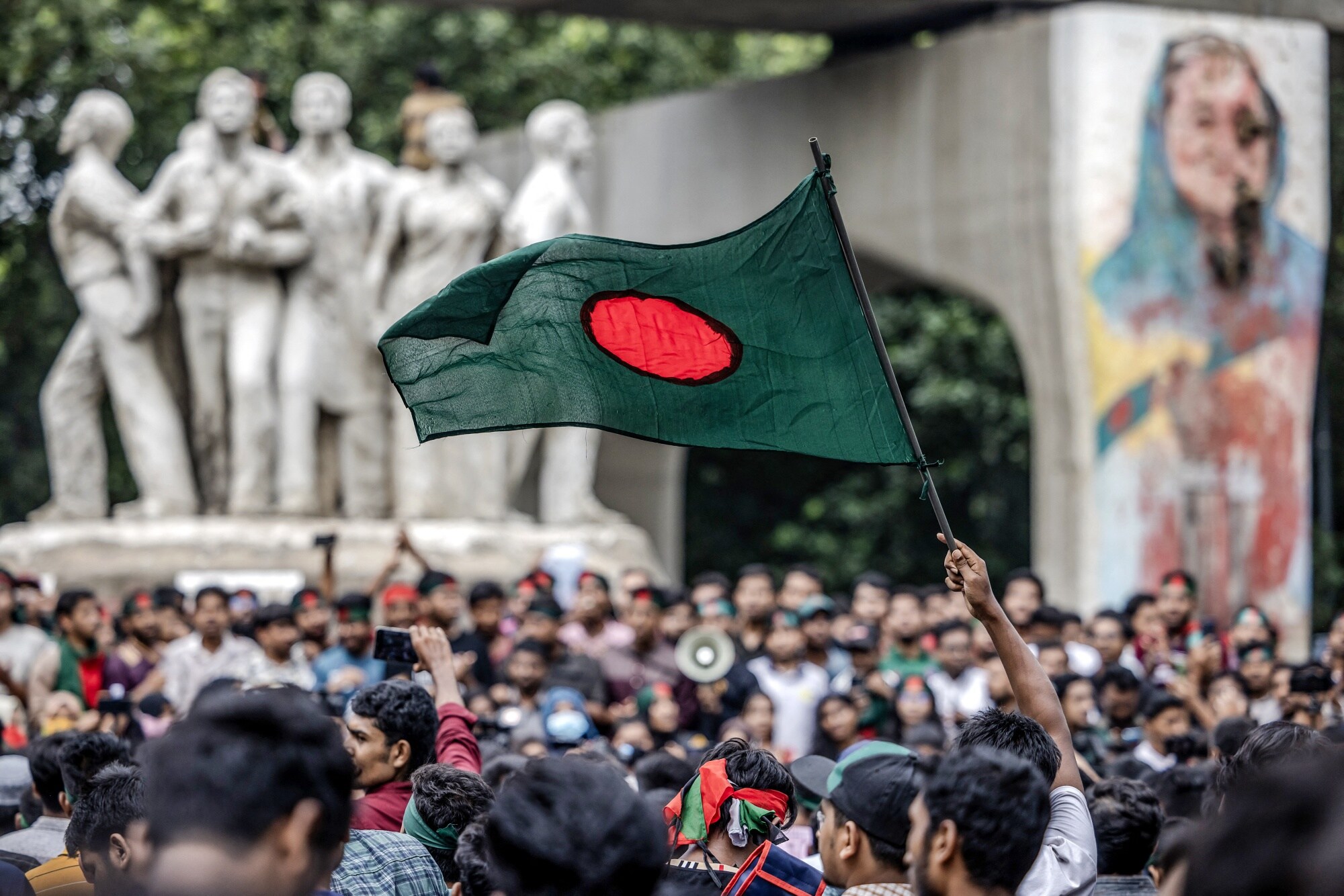
(Bloomberg Opinion) -- The eyes of the world have moved on from Bangladesh, where protests ousted the world's longest-serving female leader earlier this month. It would be a mistake, however, to assume stability has returned to one of the world's most populous countries. The new regime shouldn't underestimate how urgent that task is.
Any expression of concern about Bangladesh's path causes some, particularly in the country's active and vocal diaspora, to fume. A certain amount of turmoil in reaction to former Prime Minister Sheikh Hasina's long and increasingly authoritarian rule is understandable, they argue. And it is true that the arrival of Nobel laureate Muhammad Yunus to lead an interim government has calmed some nerves. The Bangladeshi military seems to be staying in its barracks for now.
Yet such defensiveness is wrong and counterproductive. Vigilantism and extremism cannot be allowed to take over — and there are too many indications that is precisely what is happening.
In particular, there's evidence that Bangladesh's Hindu minority is being singled out for violence. Some have argued that this is because they were steadfast supporters of Sheikh Hasina's Awami League party, not because of their religion. That's hardly a defense.
In fact, there are plenty of other signs that political Islamism, long suppressed by Hasina, is returning. The interim government has lifted a ban on the operations of the country's largest Islamist political force, the Jamaat-e-Islami.
And consider what's happening at universities, always the first target of obscurantists. A mob of students intimidated the dean of Dhaka University into quitting after he prevented a Quran recitation on campus.
Tellingly, the dean was forced to participate in a prayer session immediately after drafting his letter of resignation. Several other university administrators with ties to the old regime have also left or been driven to quit. Organizations linked to the Jamaat-e-Islami have staked a claim to their positions.
The new establishment seems to be weaponizing the judicial system, too. Multiple ministers in past governments have been arrested on what appear, in many cases, to be trumped-up charges. Some have even been assaulted by lawyers while appearing to defend themselves in court. A former Supreme Court judge was beaten badly enough to require hospitalization.
Journalists attempting to leave the country have been arrested at Dhaka airport and had their names added, apparently arbitrarily, to murder investigations. That's allowed authorities to throw them in jail without trial.
Even one of Bangladesh's best-known sportsmen — named by Hasina to Parliament earlier this year — has been implicated in a murder case. He's currently representing Bangladesh on a cricketing tour of Pakistan and was instrumental in an unprecedented victory for the cricket-mad nation this week. That he may nevertheless be arrested on his return is one indication of how unconstrained the anti-Awami factions are feeling.
Already conspiratorial thinking — a curse associated with basket case economies such as Pakistan's — seems to be taking over. When devastating floods hit Bangladesh last week, leaving more than a dozen dead and millions stranded, anti-India protesters immediately (and wrongly) accused New Delhi of releasing dam waters deliberately.
Democracies, from India to the West, cannot be expected to ignore these danger signs. Every day that such tumult continues, Bangladesh loses more investment. One Indian industrialist told Bloomberg News last week that his company was postponing plans for a large new factory in the country.
Bangladesh can ill afford to dismiss such fears. Integration with the world economy has served the country well. Exports, particularly of ready-made garments, have sharply reduced poverty and ensured the country's per capita income is comparable to that of neighboring India.
But this sector, which relies on short-term contracts, is particularly sensitive to political risk and social instability. If Bangladesh turns inward, it could easily lose the gains it has made.
Foreign investors have long appreciated the country's commitment to modernization and secularism. The new government needs to make clear — quickly — that this commitment isn't being abandoned.
It can do that by laying out a timeline for both elections and the restoration of institutional integrity, as well as a commitment to allow the Awami League to participate. Otherwise the interim government risks being seen by the world as no better — and perhaps worse — than the regime it replaced.
Bangladesh's new leaders have won one battle, against a regime that had spent years abusing its authority and eroding its democratic legitimacy. They need to fight another, against the forces of chaos and extremism.
More From Bloomberg Opinion:
- Bangladesh's Failure Must Worry India: Andy Mukherjee
- This Is Not a Happy Ending for Bangladesh: Mihir Sharma
- People Power Has Won in Bangladesh, for Now: Karishma Vaswani
This column does not necessarily reflect the opinion of the editorial board or Bloomberg LP and its owners.
Mihir Sharma is a Bloomberg Opinion columnist. A senior fellow at the Observer Research Foundation in New Delhi, he is author of “Restart: The Last Chance for the Indian Economy.”
More stories like this are available on bloomberg.com/opinion
©2024 Bloomberg L.P.

-
Indians Are Travelling, But Not Every Journey Is A Holiday | The Week In Whys

Pilgrims, patients and working women are the real travellers, and the system hasn't quite caught up with them.
-
Getting To Work Costs Women More | The Reason Why
It is not just about women paying more than men. It is about women paying much more in cities than in villages.
-
AI Bias In Investing Cannot Be Eliminated, But It Can Be Governed
Framing is a particularly important example as identical financial information presented in terms of gains rather than losses can lead an LLM to reach a different assessment.
-
Joining The Dots | Dark Skies, Steady Diya: Why Hope Holds This Diwali
With war, a weak rupee and foreign outflows weighing on sentiment, policymakers at the NDTV World Summit and market veterans at NDTV Profit Ignite: Diwali Edition offered the same advice: stay invested and filter out the noise.
-
The Curious Case of Equitas Small Finance Bank And A CEO Who Quit For Stock
PN Vasudevan believes persistent investor concerns over a perceived conflict of interest had become a governance overhang on Equitas Small Finance Bank's stock, even as the lender improved profitability and asset quality.
-
Talking Points This Week: AI Cash Burn, A Tiger Comeback And An India That Still Finds Its Own Path
India is not immune to higher oil or tighter global liquidity, yet its earnings base is broader, its domestic policy levers are still available.
-
Foreign Investors Own Half Of HDFC Bank and ICICI Bank. An LTCG Cut Could Matter Most Here
Foreign portfolio investors have US$115 billion parked in HDFC Bank, ICICI Bank. If the government cuts long-term capital gains tax, Jefferies says returning foreign money could land here first.
-
'Never Seen This Level Of Negativity': Sandeep Tandon Says The Next Rally May Be Closer Than You Think
Veteran investor Sandeep Tandon says foreign selling is easing, large-caps are due a comeback and mid-caps are crowded, while he turns positive on gold, power and pharma this Diwali.
-
Indians Stay With Family, Not In Hotels | The Reason Why
India still lacks enough clean, reliable and affordable hotels for budget-conscious travellers.
-
The Economic Imperative: Analysing The Material Driving Force Behind India-Canada Strategic Reset
This economic complementarity is further reinforced by deep institutional investment ties and talent mobility, which form the bedrock of the bilateral framework.










