At Yahoo, CEO's pay is tied to another company's performance
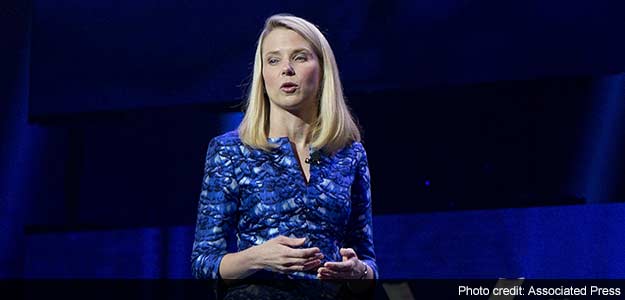
Marissa Mayer has hit it big in the executive compensation lottery.
According to recent public filings and an analysis prepared by Equilar, an executive compensation data firm, by the end of last year, Mayer, the Yahoo chief executive, had received compensation worth potentially $214 million - most of which was for doing nothing.
Her good fortune stems from Yahoo's stake in the Chinese Internet behemoth Alibaba, a deal that was arranged in 2005 by Yahoo's co-founder, Jerry Yang. The enthusiasm and hype over a likely initial public offering by Alibaba has driven Yahoo's stock to a sky-high valuation, a surge that has showered Mayer with vast riches.
Huge compensation packages for corporate chieftains are not uncommon, of course, and remain the subject of a fierce debate. Yet, the example of Mayer highlights the absurdities of executive compensation based on stock prices.
When Mayer was hired away from Google in 2012, it was meant to show that Yahoo, a faltering Internet giant, was again going to be a dynamic and hip place to work. To lure such a rock-star executive, Yahoo awarded her a pay package of $35 million in restricted stock and $21 million in options.
Some $15 million of that was to compensate Mayer for stock and options she forfeited when she left Google. At the time of her hiring, Yahoo shares were trading at $15.78 a share.
Since then, Yahoo's stock has been on a tear, reaching a high of $41.72 before retreating in the recent technology sell-off to about $34. It's up about 140 percent since Mayer arrived.
As a result of the rise in the stock price, Equilar calculates, Mayer's $56 million package had grown to be worth about $186 million as of the end of last year, after Mayer forfeited some of the stock for failure to meet some performance requirements. In addition, Mayer was awarded $12.47 million worth of restricted stock in early 2013 that had grown to $23.7 million by year-end. Add in $4.3 million in cash paid to Mayer, and the figure rises to about $214 million for 15 months of work.
To be sure, for some of this compensation, Mayer will have to stay at Yahoo for another few years and meet performance goals. And Yahoo's stock price will have to stay at this level. Yet $57.8 million worth of Mayer's stock and options already vested last year alone.
By any measure, this was not the value initially intended to be paid to Mayer.
These are estimates, because after spending a few hours with Yahoo's public filings, I found it impossible to calculate an exact figure of her earnings from Yahoo and had to turn to Equilar.
A spokesman for Yahoo declined to comment but directed me to the compensation figures in the proxy.
If you read Yahoo's filing for its shareholder meeting, it states in a summary compensation table that Mayer was paid $61.5 million for 2012 and 2013, an amount the filing notes is based not on the current value of Mayer's compensation but the value when granted. Nowhere does it say with a single number what Mayer's package is worth as of year-end or even what she actually made last year - that $57.8 million figure.
A paycheck of more than $200 million is sweet, but the problem is that the value is not primarily a result of anything she has done as chief executive. Yahoo continues to struggle - its revenue last year was $4.68 billion, down from $4.98 billion in 2012. In the first quarter of 2014, Yahoo's income fell 84 percent, to $30 million from $186 million in the quarter a year earlier.
Moreover, there has been a bit of turmoil in Yahoo's executive suites. Mayer's trusted lieutenant, Henrique de Castro, who was hired to assist the turnaround, was recently fired as chief operating officer.
Still, Mayer has some achievements at Yahoo. She has revamped products and replaced much of Yahoo's staff while reversing two years of losses in the number of people using its sites and services. All told, it's too soon to know what will happen to Yahoo, and certainly those gains are not what is driving its stock price up right now.
For now, however, Yahoo still holds its crown jewel, its stake in Alibaba.
Yahoo initially bought 40 percent of the Chinese company in 2005. Yahoo sold part of it back to Alibaba in 2012 for $7.6 billion, but retained a 24 percent stake.
Since then, Alibaba has been growing rapidly and is expected to go to market in the coming months in an IPO that may value the company at more than $150 billion, and Yahoo's stake at $36 billion.
Simply put, without Alibaba, Mayer's options would probably be close to worthless and her package would be worth about $10 million.
In other words, Alibaba has most likely added most of the money to Mayer's pocket from a pay package intended to provide performance incentives.
Despite the good luck of Mayer and others, option and incentive compensation persist, spurred by government subsidies through favorable tax treatment and the fact that, unlike cash, stock compensation appears to cost the company very little to award. Not only that, companies are not required to disclose how much they miss the mark in awarding initial compensation.
It's time to recognize that stock-based compensation can often be no more than casino chips. Stock is easy for a board to hand out without regard to the true cost, creating a huge win for executives in a game stacked in the chief's favor.
Mayer's case is extreme, but it shows it is time to rethink all stock compensation. Instead, executives can simply be paid in cash based on their effort - a novel concept to be sure.
© 2014, The New York Times News Service

-
The Curious Case of Equitas Small Finance Bank And A CEO Who Quit For Stock

PN Vasudevan believes persistent investor concerns over a perceived conflict of interest had become a governance overhang on Equitas Small Finance Bank's stock, even as the lender improved profitability and asset quality.
-
Talking Points This Week: AI Cash Burn, A Tiger Comeback And An India That Still Finds Its Own Path
India is not immune to higher oil or tighter global liquidity, yet its earnings base is broader, its domestic policy levers are still available.
-
Foreign Investors Own Half Of HDFC Bank and ICICI Bank. An LTCG Cut Could Matter Most Here
Foreign portfolio investors have US$115 billion parked in HDFC Bank, ICICI Bank. If the government cuts long-term capital gains tax, Jefferies says returning foreign money could land here first.
-
'Never Seen This Level Of Negativity': Sandeep Tandon Says The Next Rally May Be Closer Than You Think
Veteran investor Sandeep Tandon says foreign selling is easing, large-caps are due a comeback and mid-caps are crowded, while he turns positive on gold, power and pharma this Diwali.
-
Indians Stay With Family, Not In Hotels | The Reason Why
India still lacks enough clean, reliable and affordable hotels for budget-conscious travellers.
-
The Economic Imperative: Analysing The Material Driving Force Behind India-Canada Strategic Reset
This economic complementarity is further reinforced by deep institutional investment ties and talent mobility, which form the bedrock of the bilateral framework.
-
Medicine Pricing: Where Must Profit Stop?
India must confront excessive margins, hidden incentives and regulatory gaps that threaten the integrity of medicine.
-
Why Amazon And Flipkart Are Struggling To Beat Meesho In India's Smaller Cities
With 274 million users and lowest-cost logistics, Meesho is defending its value commerce crown against giants like Amazon and Flipkart.
-
High US Salaries, No Green Card Certainty: The Financial Calculation Facing Indian H-1B Families
The suspension of PERM processing at eight technology employers does not cancel existing H-1B visas. What it does is force a question many Indian families have been avoiding: is the US salary worth tying your career and family plans to one employer?
-
Swiggy vs Eternal: Food Delivery's Two Rivals Are No Longer In The Same Race
Eternal is building a private AI assistant, dark.ai. Swiggy is still working out how to make Instamart pay, with an operating loss of Rs 895 crore in the July-September quarter while Blinkit stayed profitable.










