Asian Stocks Hit Four-month Lows as HK Seethes, Dollar Shines
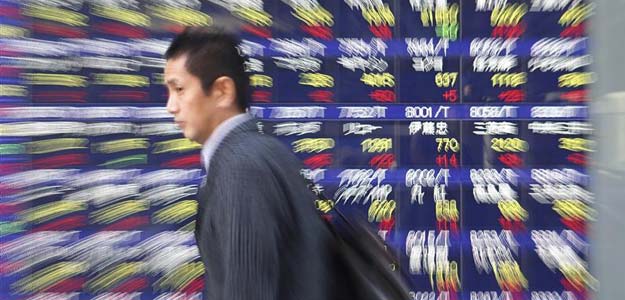
Asian stocks stumbled to a four-month low on Monday as political unrest in Hong Kong rattled investors, while the US dollar basked in the afterglow of data showing the world's biggest economy on a strong footing.
Hong Kong shares dropped 2.3 per cent to three-month lows in the worst unrest since China took back control of the former British colony two decades ago.
In Europe, shares prices are expected to rise in sympathy with the rebound in US stocks on Friday following upbeat revised second quarter US growth figures.
Asia, however, failed to ride on Wall Street's performance, with the MSCI's broadest index of Asia-Pacific shares outside Japan dropping 1.3 per cent, hitting its lowest level since mid-May.
Even the usually calm Hong Kong-dollar, which is pegged to a narrow band against the US dollar, slipped 0.1 per cent to 7.761 against the greenback, its lowest level since March, as the street clashes affected some banks' operations.
"We consider the peg (to the US dollar) virtually unbreakable but (today's fall in the spot price) is a warning that financial markets and the economy are vulnerable to political uncertainty," said Tim Condon, Asia economist at ING.
Offshore yuan traded at 6.1545 to the dollar, slightly weaker than Friday but off the six-week low of 6.1787 hit earlier this month.
Markets in mainland China fared better, with Shanghai shares little changed near 1 1/2-year highs.
Japan's Nikkei average also rose 0.5 per cent, with the yen's weakness flattering the export sector.
The dollar index rose as high as 85.779, its highest since July 2010, in early trade after having posted an 11th straight week of gains last week, extending the longest winning streak since its 1971 uncoupling from gold.
The US Commerce Department on Friday raised its estimate of gross domestic product growth to an annualised 4.6 per cent, the fastest pace in 2-1/2 years, and accelerating from the 4.2 per cent reported last month.
The data reinforced the perception that the United States is the brightest spot in the global economy, with the Federal Reserve on course to raise interest rates while other major central banks need to enact more stimulus to support growth.
"Given that the Federal Reserve is on track to normalise its policy, you can't bid up stocks and bonds too much. In a way, investors had nothing to do but to buy the dollar," said Tohru Yamamoto, chief strategist at Daiwa Securities.
The euro dropped to a 22-month low of $1.2664 and last stood at $1.2667, 0.2 per cent below late US levels on Friday.
Against the yen, the dollar rose to six-year high of 109.74 yen. The Australian dollar dropped to as low as $0.8684, its lowest level in almost eight months and coming within sight of its January low of $0.8660.The New Zealand dollar also dropped to a one-year low of $0.7708 after Reserve Bank of New Zealand data showed that the central bank had sold the currency on the open market last month to accelerate its fall from historic highs.
US debt yields were little changed, with the 10-year yield at 2.529 per cent.
The market is gripped by jitters that Pimco may sell more bonds if investors pull out funds from its flagship bond fund, the world's biggest bond fund, after its chief investment officer Bill Gross left the company.
"Now that one of the biggest bond bulls in the market has stepped down from the helm, the market may be questioning what strategic direction PIMCO will take, particularly in regard to the new neutral credo," analysts at Societe Generale said in report.
Elsewhere, copper futures price fell to three-month lows of $6,666.0 per tonne, extending their losses on worries over an expected supply surge and weak demand from top consumer China.
Copyright: Thomson Reuters 2014

-
We May Need Another Tukaram Mundhe To Fight Air Pollution | The Reason Why

Developers may install basic measures such as sprinklers and green nets, resume work, and continue violating rules when this equipment stops working.
-
Extracting Value From Battery Scrap Could Be Challenging For India | The Reason Why
A discarded lithium-ion battery still contains valuable materials such as lithium, nickel and cobalt. These can be recovered and reused. When such batteries are crushed and shredded, they produce a dark powder called black mass.
-
One El Nino, India Can Handle. Two Could Break The Granary
India's grain stocks can absorb one bad year, but a second El Nino could drain the buffer in two to three years, economists say.
-
India's Troika Of Good Luck | Joining The Dots
As Jensen Huang's exit drags Nvidia down, a cooling AI trade and resilient earnings have revived investor interest in India. A likely RBI rate hike looms.
-
Talking Points This Week: Leadership Shock At Nvidia, Earnings Strength, And The Fog Over Hormuz
The Anthropic IPO pricing and first trading day, Nvidia's upcoming earnings, and any fresh signals from Iran will set the tone for the following week.
-
Signature Play: The Classic Cocktail Is Dead. Or Is It?
Classic cocktails are disappearing from India's cocktail menus. But they're still being ordered, taught to bartenders and borrowed from. So, who's really having the last drink?
-
A New Samvat Wishlist: Inclusive Prosperity And Human Development
India has strengthened its economic foundations through infrastructure, digital access and enterprise. Its next growth chapter must deepen productivity, create better livelihoods and widen participation in prosperity.
-
Love, Sex Aur Dhokha: The Audacious Plot To Spy On Jensen Huang
A Taipei dinner, a Singapore chip buyer and a suspected Chinese asset: inside the alleged spy operation that got close to NVIDIA's Jensen Huang.
-
Ten Things I Learnt This Samvat
Patience can be a trap. Cheap stocks can stay cheap. Leverage can wipe you out. What did Samvat 2082 teach us? Niraj Shah writes on 10 lessons from the year gone by.
-
Talking Points This Week: Tech Nerves, FII Buying, And A Faraway Banking Shock
The global markets are not shining this Diwali. The exception in the large markets is, India.









