Arun Jaitley's Disinvestment Programme Raises Capital Market Ambitions
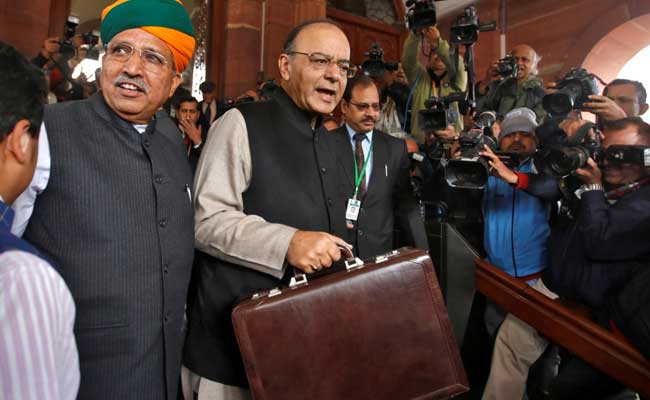
Singapore: Government has unveiled its most ambitious target for public share sales so far, looking to capitalise on the robust domestic capital markets to cut its annual deficit.
In last week's Union Budget, Finance Minister Arun Jaitley set a Rs 72,500 crore target for divestment in the 12 months from April 1, up from a revised Rs 45,500 crore goal in the current fiscal year.
The government intends to raise Rs 11,000 crore from the listing of state-owned insurance companies, Rs 46,500 crore from the sale of stakes in state-owned companies on local stock exchanges and Rs 15,000 crore from strategic sales in 2017-18.
Analysts and investors welcomed the budget, sending stocks and bonds broadly higher on promises of tax cuts and a lower fiscal deficit. However, the statement makes it clear that the capital markets will play a far greater role in the country's finances than in previous years.
Mr Jaitley proposed stock-market listings for three units of the state-owned Indian Railways and pledged to use more exchange traded funds to hold stakes in public-sector companies.
The government also announced a lower-than-expected recapitalisation plan for state-owned banks, putting the sector under more pressure to tap the capital markets for funds.
Including the insurance listings, the 2017-18 divestment target is more than double the Rs 30,900 crore raised in the current fiscal year through stake sales and buybacks in state-owned companies, including a Rs 3000 crore stake in Larsen & Toubro held through the Specified Undertaking of Unit Trust of India ETF.
Rating agency Icra said the divestment target appeared high, but its achievement "would be crucial to ensure the budgeted reduction in the fiscal deficit and the lower than expected gross borrowing figure".
According to Nomura, the divestment target is optimistic and "some shortfall, as is the norm every year, is likely".
RAIL FLOATS
The proposed listings of Indian Railway Catering and Tourism Corporation, Ircon International and Indian Railway Finance Corporation could net the government a total of Rs 10,000 crore- Rs 15,000 crore, according to early estimates of bankers.
IRCTC handles the catering, ticketing and tourism operations of state-owned Indian Railways and is the country's largest online ticketing company. Ircon is an engineering and construction entity specialising in transport infrastructure, and IRFC is Indian Railways' financing arm.
The spin-offs are by no means straightforward. While the budget reveals plans to list IRCTC, it has also done away with the service charge on online bookings, which contributes nearly a third of IRCTC's revenue. In the financial year to March 31 2016, IRCTC reported a net profit of Rs 180 crore on revenue of Rs 1,500 crore.
"At this rate, the listing of IRCTC will be a non-starter," said one ECM banker.
Bankers have said the listings of these units are a long way off as the government has to get the assets valued properly. Also, at this stage, it is unclear if the listings will be done through strategic sales or IPOs.
While government has successfully sold stakes in state-owned companies through offers for sale, it has been slow to complete IPOs. Floats announced in Hindustan Aeronautics and Rashtriya Ispat years ago have yet to be completed. Last year, it initiated plans to sell stakes in Cochin Shipyard and Housing and Urban Development Corporation for a total of $300 million through IPOs. The government's deadline for the IPOs is March 31.
INSURANCE IN VOGUE
The Rs 11,000 crore target for insurance sector listings builds on January's announcement of plans to sell, in stages, 25 percent stakes in each of General Insurance Corporation, National Insurance, New India Assurance, Oriental Insurance and United India Insurance. GIC and NIA are seen as the strongest candidates and expected to list first.
India's insurance regulator last year recommended that all companies under its charge should, at a certain stage of maturity, complete IPOs to improve their access to regulatory capital.
After the successful Rs 6,000 crore follow-on offering of the CPSE-Exchange Traded Fund in January, the government plans to set up another ETF of state-owned companies and other private-sector entities in which it owns stakes in the 2017-2018 fiscal year.
BANK CAPITAL
Arun Jaitley allotted just Rs 10,000 crorefor the recapitalisation of public-sector banks, potentially pushing more to tap the capital markets for regulatory capital as their asset qualities are expected to deteriorate after last November's demonetisation.
"We believe banks need three times the allotted capital if they have to make provisions and grow at around 10 percent," said Saswata Guha, a director at Fitch Ratings.
Independent research provider CreditSights has said banks will have to raise Rs 80,000 crore in equity capital over the next two years to meet Basel III requirements. State-owned banks have been finding it hard to sell shares as investors have demanded steep discounts. As a result, most of these issues will involve AT1 bonds.
Some banks are already chalking out plans for AT1 offerings.
"We are planning to raise 20 billion rupees from AT1 bonds in the near term as there is appetite," said a source at state-owned Bank of Baroda.
The budget also proposed the listing and trading of security receipts (SRs), which asset reconstruction companies issued when purchasing banks' bad loans.
"If SRs can be listed, it creates more opportunities for banks to sell them off and remove the risk from their books," said Ben You Ang, research analyst at CreditSights.
POSITIVE BUDGET
The initial response to the budget statement has been positive.
Economists took comfort in the government's commitment to financial discipline, with a fiscal deficit target of 3.2 percent for 2017-18 versus 3.5 percent in 2016-17 and a new fiscal roadmap for a reduction in government debt to 60 percent of GDP from 66 percent in 2023.
Equity market participants were relieved at the absence of much-feared taxation measures on long-term capital gains and the securities transactions. The budget also did its bit for the IPO market in allowing selected non-banking finance companies to invest in IPOs under the Qualified Institutional Buyer category. Currently, only banks and insurance companies are categorised as QIBs.
Banking stocks rallied on hopes of a revival in credit growth on the back of higher spending and tax cuts for individuals and small businesses. Foreign institutional investors also welcomed the extension of the concessional 5 percent withholding tax until 2020 on sovereign rupee bonds.
"The reduced tax rate puts India more in line with other comparable government bond markets," said Teresa Kong, portfolio manager at Matthews Asia.
Kong pointed out that the government's efforts to improve transparency, digitalisation and curb black money were other positives in the budget.
The budget limited cash donations to political parties to 2,000 rupees, and proposed electoral bonds to bring bigger donations into the banking system. The details are not yet clear, but the scheme calls for individuals to make donations to political parties by buying bonds from banks, which the parties can then encash with the banks.
"I never heard of an electoral bond before," said one investment banker. "It is a novel concept."

-
We May Need Another Tukaram Mundhe To Fight Air Pollution | The Reason Why

Developers may install basic measures such as sprinklers and green nets, resume work, and continue violating rules when this equipment stops working.
-
Extracting Value From Battery Scrap Could Be Challenging For India | The Reason Why
A discarded lithium-ion battery still contains valuable materials such as lithium, nickel and cobalt. These can be recovered and reused. When such batteries are crushed and shredded, they produce a dark powder called black mass.
-
One El Nino, India Can Handle. Two Could Break The Granary
India's grain stocks can absorb one bad year, but a second El Nino could drain the buffer in two to three years, economists say.
-
India's Troika Of Good Luck | Joining The Dots
As Jensen Huang's exit drags Nvidia down, a cooling AI trade and resilient earnings have revived investor interest in India. A likely RBI rate hike looms.
-
Talking Points This Week: Leadership Shock At Nvidia, Earnings Strength, And The Fog Over Hormuz
The Anthropic IPO pricing and first trading day, Nvidia's upcoming earnings, and any fresh signals from Iran will set the tone for the following week.
-
Signature Play: The Classic Cocktail Is Dead. Or Is It?
Classic cocktails are disappearing from India's cocktail menus. But they're still being ordered, taught to bartenders and borrowed from. So, who's really having the last drink?
-
A New Samvat Wishlist: Inclusive Prosperity And Human Development
India has strengthened its economic foundations through infrastructure, digital access and enterprise. Its next growth chapter must deepen productivity, create better livelihoods and widen participation in prosperity.
-
Love, Sex Aur Dhokha: The Audacious Plot To Spy On Jensen Huang
A Taipei dinner, a Singapore chip buyer and a suspected Chinese asset: inside the alleged spy operation that got close to NVIDIA's Jensen Huang.
-
Ten Things I Learnt This Samvat
Patience can be a trap. Cheap stocks can stay cheap. Leverage can wipe you out. What did Samvat 2082 teach us? Niraj Shah writes on 10 lessons from the year gone by.
-
Talking Points This Week: Tech Nerves, FII Buying, And A Faraway Banking Shock
The global markets are not shining this Diwali. The exception in the large markets is, India.









