Arun Jaitley May Lower Corporate Tax In Budget: Deloitte
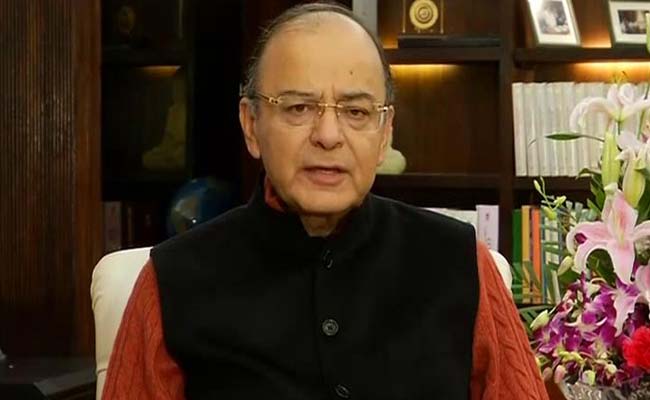
New Delhi: Finance Minister Arun Jaitley may address the transient pain of demonetisation by cutting corporate tax rates when he presents the Budget for 2017-18 in just over two weeks time.
Mr Jaitley in his second Budget speech in February 2015 had announced phasing out of tax incentives with effect from April 1, 2017 and reducing the corporate tax rate from 30 per cent to 25 per cent.
In a survey by Deloitte Touche Tohmatsu India LLP, commissioned on budget expectations of India Inc, 53 per cent of the respondents expect the corporate tax rate to be reduced this time.
"Given the strict measures taken by the government in curbing black money, it may be the appropriate time to reduce the tax rate," Deloitte noted.
Corporate tax accounted for a little less than a fifth (19 per cent) of the government's receipts last fiscal whereas income tax receipts accounted for just 14 per cent of total receipts.
"Since the demonetisation announcement, one of the major concerns has been around the deceleration of the growth momentum in the economy emanating from a decline in demand.
This concern resonates in survey as well because 80 per cent of respondents think the government would unveil measures to counteract the negative impact on demand," it said.
Deloitte further said, 40 per cent of the respondents agree that complete phase-out of tax incentives is a good measure and will reduce litigation.
An equal number of participants believe profit-linked tax incentives should continue for growth sectors like infrastructure.
Interestingly, 15 per cent of the respondents agree that instead of phasing out incentives for infrastructure sector, it should continue in the form of investment-linked tax incentive.
"Considering that some tax incentives will continue, one of the most eligible sectors is the infrastructure sector since the higher tax cost will impact the common man," it said.
A majority of respondents (66 per cent) think that the gains from demonetisation are likely to be focused on development expenditure so as to boost investment demand in he economy.
As much as 26 per cent of them are of view that the gains will be spread evenly across major expenditure areas as the government possibly tries to limit the fallout on various sectors, Deloitte said adding a 6 per cent think that the government can go in for increasing subsidy expenditure.
"Therefore, the industry clearly continues to hope for policy measures that strengthen the pace of structural reforms," it said.
On the impact of demonetisation on real estate industry, the survey said, there may be a phase of depressed demand, but the low-cost and affordable segment will be the driver of growth.
"When additional funds come back in the system, mortgage rates will reduce and with the benefits offered by the government, low-cost and affordable housing will be back in demand," it said.
Deloitte said tax regime is one of the significant considerations for multinational companies to set up their business in a particular tax jurisdiction.
About 43 per cent respondents reinforce this sentiment, giving more than 20 per cent weightage to the attractiveness of tax jurisdictions for carrying business. Very few respondents (4 per cent) gave less than 10 per cent weightage.
Among measures to achieve ease of doing business, the survey respondents placed higher weightage on tax rate reduction (35 per cent), followed by dispute prevention measures (23 per cent) and effective dispute resolution mechanism (16 per cent).
Co-operative tax assessment mechanism and improvement in taxpayer service were the other two important measures pointed out by the respondents.
"Surprisingly, easier application of foreign tax credit rules and burden of Dividend Distribution Tax (DDT) did not appear to weigh higher on the mind of the respondents," it said.
On expectations of recovery in global economy, Deloitte said of late, some positive news has come from developed economies which seems to have generated somewhat of an optimistic outlook in the markets.
About 66 per cent of the participants feel the global economy is likely to witness a recovery in growth rates in FY 2016-17 while 21 per cent think that it is unlikely to be the case.
"It is important to note that there are still numerous macro risks like rising trade tensions, oil prices as well as an increasing environment of uncertainty in the global markets, that pose challenge to any meaningful recovery," it said.
About 46 per cent of the respondents said the impact of tax administration improvement measures like no routine filing of appeal cases by the revenue, risk-based audit selection and electronic refund transfers were significant.
On General Anti Avoidance Rules (GAAR), which was introduced for the first time through Finance Act 2013 but its implementation deferred to Arpil 1, 2017, only a 37 per cent said their organisations were ready for its implementation while the other were either not prepared at all or unsure about their preparedness.
"In view of an array of reforms such as demonetisation, Goods and Services Tax, country by country reporting regarding transfer pricing information, etc, the government may consider providing more time to the industry to deal with GAAR," Deloitte said.
(This story has not been edited by NDTV staff and is auto-generated from a syndicated feed.)

-
Signature Play: The Classic Cocktail Is Dead. Or Is It?

Classic cocktails are disappearing from India's cocktail menus. But they're still being ordered, taught to bartenders and borrowed from. So, who's really having the last drink?
-
A New Samvat Wishlist: Inclusive Prosperity And Human Development
India has strengthened its economic foundations through infrastructure, digital access and enterprise. Its next growth chapter must deepen productivity, create better livelihoods and widen participation in prosperity.
-
Love, Sex Aur Dhokha: The Audacious Plot To Spy On Jensen Huang
A Taipei dinner, a Singapore chip buyer and a suspected Chinese asset: inside the alleged spy operation that got close to NVIDIA's Jensen Huang.
-
Ten Things I Learnt This Samvat
Patience can be a trap. Cheap stocks can stay cheap. Leverage can wipe you out. What did Samvat 2082 teach us? Niraj Shah writes on 10 lessons from the year gone by.
-
Talking Points This Week: Tech Nerves, FII Buying, And A Faraway Banking Shock
The global markets are not shining this Diwali. The exception in the large markets is, India.
-
Midterm Rally Lasted A Day. The Hard Reality Of A Divided US May Last Two Years | Opinion
Between a contested AI boom, a debt ceiling that arrives in 2027 and a president with every incentive to act alone, the next two years may prove more volatile than the first day's rally suggests.
-
Blue Wave Will Derail the AI Trade but Won't Dismantle the AI Era | Unhedged Position
The Democrats' sweep of the US Congress will see politics collide with economic forces both over the long and short term.
-
It's Time To Take The GST Council's Bet On Trust Global
Payment records can prove India's services exports, and clear, proportionate rules can bring foreign digital sellers into the tax net.
-
Opinion | India at 38: From Innovation Overperformer to Innovation Powerhouse
India now has 453 VC-backed deep science startups, 18 of them late-stage, after 117 percent growth since 2020. Laurus Labs, at USD 9.3 billion, is the most valuable deep science company in any middle-income economy outside China.









