Aramco Keeps $31 Billion Payout Amid Saudi Budget Deficit
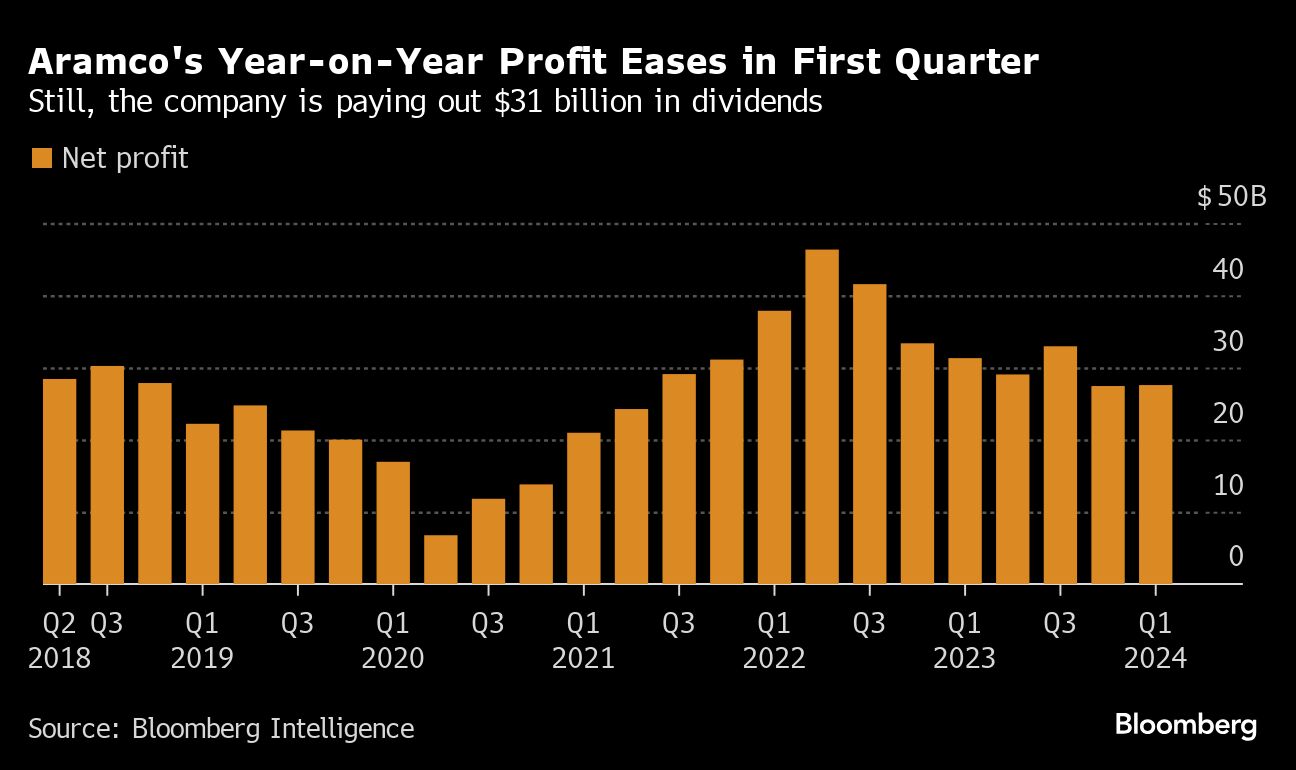
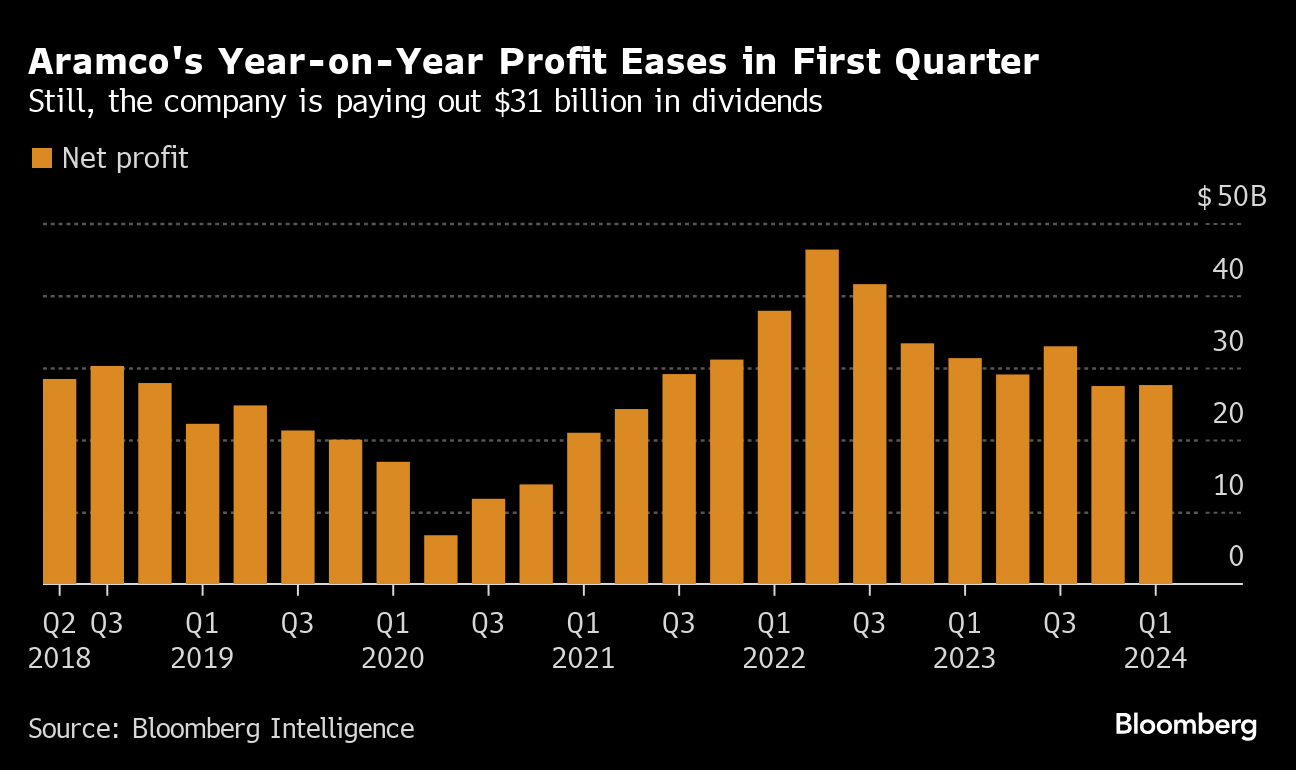
(Bloomberg) -- Aramco kept its $31 billion dividend payout to the Saudi government and other investors despite lower profit, a boon for the kingdom's economy as it struggles with a budget deficit.
The generous payouts from the world's biggest oil exporter are becoming increasingly important for the Gulf state as crude prices remain below the levels it needs to balance its budget. Crown Prince Mohammed bin Salman is pursuing expensive ventures such as the futuristic project of Neom, making a big bet on tourism and seeking stakes in sporting leagues as he tries to transform the economy.
Aramco has said that the distributions, including a special component, will be higher this year than in 2023, which will help fund some of the kingdom's vast spending plans. Global oil majors such as Shell Plc and BP Plc have also kept their focus on returning cash to shareholders.
The kingdom needs oil at around $108 a barrel to balance the budget, including domestic spending by its sovereign wealth fund, according to Bloomberg Economics. Benchmark crude prices in London were trading near $83 a barrel on Tuesday.

Saudi Arabia has already delayed some projects that are part of its economic transformation plan past 2030 and scaled back its ambitions for Neom. Its economy has contracted for three quarters straight while the budget has been in deficit for six consecutive quarters.
Aramco's net income fell 14% to $27.3 billion in the first quarter compared with a year earlier, according to a statement Tuesday. Its free cash flow — cash from operations minus capital expenditure — of $22.8 billion in the period was less than the total dividend payout. The shares were little changed in Riyadh.
Morgan Stanley analysts including Martijn Rats said cash flow came in above their estimates, primarily because capital expenditure was lower than expected. Aramco said it spent $10.8 billion in the quarter out of a forecast range of $48 billion to $58 billion this year. That is expected to increase this decade as the company continues work on major projects like the Jafurah gas development as it seeks to boost supply of the fuel for power and industry.
The company's massive earnings comes even as Saudi Arabia has revived plans for a follow-on offering of the company's shares that would help raise billions of dollars. But global investors, some of whom had balked at the kingdom's valuation expectations and the low yield compared with industry peers during the firm's 2019 IPO, will keep an eye on the Saudi economy and the country's oil output levels.
Read: Saudi Arabia Hikes Oil Selling Prices for All Grades to Asia
Saudi Arabia has been leading efforts by the Organization of Petroleum Exporting Countries and its allies in restricting production in an effort to prevent a supply surplus and shore up prices. The group will gather on June 1 to consider whether to extend current supply curbs into the second half of the year. A majority of traders and analysts surveyed by Bloomberg expect the group to prolong the curbs, perhaps to the end of 2024.
(Updates with analyst comment in the seventh paragraph.)
More stories like this are available on bloomberg.com
©2024 Bloomberg L.P.

-
Why Swapping Your Old Gold Can Trigger A Rs 5 Lakh Tax Bill, And How You Can Avoid It Legally

Swapping old gold for new is taxed as a sale and a fresh purchase. Getting your own gold remade can cut most of that bill, though it has its own costs.
-
The AI Trade is Done. The Real Opportunity for Investors Starts in 2027 | Unhedged Position
As pureplay AI stocks plunge and circular, capex-led financing unwinds, 2027 is set to be a year of reckoning for AI companies. Yet the bust clears the way for a better opportunity for investors in 2027 -- shifting the spotlight from AI builders to the companies using AI.
-
Leadership As Mission: Why The Age Of AI Demands More Human Leadership
Debjani Ghosh examines how AI is changing leadership, arguing that its success must be measured by its impact on people and the accountability of those guiding its use.
-
We May Need Another Tukaram Mundhe To Fight Air Pollution | The Reason Why
Developers may install basic measures such as sprinklers and green nets, resume work, and continue violating rules when this equipment stops working.
-
Extracting Value From Battery Scrap Could Be Challenging For India | The Reason Why
A discarded lithium-ion battery still contains valuable materials such as lithium, nickel and cobalt. These can be recovered and reused. When such batteries are crushed and shredded, they produce a dark powder called black mass.
-
One El Nino, India Can Handle. Two Could Break The Granary
India's grain stocks can absorb one bad year, but a second El Nino could drain the buffer in two to three years, economists say.
-
India's Troika Of Good Luck | Joining The Dots
As Jensen Huang's exit drags Nvidia down, a cooling AI trade and resilient earnings have revived investor interest in India. A likely RBI rate hike looms.
-
Talking Points This Week: Leadership Shock At Nvidia, Earnings Strength, And The Fog Over Hormuz
The Anthropic IPO pricing and first trading day, Nvidia's upcoming earnings, and any fresh signals from Iran will set the tone for the following week.
-
Signature Play: The Classic Cocktail Is Dead. Or Is It?
Classic cocktails are disappearing from India's cocktail menus. But they're still being ordered, taught to bartenders and borrowed from. So, who's really having the last drink?
-
A New Samvat Wishlist: Inclusive Prosperity And Human Development
India has strengthened its economic foundations through infrastructure, digital access and enterprise. Its next growth chapter must deepen productivity, create better livelihoods and widen participation in prosperity.









