Apple’s $1 Billion Investment May Be Fleeting Win For Indonesia

Indonesia claimed victory after Apple Inc. offered to increase its investment in the country to $1 billion to get President Prabowo Subianto's government to lift a ban on the sale of iPhone 16s. The win may be short-lived.
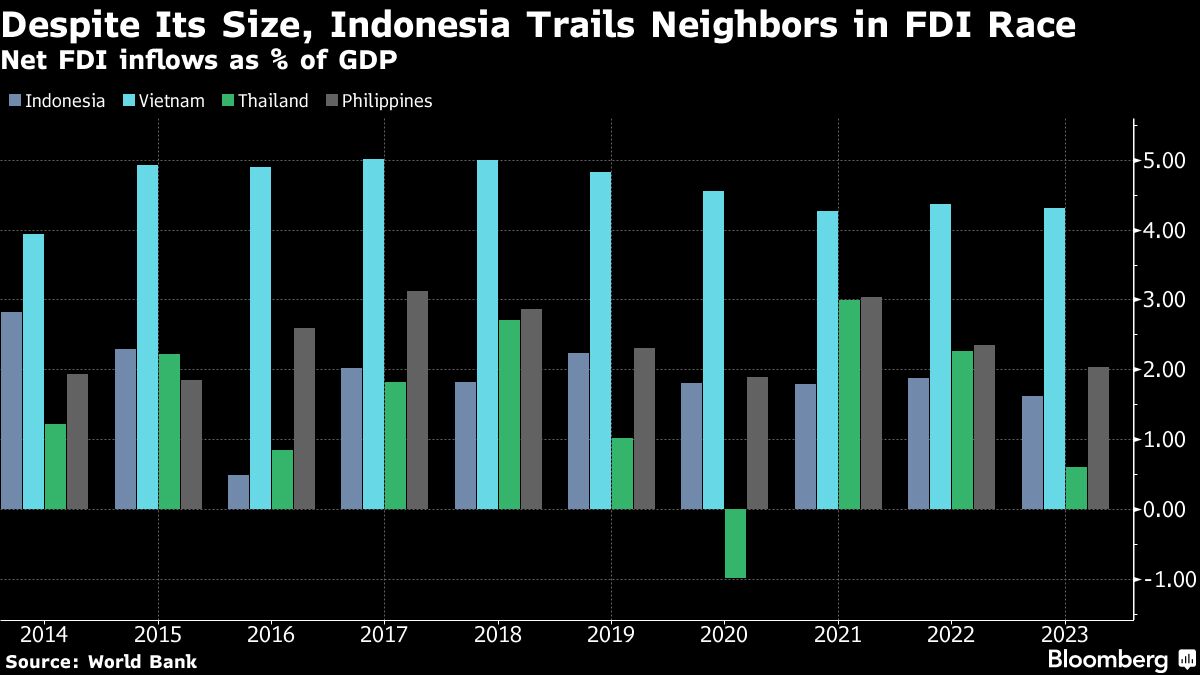
Using a protectionist playbook to get companies to build factories could end up sidelining Southeast Asia's largest economy when neighbors are rolling out the red carpet for investors who are relocating from China ahead of Donald Trump's potential tariffs, analysts said.
“Now is not the best time to play hardball,” said Krisna Gupta, senior fellow at the Center for Indonesian Policy Studies. “It can be a dangerous game to play.”
Indonesia brandished what are known as domestic content requirements to push Apple to raise its investment bid from $10 million to $1 billion in the space of a month, if it wants to be allowed to sell its flagship device in the country.
As part of Apple's latest offer, one of its suppliers will set up a plant producing AirTags on the island of Batam and employ around 1,000 workers, Bloomberg News reported.
It's the government's way of securing more foreign direct investment, aimed particularly at companies “with significant stakes in maintaining access to the Indonesian market” of 270 million people, according to David Sumual, chief economist at PT Bank Central Asia in Jakarta.
“The policy may also deter FDI by raising costs, introducing regulatory complexities, and mandating localization in sectors where domestic suppliers often lack the capacity to meet global standards — especially in industries dependent on advanced technology,” Sumual said.
Indonesia needs a manufacturing revival to create jobs and boost economic activity to meet Prabowo's target of 8% annual growth in the next five years. The country is aiming for high-income economy status by 2045.
The plan has suffered from setbacks. Several textile and footwear factories closed down this year, laying off thousands of workers amid weak sales and mounting losses. A local pharmaceutical company also plans to halve its manufacturing plants in the coming years.
“We want to see fairness. You get benefits here, you invest here and create jobs,” said Investment Minister Rosan Roeslani earlier this month when discussing Apple's latest offer. “The most important thing is that the global value chain moves to us.”
Apple is following Samsung Electronics Co. and Xiaomi Corp. in spending billions building factories to meet local content regulations, despite the cost and supply chain challenges that can hamper such investments.
The American Chamber of Commerce said in a November report that the rules can lead to lower production levels. Companies also are often forced to source costlier or lower-quality materials with advanced electronics components in limited supply locally.
“The gap between the government's demand for local production and the actual infrastructure to support high-technology standards creates obstacles for foreign investors,” it said.
Tech Shift
Indonesia's content requirements could become an even bigger hurdle for foreign investors. The government wants to raise the domestic content ratio from 35% for all mobile phones and tablets sold in the country, Industry Minister Agus Gumiwang Kartasasmita said in November.
The ministry is also considering abolishing an investment path that Apple used in the past, which is to fund developer academies, he said. This leaves companies with just two options to meet the domestic content rules: making parts or applications in Indonesia.
That's a hard sell when technology is getting more and more advanced. Previously, companies complied with content requirements through packaging and accessories like charger cables and headsets, according to AmCham.
“With the shift to wireless technology, these components are now less relevant, and Indonesia lacks the capability to produce alternatives, such as wireless earbuds,” it said in the report.
Local content requirements cover a range of industries, from cars to medical devices. Together with decades-old problems such as red tape, high taxes and a less productive workforce, Indonesia's manufacturing growth has slowed to a crawl.
In contrast, neighbors like Vietnam and India are offering tax incentives, swift approvals and the freedom to source their components from across their global supply chains, Gupta of the Center for Indonesian Policy Studies said.
That makes them attractive for companies looking to produce for export and explains why Apple can invest a much larger $15 billion in Vietnam despite the nation having a smaller domestic market than Indonesia, he said.
“Without that scale, it would be more difficult for companies to justify the sizable fixed cost needed to set up a manufacturing plant here,” Gupta said.
In Vietnam's northern Bac Giang province that's home to several Apple suppliers, officials arrange buses for workers to travel from their villages to factories, give land clearance for dormitories and help mediate labor disputes. They even conduct night calls with Apple's headquarters in Cupertino, California to make sure things are running smoothly.
“There are investors that may prefer more liberalized markets such as Vietnam, compared to Indonesia. It could lead them to reconsider investment decisions to favor countries with less restrictions,” said Jia Hui Tee, senior trade policy analyst at the Hinrich Foundation.

-
Getting To Work Costs Women More | The Reason Why

It is not just about women paying more than men. It is about women paying much more in cities than in villages.
-
AI Bias In Investing Cannot Be Eliminated, But It Can Be Governed
Framing is a particularly important example as identical financial information presented in terms of gains rather than losses can lead an LLM to reach a different assessment.
-
Joining The Dots | Dark Skies, Steady Diya: Why Hope Holds This Diwali
With war, a weak rupee and foreign outflows weighing on sentiment, policymakers at the NDTV World Summit and market veterans at NDTV Profit Ignite: Diwali Edition offered the same advice: stay invested and filter out the noise.
-
The Curious Case of Equitas Small Finance Bank And A CEO Who Quit For Stock
PN Vasudevan believes persistent investor concerns over a perceived conflict of interest had become a governance overhang on Equitas Small Finance Bank's stock, even as the lender improved profitability and asset quality.
-
Talking Points This Week: AI Cash Burn, A Tiger Comeback And An India That Still Finds Its Own Path
India is not immune to higher oil or tighter global liquidity, yet its earnings base is broader, its domestic policy levers are still available.
-
Foreign Investors Own Half Of HDFC Bank and ICICI Bank. An LTCG Cut Could Matter Most Here
Foreign portfolio investors have US$115 billion parked in HDFC Bank, ICICI Bank. If the government cuts long-term capital gains tax, Jefferies says returning foreign money could land here first.
-
'Never Seen This Level Of Negativity': Sandeep Tandon Says The Next Rally May Be Closer Than You Think
Veteran investor Sandeep Tandon says foreign selling is easing, large-caps are due a comeback and mid-caps are crowded, while he turns positive on gold, power and pharma this Diwali.
-
Indians Stay With Family, Not In Hotels | The Reason Why
India still lacks enough clean, reliable and affordable hotels for budget-conscious travellers.
-
The Economic Imperative: Analysing The Material Driving Force Behind India-Canada Strategic Reset
This economic complementarity is further reinforced by deep institutional investment ties and talent mobility, which form the bedrock of the bilateral framework.
-
Medicine Pricing: Where Must Profit Stop?
India must confront excessive margins, hidden incentives and regulatory gaps that threaten the integrity of medicine.










