Apple Warns Of Sluggish Holiday Quarter After China Slowdown

(Bloomberg) -- Apple Inc., already facing a slowdown in China, warned that revenue in the holiday quarter will be about the same as last year, signaling that investors won't see the growth rebound they were banking on.
Though iPhone revenue is expected to increase in the December quarter, overall sales will be similar to the year-earlier period, Chief Financial Officer Luca Maestri said on a conference call Thursday following Apple's quarterly report. The tepid outlook sent the shares down as much as 4.6% in late trading.
Wall Street had projected revenue growth of about 5% in the quarter, which is invariably Apple's biggest sales period of the year. Revenue from the iPad and the company's wearables category, which includes its smartwatch line, will drop significantly during the quarter, Apple said. The Mac, on the other hand, will see an acceleration.
The company has been trying to pull out of its longest sales slowdown in decades. It just reported its fourth straight revenue decline, matching a streak it suffered in 2001, as the company struggles with a sluggish computer market and shaky demand in China.
Revenue fell to $89.5 billion in the fiscal fourth quarter, which ended Sept. 30. That compared with an average Wall Street estimate of $89.4 billion. Apple didn't provide formal guidance for the current quarter, sticking with a policy it adopted during the pandemic.
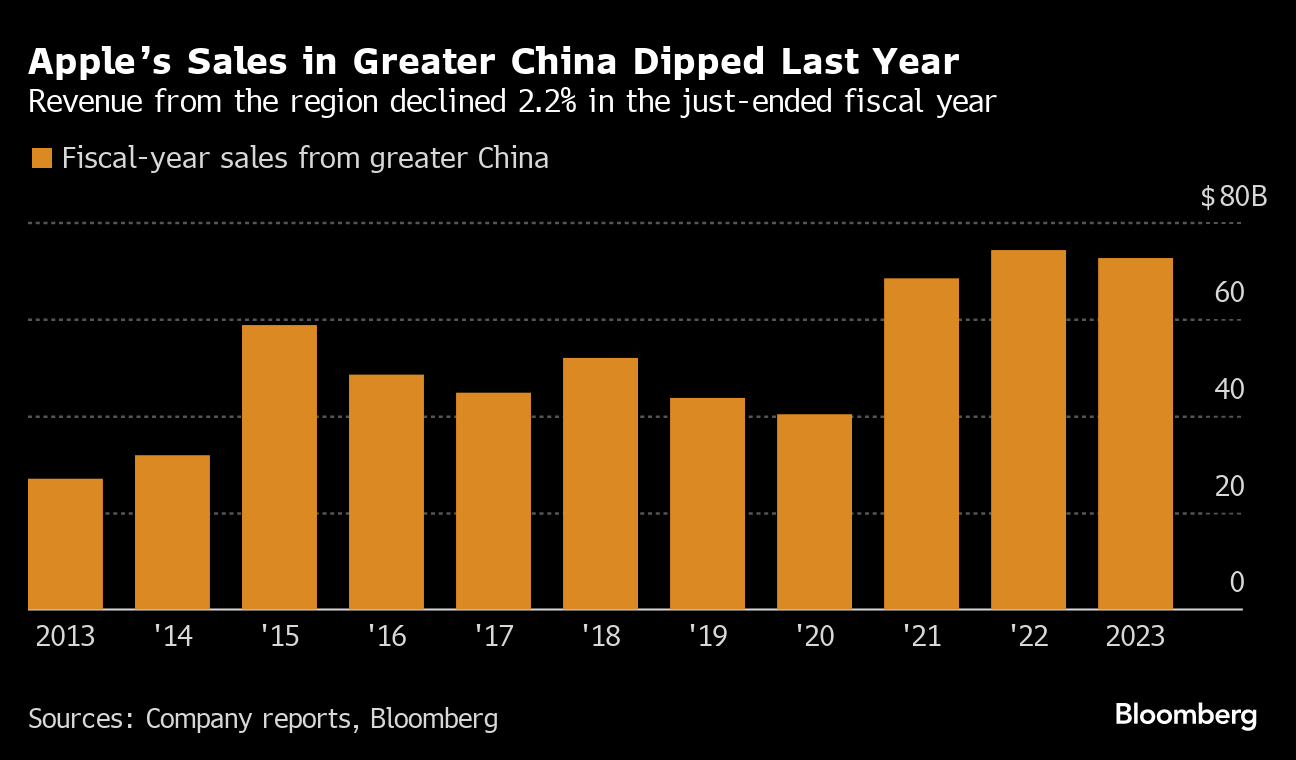
The results suggest that Apple is facing a deceleration in China. The government there has imposed bans on US technology in some workplaces, and a new phone from Huawei Technologies Co. is providing fresh competition. Revenue from that region amounted to $15.1 billion last quarter, down slightly from a year earlier and well short of the $17 billion that some analysts had predicted. Cook said the decline was due to a drop in Mac and iPad sales, as well as currency fluctuations.
Apple shares dropped as low as $169.33 in extended trading. They had closed at $177.57 in New York, leaving them up 37% this year.
The company updated the iPhone, its flagship product, during the fourth quarter. The period included a little over a week of sales data following the device's launch on Sept. 22. The Cupertino, California-based company also released new watch models — the Series 9 and Ultra 2 — and updated its AirPods Pro to add a USB-C port.
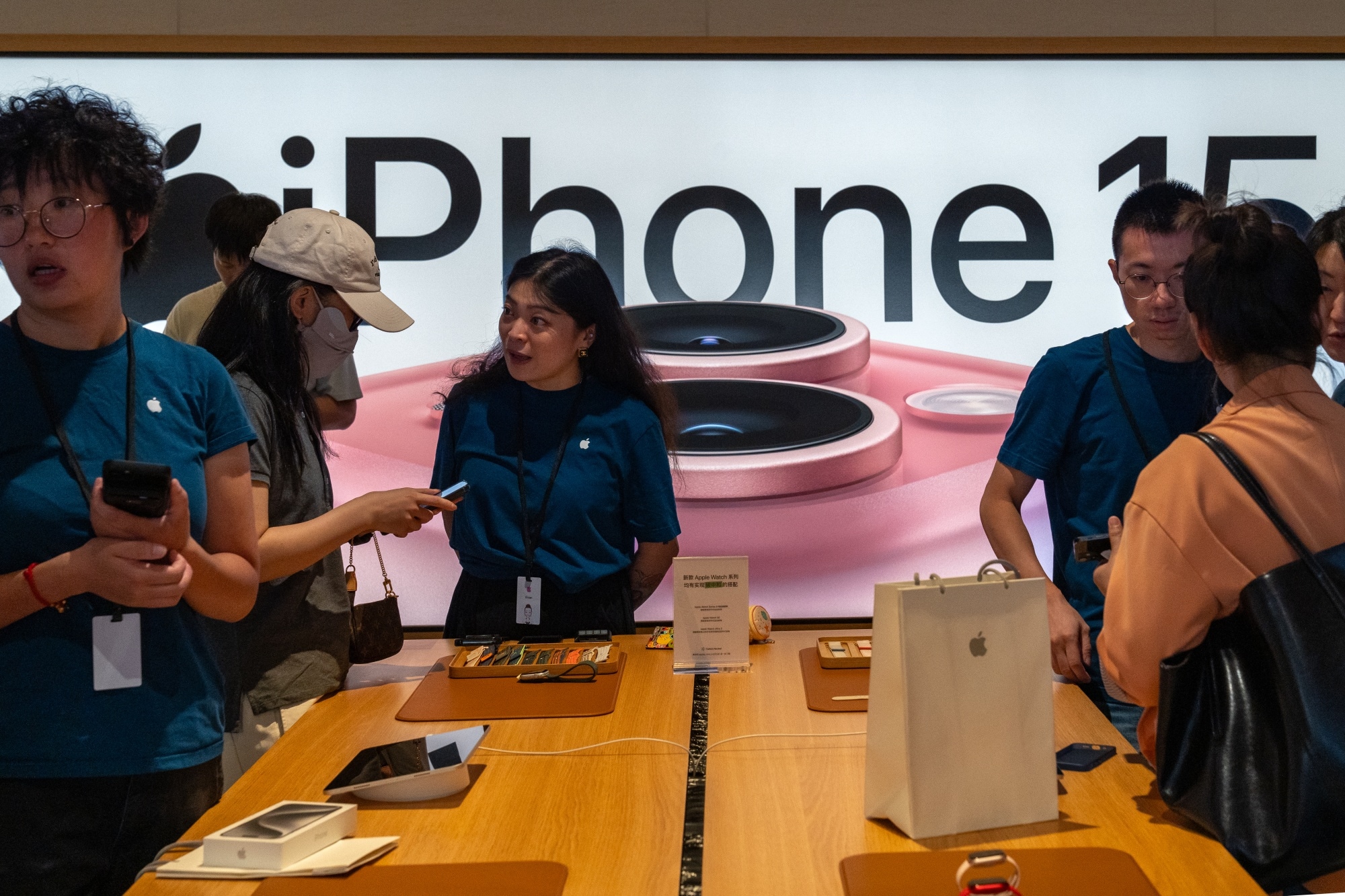
Even with the challenges, the iPhone performed slightly better than projected. It generated $43.8 billion in sales, compared with an average estimate of $43.7 billion. And, despite the concerns, the device reached a quarterly revenue record in mainland China, Chief Executive Officer Tim Cook said during the conference call with analysts. Earnings came in at $1.46 a share last quarter, topping the $1.39 forecast.
Cook also said the company was investing “quite a bit” in generative artificial intelligence. Bloomberg News recently reported that Apple is planning to inject the technology into several new apps and services next year. “You will see product advancements over time,” Cook said, “where those technologies are at the heart of them.”
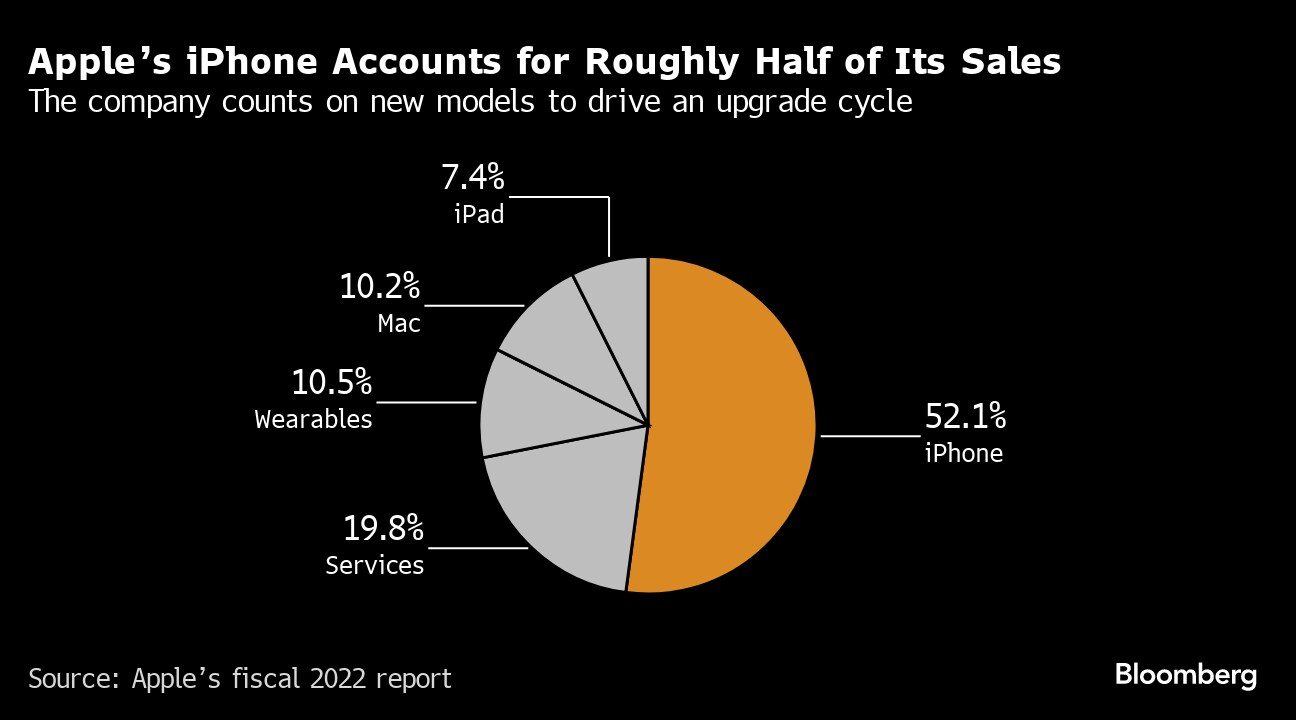
The iPhone accounts for roughly half of Apple's sales, so the launch of a new model is closely watched by investors. With the iPhone 15, the company redesigned the high-end versions — giving them titanium cases — and added features such as a more powerful zoom camera lens. The hope was to entice smartphone shoppers who had been holding onto their old models for longer these days.
Apple had a favorable year-over-year comparison this cycle because 2022's iPhone 14 Pro models faced supply constraints due to shutdowns at Apple's manufacturing partners in China. The iPhone 15 Pro had no such limitations.
Thursday's report follows an upbeat view from Qualcomm Inc., the leading maker of smartphone chips. On Wednesday, it forecast stronger sales for the current quarter than analysts expected, kicking off a rally for its stock.
What Bloomberg Intelligence Says:
“The sales miss in China is discouraging and could have been caused by soft consumer spending.”
— Anurag Rana, BI technology industry analyst
Click here to read his research.
In one potentially ominous sign, Qualcomm said that its smartphone chip business saw a 35% increase from Chinese manufacturers of Android phones, suggesting that customers in the region are opting for non-iPhones in larger numbers.
The area is Apple's largest international market, accounting for about a fifth of sales. Still, Cook said he believes Apple actually gained smartphone market share in China during the quarter.
The company said that the iPhone set revenue records in several developed and emerging markets, including India.
The personal computer market also is poised for a resurgence, but Apple didn't debut any new models during the quarter. Though it unveiled new MacBook Pros, iMacs and M3 processors earlier this week, sales of those machines won't show up in Apple results until the quarter ending in December.
Apple brought in $7.61 billion from the Mac during the fourth quarter, missing forecasts of $8.76 billion. The company did release some new computers earlier this year, including a 15-inch MacBook Air and faster desktops. Apple blamed the steep decline on manufacturing challenges for the Mac last year. The company lost sales during the June quarter a year ago, only to regain them from pent-up demand in the September period. That set up a poor comparison for this year.
Read More: Apple Unveils New Laptops, iMac and Trio of More Powerful Chips
Revenue for the September quarter might have been stronger if the company had released new iPads during the period, which it sometimes does, or made more significant changes to its accessories. The latest Apple Watches and AirPods only represent modest tweaks from their predecessors.
The Wearables, Home and Accessories segment, which includes the watch, AirPods, Apple TV set-top box and Beats headphones, brought revenue of $9.32 billion. That fell short of the $9.41 billion estimate.
The services segment generated $22.3 billion in sales, beating Wall Street targets of $21.4 billion. That's an all-time record for the category. The company is looking to make that business even more lucrative: It raised the prices for Apple TV+, Arcade and News+ last month, though that change was too recent to affect these results.
The iPad brought in revenue of $6.44 billion. Though that was a 10% decline from last year, it was better than the $6.12 billion projection. Apple hasn't introduced a new iPad this calendar year, the first time that's happened since the product first debuted in 2010. It did, however, release a cheaper Apple Pencil stylus for its tablets this week.
(Updates with more commentary from conference call starting in 10th paragraph.)
More stories like this are available on bloomberg.com
©2023 Bloomberg L.P.

-
Talking Points This Week: Leadership Shock At Nvidia, Earnings Strength, And The Fog Over Hormuz

The Anthropic IPO pricing and first trading day, Nvidia's upcoming earnings, and any fresh signals from Iran will set the tone for the following week.
-
Signature Play: The Classic Cocktail Is Dead. Or Is It?
Classic cocktails are disappearing from India's cocktail menus. But they're still being ordered, taught to bartenders and borrowed from. So, who's really having the last drink?
-
A New Samvat Wishlist: Inclusive Prosperity And Human Development
India has strengthened its economic foundations through infrastructure, digital access and enterprise. Its next growth chapter must deepen productivity, create better livelihoods and widen participation in prosperity.
-
Love, Sex Aur Dhokha: The Audacious Plot To Spy On Jensen Huang
A Taipei dinner, a Singapore chip buyer and a suspected Chinese asset: inside the alleged spy operation that got close to NVIDIA's Jensen Huang.
-
Ten Things I Learnt This Samvat
Patience can be a trap. Cheap stocks can stay cheap. Leverage can wipe you out. What did Samvat 2082 teach us? Niraj Shah writes on 10 lessons from the year gone by.
-
Talking Points This Week: Tech Nerves, FII Buying, And A Faraway Banking Shock
The global markets are not shining this Diwali. The exception in the large markets is, India.
-
Midterm Rally Lasted A Day. The Hard Reality Of A Divided US May Last Two Years | Opinion
Between a contested AI boom, a debt ceiling that arrives in 2027 and a president with every incentive to act alone, the next two years may prove more volatile than the first day's rally suggests.
-
Blue Wave Will Derail the AI Trade but Won't Dismantle the AI Era | Unhedged Position
The Democrats' sweep of the US Congress will see politics collide with economic forces both over the long and short term.
-
It's Time To Take The GST Council's Bet On Trust Global
Payment records can prove India's services exports, and clear, proportionate rules can bring foreign digital sellers into the tax net.
-
Opinion | India at 38: From Innovation Overperformer to Innovation Powerhouse
India now has 453 VC-backed deep science startups, 18 of them late-stage, after 117 percent growth since 2020. Laurus Labs, at USD 9.3 billion, is the most valuable deep science company in any middle-income economy outside China.









