Apple Hits Historic $3 Trillion Milestone

(Bloomberg) -- Apple Inc. made Wall Street history as the first company with a market value over $3 trillion, the latest sign of big tech's seemingly unstoppable dominance in equity markets.
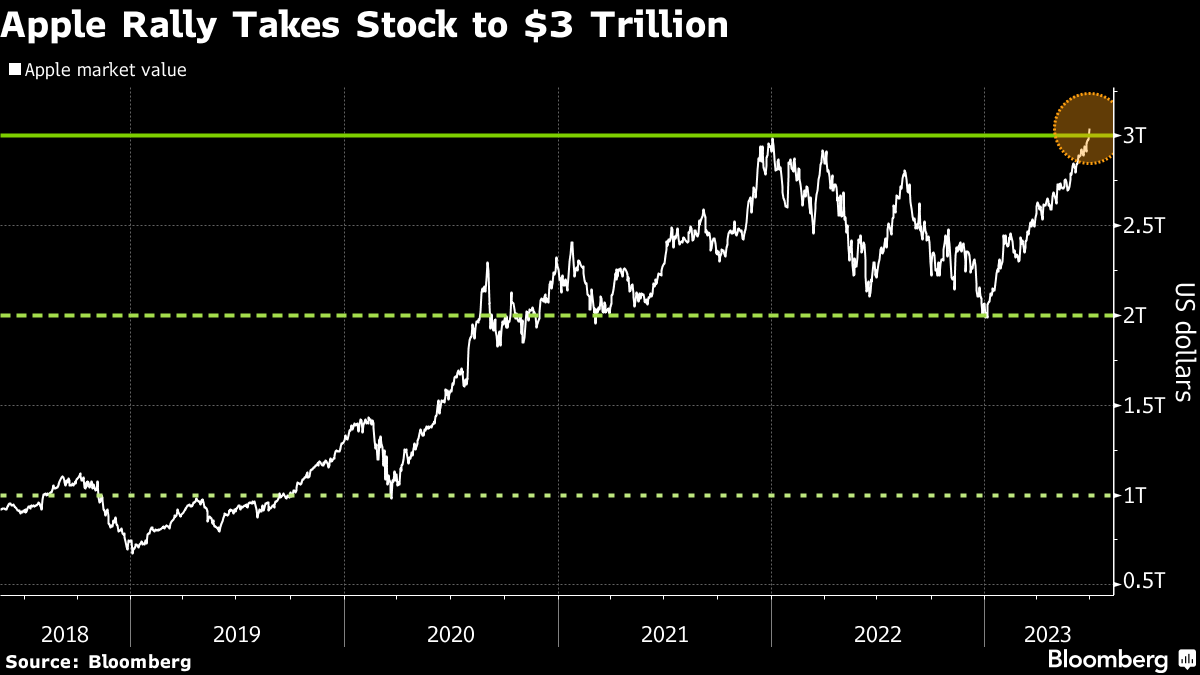
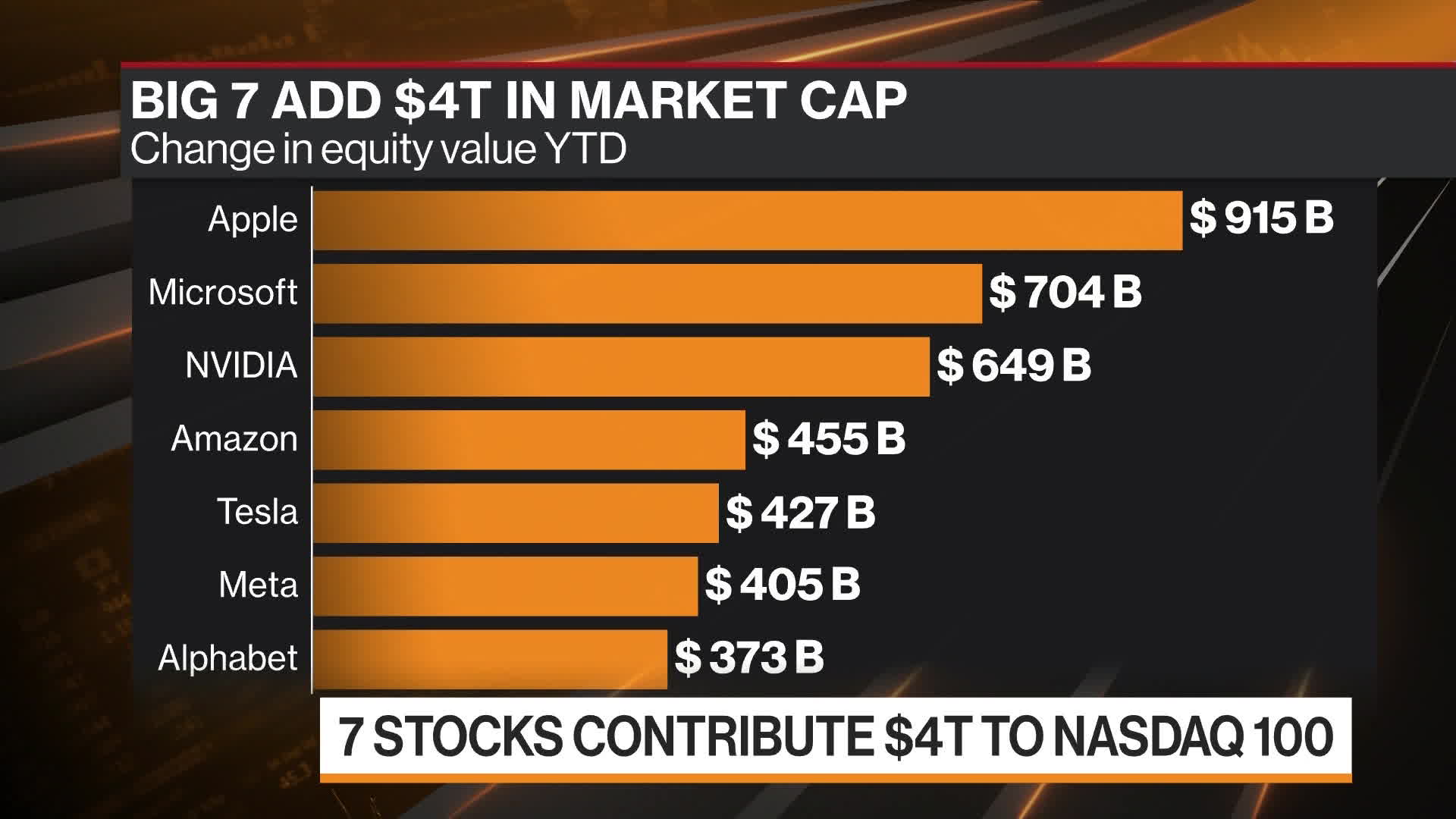
The iPhone maker gained 2.3% on Friday, adding to a rally that's added more than $983 billion to its size this year and leaving it roughly a half-trillion dollars above the next-largest company. Apple's ascent to the milestone helped the Nasdaq 100 Index to its best-ever first half ever, driving a broader stock rally that underscored the dominance of tech megacaps
Read more: Nasdaq 100 Adds $5 Trillion in Record Start to Year: Tech Watch
The rally has caught many strategists off guard, leading some to question its viability as the economy faces potentially more Federal Reserve interest-rate hikes. However, investors remain excited about the growth potential of artificial intelligence, and they have also gravitated toward the kind of quality factors that Apple has in spades, including a strong balance sheet, durable revenue streams, and a robust competitive position.
“The reason Apple has outperformed for more than a decade isn't because investors are being foolhardy, but because it is executing on a business strategy that works, its earnings plan is working, and its lock on the consumer is only getting stronger,” said Jonathan Curtis, director of portfolio management for Franklin Equity Group.
“The balance sheet is phenomenal, it pays a dividend it can continue to grow, it has an active repurchasing program, and a consumer staples-esque platform business, all powered by a device people look at four hours a day,” Curtis said.
In a sign of Wall Street's ongoing optimism about the stock, Citi on Thursday began coverage of Apple with a buy rating, writing that its ability to continue expanding margins was underappreciated. It sees additional upside of about 30% for the stock, a target that would take Apple close to a $4 trillion valuation.
The Trillion-Dollar Club
Apple first became the world's most valuable stock in 2011, when its market cap was under $340 billion and it comprised about 3.3% of the S&P 500. Since then, it has rarely forfeit that title. It first reached $1 trillion in value in mid-2018, and it achieved a $2 trillion valuation in August 2020, making it the first US company to surpass that level, though Saudi Aramco was the first $2 trillion company overall.
The iPhone maker briefly rose above the $3 trillion level in early 2022, although it failed to close above it, and that peak marked the start of a downtrend that has now been fully erased.
Companies of this size are few and far between, and in the US the club is populated only by other megacap technology and internet stocks, including Alphabet Inc., Amazon.com Inc., and chipmaker Nvidia Corp., which became the first trillion-dollar chipmaker earlier this year. Microsoft Corp is the only other US stock with a valuation above $2 trillion.
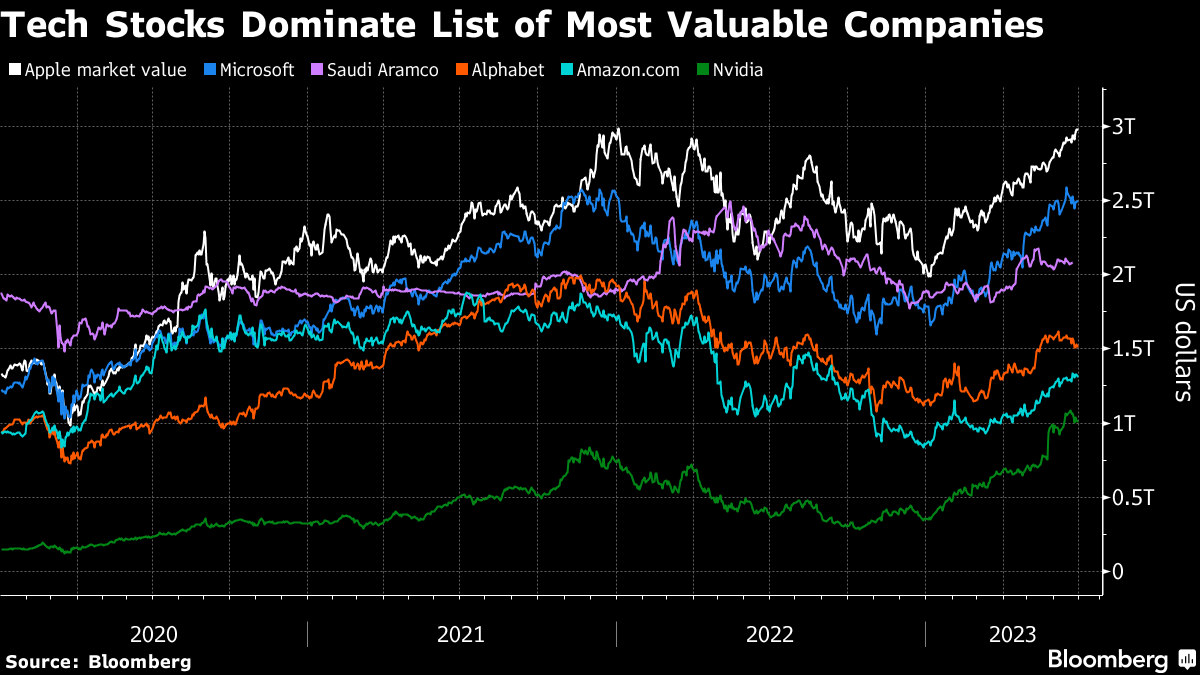
While Apple is not the biggest gainer of the year — Nvidia, Meta Platforms Inc., and Tesla Inc. have more than doubled — its size gives it a massive influence over markets, accounting for 7.7% of the weight of the S&P 500 Index.
Still, the milestone doesn't mean smooth sailing for Apple from here. The stock trades at about 30 times forward earnings, and while this is down from a 2020 peak above 35, it remains well above its 10-year average multiple of 17.9.
Read more: Apple $3 Trillion Valuation Isn't About the Headset: Tech Daily
Despite Citi's new bull call, analysts have been pulling back on the stock amid the year's rally. Fewer than 70% of the firms tracked by Bloomberg recommend buying the stock, the lowest such ratio among the trillion-dollar stocks. Furthermore, its consensus rating — a proxy for its ratio of buy, hold, and sell ratings — is near its lowest since November 2020. A recent downgrade from UBS was the latest example of weaker sentiment.
Furthermore, Apple is above the average price target, suggesting analysts aren't anticipating much in the way of additional gains from current levels.
--With assistance from Kit Rees and Thyagaraju Adinarayan.
(Updates to market close.)
More stories like this are available on bloomberg.com
©2023 Bloomberg L.P.

-
The Economic Imperative: Analysing The Material Driving Force Behind India-Canada Strategic Reset

This economic complementarity is further reinforced by deep institutional investment ties and talent mobility, which form the bedrock of the bilateral framework.
-
Medicine Pricing: Where Must Profit Stop?
India must confront excessive margins, hidden incentives and regulatory gaps that threaten the integrity of medicine.
-
Why Amazon And Flipkart Are Struggling To Beat Meesho In India's Smaller Cities
With 274 million users and lowest-cost logistics, Meesho is defending its value commerce crown against giants like Amazon and Flipkart.
-
High US Salaries, No Green Card Certainty: The Financial Calculation Facing Indian H-1B Families
The suspension of PERM processing at eight technology employers does not cancel existing H-1B visas. What it does is force a question many Indian families have been avoiding: is the US salary worth tying your career and family plans to one employer?
-
Swiggy vs Eternal: Food Delivery's Two Rivals Are No Longer In The Same Race
Eternal is building a private AI assistant, dark.ai. Swiggy is still working out how to make Instamart pay, with an operating loss of Rs 895 crore in the July-September quarter while Blinkit stayed profitable.
-
Where You Live Shapes How You Get To Work | The Reason Why
Two-wheelers are the most popular way to get to work in India, accounting for nearly 43% of workplace commutes.
-
Unhedged Position: Can India See An Indonesia-Style Time Correction?
The Nifty is trading below levels it first clocked in 2024. Is there, then, as I have suggested in the headline, potential that the current time correction drags on painfully for the next three-five, even ten years?
-
Navigating Friction And Energy Realities: An Analysis Of Marco Rubio's October Visit To India
Occurring at a critical juncture marked by stalled trade negotiations and escalating geopolitical pressures over global energy supplies, the visit offers a profound window into modern US-India relations.
-
India Exports Capital. Why Not Export Trusteeship?
The big question, then, is whether India can build an institution that global borrowers, investors, banks, and lawyers can trust, even without an Indian connection.
-
France's Economy & Politics Are In Crisis | The Reason Why
Let's look at how the French economy and politics evolved under Nicolas Sarkozy, Franois Hollande and Emmanuel Macron.










