Americans Are Working Less Than They Were Before the Pandemic
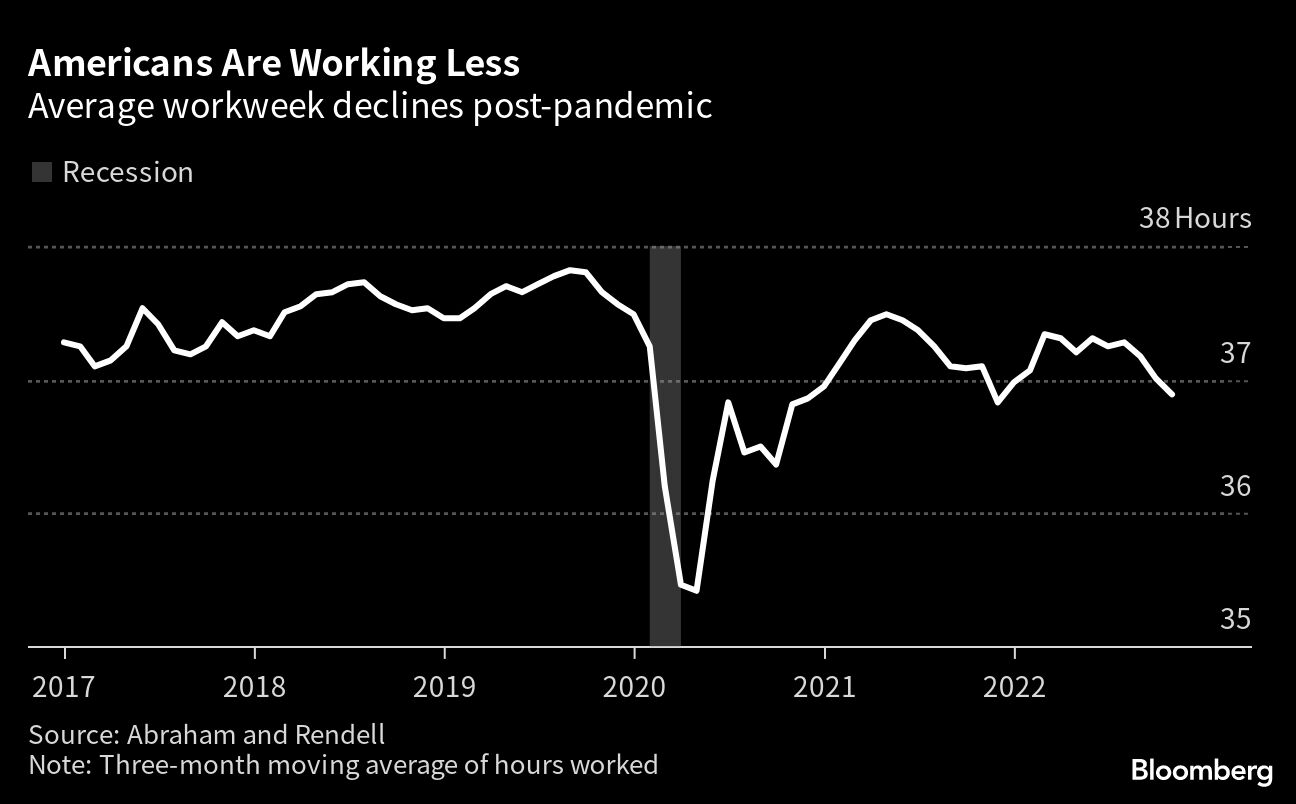
(Bloomberg) -- Americans are spending less time working than they did before the pandemic. That's good for many of them, but it's not necessarily great for the inflation-fighting Federal Reserve.
The average US workweek has dropped by more than a half hour over the last three years, according to new research by former Bureau of Labor Statistics Commissioner Katharine Abraham and her University of Maryland colleague Lea Rendell. That's enabled some Americans to emulate their European counterparts and spend more time on leisure and other activities.

But it's also meant a shortfall of labor – equivalent to 2.4 million employees, according to the paper. That shortfall adds to pressures in a hot jobs market that Fed Chair Jerome Powell and his colleagues have been trying to cool, in an effort to bring down an inflation rate that's more than double their 2% goal.
What's going on with weekly hours is “a very significant part of the story why labor supply is so low,” Stephanie Aaronson, senior associate director of the division of research and statistics at the Fed, said at a conference last week where the research was discussed.
In his commentary at the Brookings Institution conference, Washington University in St. Louis professor Yongseok Shin highlighted three groups that have reduced their hours: educated young men, high-earners – who cut their workweek by 1.5 hours – and workaholics – who reduced time on the job to “only” 52 hours from 55 in 2019.
People who have access to remote work or hybrid work are also more prone to shortening hours. “Nobody will notice if you call it a day a little bit earlier on a Friday,” Shin explained.
Jobs Report
Fed officials will get a fresh reading on the state of the jobs market on Friday, with the release of the monthly employment report. Payroll growth is projected to have slowed to 240,000 last month from 311,000 in February, with joblessness holding steady at 3.6%, according to the median forecasts of economists surveyed by Bloomberg.
US companies added fewer jobs than forecast in March, according to payroll data released Wednesday by ADP Research Institute. But the overall figure masked differences among industries: The leisure, trade and construction sectors increased payrolls, while financial services cut jobs.
When inflation began taking off in 2021, Powell was counting on a surge in the number of Americans returning to work to help keep wage increases in check and prevent the jobs market from overheating. When that didn't happen, it spawned a cottage industry of academics seeking to explain why.
Recent research – by Abraham and Rendell and by some Fed staffers – suggests the shortfall shouldn't have come as such a big surprise. A lot of the decline in the labor force participation rate – to 62.5% now from 63.3% just before the pandemic recession – can be explained by trends that were in place before Covid-19 struck, including the aging of the population.
Read More: Aging Boomers Explain Shrinking Labor Force, NY Fed Study Says
A smaller part of the drop in participation is due to the coronavirus itself – either the fear of catching it or long Covid, the debilitating long-term effect on some who've been infected.
But what's more puzzling, and significant for labor supply, is the decline in hours worked, according to Abraham and Rendell.
They find that no more than about 10% of the drop in hours can be attributed to long Covid. What else is at play is unclear, though they speculate that part of the explanation may lie in a re-examination of the work/life balance by many Americans.
One proviso: The paper's findings are based on data from the monthly household survey of employment, not the payroll report. The latter shows that average weekly hours are currently above pre-pandemic levels. That's partly because the payrolls report is a measure of hours per job, not per person, and so doesn't reflect changes in the number of workers with more than one job.
Noting that Americans have traditionally toiled longer hours than their counterparts in some other industrial countries, Stanford University professor Caroline Hoxby wondered whether the pandemic had shocked US workers into adopting more of a European approach to work.
And it may be a shift that's here to stay. “I wouldn't be surprised if this was relatively long lasting,” Abraham said.
--With assistance from Augusta Saraiva.
(Adds ADP payroll data in eighth paragraph.)
More stories like this are available on bloomberg.com
©2023 Bloomberg L.P.

-
The Economic Imperative: Analysing The Material Driving Force Behind India-Canada Strategic Reset

This economic complementarity is further reinforced by deep institutional investment ties and talent mobility, which form the bedrock of the bilateral framework.
-
Medicine Pricing: Where Must Profit Stop?
India must confront excessive margins, hidden incentives and regulatory gaps that threaten the integrity of medicine.
-
Why Amazon And Flipkart Are Struggling To Beat Meesho In India's Smaller Cities
With 274 million users and lowest-cost logistics, Meesho is defending its value commerce crown against giants like Amazon and Flipkart.
-
High US Salaries, No Green Card Certainty: The Financial Calculation Facing Indian H-1B Families
The suspension of PERM processing at eight technology employers does not cancel existing H-1B visas. What it does is force a question many Indian families have been avoiding: is the US salary worth tying your career and family plans to one employer?
-
Swiggy vs Eternal: Food Delivery's Two Rivals Are No Longer In The Same Race
Eternal is building a private AI assistant, dark.ai. Swiggy is still working out how to make Instamart pay, with an operating loss of Rs 895 crore in the July-September quarter while Blinkit stayed profitable.
-
Where You Live Shapes How You Get To Work | The Reason Why
Two-wheelers are the most popular way to get to work in India, accounting for nearly 43% of workplace commutes.
-
Unhedged Position: Can India See An Indonesia-Style Time Correction?
The Nifty is trading below levels it first clocked in 2024. Is there, then, as I have suggested in the headline, potential that the current time correction drags on painfully for the next three-five, even ten years?
-
Navigating Friction And Energy Realities: An Analysis Of Marco Rubio's October Visit To India
Occurring at a critical juncture marked by stalled trade negotiations and escalating geopolitical pressures over global energy supplies, the visit offers a profound window into modern US-India relations.
-
India Exports Capital. Why Not Export Trusteeship?
The big question, then, is whether India can build an institution that global borrowers, investors, banks, and lawyers can trust, even without an Indian connection.
-
France's Economy & Politics Are In Crisis | The Reason Why
Let's look at how the French economy and politics evolved under Nicolas Sarkozy, Franois Hollande and Emmanuel Macron.










