Amartya Sen Says Note-Ban Undemocratic Move Akin To Unguided Missile
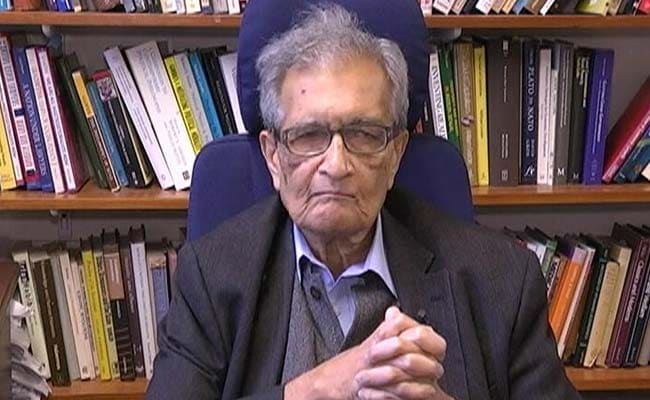
Mumbai: Nobel laureate Amartya Sen on Saturday termed note ban as an unguided "missile" fired "unilaterally" by the government without adhering to the democratic conventions.
"...every now and then we get missiles fired by the government unilaterally. Demonetisation one fine morning is of course just such a missile where there are reports coming in of hardships and suffering though it is not quite clear where the missile has landed," Sen said.
The remark was made by Sen during a talk titled 'Healthcare for all: Why and how' here, was done while comparing decision-making in a democratic country like ours and the Communist China.
The Bharat Ratna awardee said decisions get taken in China based on the vision of a small group of people, while in a democracy like ours, things move only when there is a public demand for it.
"Our political decisions, however, in contrast have to involve the public," he said, comparing our situation with China and going on to mention the demonetisation exercise as an aberration from such a convention.
Drawing attention to the critical challenges faced by the healthcare sector, the professor of economics and philosophy at Harvard said, "unilateral thoughts" like demonetisation cannot be of help.
"Firing unilateral thoughts are not the way to reform healthcare in the kind of democracy that is India," Sen said.
It can be noted that the US-based Sen has been critical of the demonetisation announced by Prime Minister Narendra Modi on November 8.
Among other things, he has described it as a "despotic action" which was taken in a hurry.
Sen also made a reference to the ideas of Buddha and made a specific mention of his work in reviving the famed University at Nalanda.
It can be noted that Sen's name was excluded after the Modi government reconstituted the board of the Nalanda University in November 2015. Sen was the founding chancellor of the varsity.
Sen said he was "deeply influenced" by Buddha's ideas including those on education, and said he was hoping to revive Nalanda from his childhood days.
Sen also spoke about the need to increase Budgetary allocation to healthcare as a share of GDP, saying the present platry allocation above 1 per cent is very low.
Ruing that healthcare gets scant attention from the media, he cited an empirical analysis of editorial space to the critical subject done by him and developmental economist Jean Dreze to drive home his point.
None of the major political parties made any mention to healthcare in the 2014 hustings as well, Sen pointed out and regretted the lack of public discussion on the subject.
Drawing parallels with the metaphor of snake and ladder game, Sen said healthcare is yet to benefit from the good delivered by economic growth.
He said during the past 25 years, we have grown on the 'ladder' of economic development but the lack of healthcare facilities has acted like the 'snake'.
The economist also said there is an urgent need to stop exploitation of the poor and the ignorant patients by doctors. Additionally, the "moral hazard" created by subsidising private hospitals in schemes like the Rashtriya Suraksha Beema Yojana also has to stop, he said.
Healthcare should also include the social determinants of health, such as nutrition, sanitation and social equity, Sen said.
(This story has not been edited by NDTV staff and is auto-generated from a syndicated feed.)

-
Getting To Work Costs Women More | The Reason Why

It is not just about women paying more than men. It is about women paying much more in cities than in villages.
-
AI Bias In Investing Cannot Be Eliminated, But It Can Be Governed
Framing is a particularly important example as identical financial information presented in terms of gains rather than losses can lead an LLM to reach a different assessment.
-
Joining The Dots | Dark Skies, Steady Diya: Why Hope Holds This Diwali
With war, a weak rupee and foreign outflows weighing on sentiment, policymakers at the NDTV World Summit and market veterans at NDTV Profit Ignite: Diwali Edition offered the same advice: stay invested and filter out the noise.
-
The Curious Case of Equitas Small Finance Bank And A CEO Who Quit For Stock
PN Vasudevan believes persistent investor concerns over a perceived conflict of interest had become a governance overhang on Equitas Small Finance Bank's stock, even as the lender improved profitability and asset quality.
-
Talking Points This Week: AI Cash Burn, A Tiger Comeback And An India That Still Finds Its Own Path
India is not immune to higher oil or tighter global liquidity, yet its earnings base is broader, its domestic policy levers are still available.
-
Foreign Investors Own Half Of HDFC Bank and ICICI Bank. An LTCG Cut Could Matter Most Here
Foreign portfolio investors have US$115 billion parked in HDFC Bank, ICICI Bank. If the government cuts long-term capital gains tax, Jefferies says returning foreign money could land here first.
-
'Never Seen This Level Of Negativity': Sandeep Tandon Says The Next Rally May Be Closer Than You Think
Veteran investor Sandeep Tandon says foreign selling is easing, large-caps are due a comeback and mid-caps are crowded, while he turns positive on gold, power and pharma this Diwali.
-
Indians Stay With Family, Not In Hotels | The Reason Why
India still lacks enough clean, reliable and affordable hotels for budget-conscious travellers.
-
The Economic Imperative: Analysing The Material Driving Force Behind India-Canada Strategic Reset
This economic complementarity is further reinforced by deep institutional investment ties and talent mobility, which form the bedrock of the bilateral framework.
-
Medicine Pricing: Where Must Profit Stop?
India must confront excessive margins, hidden incentives and regulatory gaps that threaten the integrity of medicine.










