Agriculture Ministry To Soon Move Cabinet Note To Ensure Farmers Get MSP
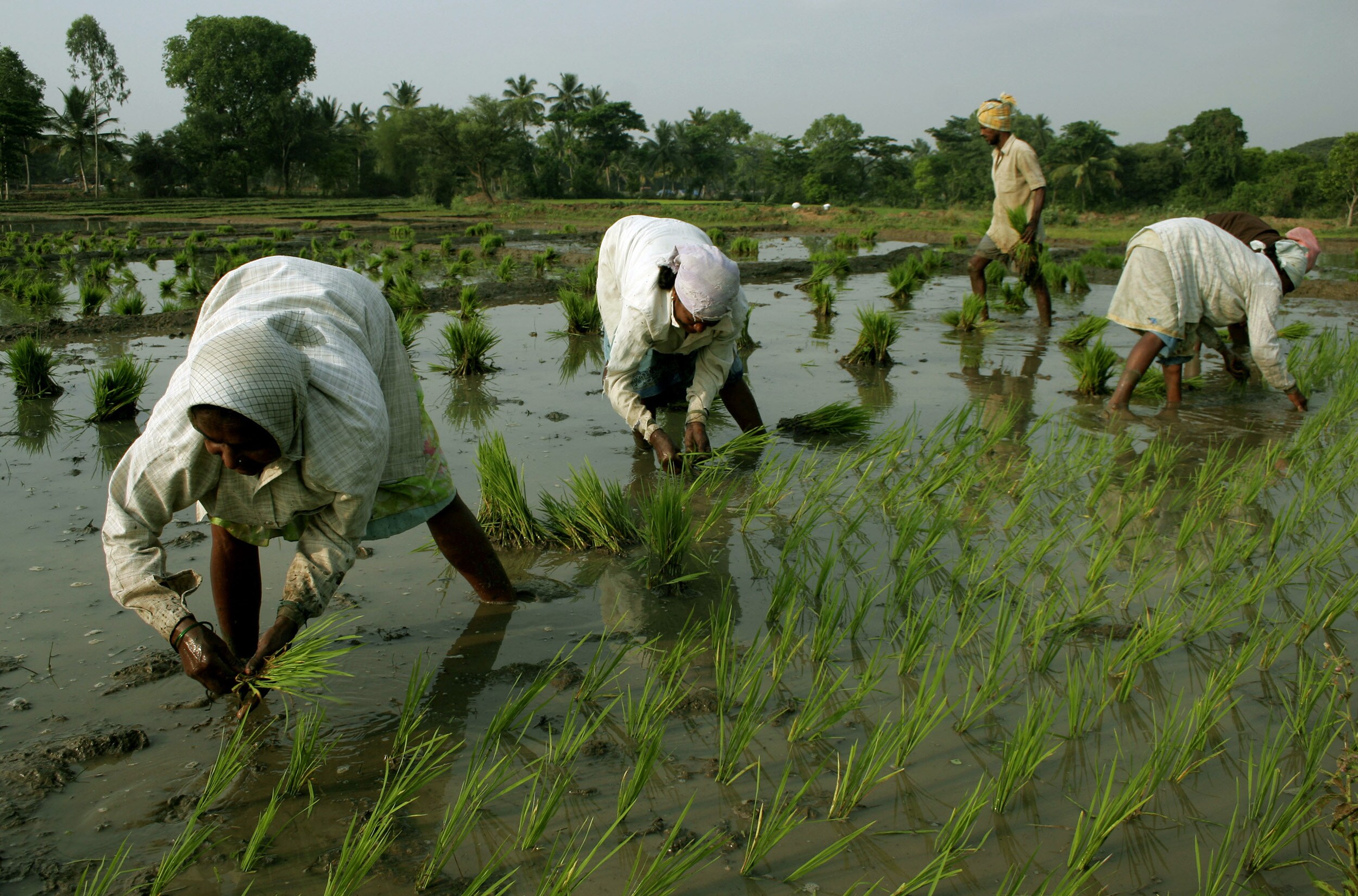
The agriculture ministry will soon move a Cabinet note seeking approval for a new policy that aims to rope in both states and private firms in procurement of other crops than wheat and paddy, for ensuring MSP to farmers, a senior government official said.
The objective of the proposed policy is to improve the speed of response and effectiveness of procurement in cases when prices drop below the minimum support price.
The ministry has proposed three models -- Market Assurance Scheme, Price Deficiency Procurement Scheme and Private Procurement and Stockists Scheme -- after consultations with an informal group of ministers, headed by Home Minister Rajnath Singh, as well as with state governments.
“The agriculture ministry is preparing a Cabinet note on this. The policy aims to give liberty to states to implement either one of the models of procurement,” the senior government official told wire agency PTI.
In case of MAS, the official said, it is to be implemented by state governments who can take immediate decisions on the basis of local conditions, to enter the market and begin procurement through their own state agencies or any other private agency authorised by states.
States will be responsible for procurement and liquidation of the procured commodity. They would create a corpus fund for this purpose and make all logistic arrangements to handle the procurement.
Also Read: Millet Farmers Could Face Crisis Next, Says Father Of India's Green Revolution MS Swaminathan
The central government will compensate the operational loss, if any, on value of MSP, up to a maximum 30-40 percent.
The second model proposed under the policy is ‘Price Deficiency Procurement Scheme' which is similar to the Bhavantar Bhugtan Yojana launched by the Madhya Pradesh government.
Under the PDS scheme, if the sale price is below a model price then the farmers would be compensated to the difference between the MSP and actual price, subject to certain conditions and ceiling.
The MAS and PDPS are primarily government-owned and driven schemes. The central government wants to bring in private sector players to supplement its schemes. Therefore the ministry, in the new policy, has proposed engagement of private sector in MSP-linked procurement through a transparent e-market platform.
States will be allowed to empanel private firms via a transparent bidding for purchase of farm produce when prices fall below the MSP. The private firms will be given tax incentive and a commission.
According to sources, the monetary implication of the proposed policy will run into thousands of crores if all three schemes are implemented by all states in all MSP notified crops.
Also, the existing Price Support Scheme and Market Intervention Scheme will be discontinued once the new policy is in place, the sources added.
It may be noted that farmers are under distress due to fall in prices of most commodities below the MSP in view of bumper crop. In the Budget 2018, the government has announced that it will ensure delivery of MSP at any cost to farmers.
Also Read: Union Budget 2018: A Fair Contract For The Farmer

-
The Economic Imperative: Analysing The Material Driving Force Behind India-Canada Strategic Reset

This economic complementarity is further reinforced by deep institutional investment ties and talent mobility, which form the bedrock of the bilateral framework.
-
Medicine Pricing: Where Must Profit Stop?
India must confront excessive margins, hidden incentives and regulatory gaps that threaten the integrity of medicine.
-
Why Amazon And Flipkart Are Struggling To Beat Meesho In India's Smaller Cities
With 274 million users and lowest-cost logistics, Meesho is defending its value commerce crown against giants like Amazon and Flipkart.
-
High US Salaries, No Green Card Certainty: The Financial Calculation Facing Indian H-1B Families
The suspension of PERM processing at eight technology employers does not cancel existing H-1B visas. What it does is force a question many Indian families have been avoiding: is the US salary worth tying your career and family plans to one employer?
-
Swiggy vs Eternal: Food Delivery's Two Rivals Are No Longer In The Same Race
Eternal is building a private AI assistant, dark.ai. Swiggy is still working out how to make Instamart pay, with an operating loss of Rs 895 crore in the July-September quarter while Blinkit stayed profitable.
-
Where You Live Shapes How You Get To Work | The Reason Why
Two-wheelers are the most popular way to get to work in India, accounting for nearly 43% of workplace commutes.
-
Unhedged Position: Can India See An Indonesia-Style Time Correction?
The Nifty is trading below levels it first clocked in 2024. Is there, then, as I have suggested in the headline, potential that the current time correction drags on painfully for the next three-five, even ten years?
-
Navigating Friction And Energy Realities: An Analysis Of Marco Rubio's October Visit To India
Occurring at a critical juncture marked by stalled trade negotiations and escalating geopolitical pressures over global energy supplies, the visit offers a profound window into modern US-India relations.
-
India Exports Capital. Why Not Export Trusteeship?
The big question, then, is whether India can build an institution that global borrowers, investors, banks, and lawyers can trust, even without an Indian connection.
-
France's Economy & Politics Are In Crisis | The Reason Why
Let's look at how the French economy and politics evolved under Nicolas Sarkozy, Franois Hollande and Emmanuel Macron.










