Adani Wilmar Q1 Results: Volume Rises 25%, Revenue At Rs 12,928 Crore
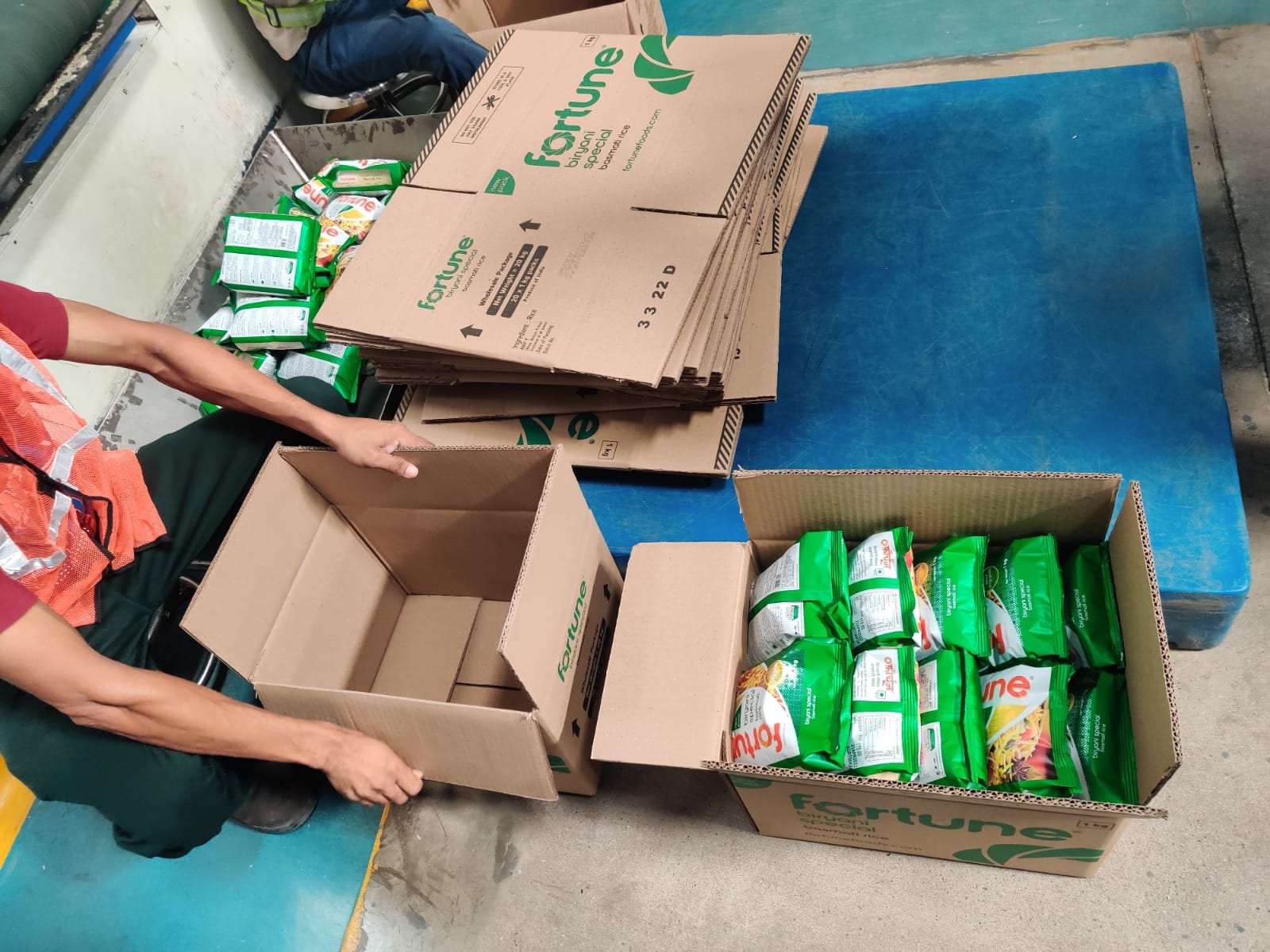
Adani Wilmar Ltd.'s first-quarter volume grew steadily on the back of sustained demand for its food and edible oil products. However, its revenue slipped, reflecting the steep decline in edible oil prices.
The consolidated revenue of the owner of the 'Fortune' brand fell 12.2% over the previous year to Rs 12,928.08 crore in the quarter-ended June, according to an exchange filing. That compares with the Rs 14,990.6 crore consensus estimate of analysts tracked by Bloomberg.
Volume rose 25% with broad-based growth across all segments.
Net loss of Rs 79 crore versus a net profit of Rs 194 crore, as against a Bloomberg estimate of Rs 211.65 crore.
Ebitda down 70.6% to Rs 130.4 crore, as compared with an estimate of Rs 496.55 crore.
Margin stood at 1% versus 3%. Analysts had forecast it at 3.3%.
The food and FMCG business recorded a revenue growth of 28% to Rs 1,097 crore. Volume rose 21% to 0.23 million metric tonne.
Volume in its mainstay edible oil business rose 27% to 0.89 million metric tonne, while revenue slipped 14% to Rs 9,845 crore.
Industrial essentials grew 21% in volume terms to 0.36 million metric tonne. Revenue, however, fell 16% to Rs 1,986 crore.
“We have regained the momentum in our edible oil business with the decline in the edible oil prices," said Angshu Mallick, managing director and chief executive officer at Adani Wilmar.
The company, he said, is strengthening 'King's' — the third-best selling brand of soyabean oil in India—and positioning it across its entire range of packaged oils and foods to gain market share from regional brands.
The company is also investing in the value-added blended oils under the Xpert brand to tap the opportunity in this segment, Mallick said.
Both urban and rural areas have witnessed strong demand, it said.
Adani Wilmar, with a market share of 19.5% in the edible oil segment, sees potential to consolidate market share, since more than half of the share is held by regional brands. Its share is also 1.5 times of its immediate peer.
High-cost inventory in an environment of falling edible oil prices, higher finance costs on the back of a hike in U.S. Fed rates, continued ban on wheat exports and disaligned hedges exerted pressure on profitability, it said.
"Prices on commodity exchanges, which are used by company to hedge price risk didn't move in tandem with physical prices. As a result, hedges were in loss without corresponding gain in physical trade," Adani Wilmar said.
Disproportionate allocation of tariff rate quota has also resulted in higher material cost for Adani Wilmar as compared with other players in April, impacting profitability. Profit was also impacted because its wholly owned subsidiary in Bangladesh made losses of Rs 21 crore during the quarter, due to price caps by the government on edible oils, local currency-related issues, as well as unavailability of counter-party for forex hedging.
Distribution expansion, gaining share in under-indexed markets and margin improvement will be the key priorities, the company said. The consumer goods business of Adani Group said it sees opportunity in exports, hotels, restaurants and catering as well as the institutional segment and is working on plans to exploit the opportunities.
During the quarter, Adani Wilmar expanded its direct reach by two times to six lakh outlets. It has also increased its rural towns coverage by 6.7 times to over 21,700 towns.
Adani Wilmar has so far utilised 49% of the IPO proceeds of Rs 3,472 crore towards loan repayment, various IPO projects and acquisitions. As for capex, the company has utilised Rs 509 crore of the Rs 1,900-crore fund.
Shares of Adani Wilmar fell 0.3% after the results were declared, as compared with a 1.07% decline in the benchmark Nifty50.
Disclaimer: AMG Media Networks Ltd., a subsidiary of Adani Enterprises Ltd., holds a 49% stake in Quintillion Business Media Ltd., the owner of BQ Prime.

-
Signature Play: The Classic Cocktail Is Dead. Or Is It?

Classic cocktails are disappearing from India's cocktail menus. But they're still being ordered, taught to bartenders and borrowed from. So, who's really having the last drink?
-
A New Samvat Wishlist: Inclusive Prosperity And Human Development
India has strengthened its economic foundations through infrastructure, digital access and enterprise. Its next growth chapter must deepen productivity, create better livelihoods and widen participation in prosperity.
-
Love, Sex Aur Dhokha: The Audacious Plot To Spy On Jensen Huang
A Taipei dinner, a Singapore chip buyer and a suspected Chinese asset: inside the alleged spy operation that got close to NVIDIA's Jensen Huang.
-
Ten Things I Learnt This Samvat
Patience can be a trap. Cheap stocks can stay cheap. Leverage can wipe you out. What did Samvat 2082 teach us? Niraj Shah writes on 10 lessons from the year gone by.
-
Talking Points This Week: Tech Nerves, FII Buying, And A Faraway Banking Shock
The global markets are not shining this Diwali. The exception in the large markets is, India.
-
Midterm Rally Lasted A Day. The Hard Reality Of A Divided US May Last Two Years | Opinion
Between a contested AI boom, a debt ceiling that arrives in 2027 and a president with every incentive to act alone, the next two years may prove more volatile than the first day's rally suggests.
-
Blue Wave Will Derail the AI Trade but Won't Dismantle the AI Era | Unhedged Position
The Democrats' sweep of the US Congress will see politics collide with economic forces both over the long and short term.
-
It's Time To Take The GST Council's Bet On Trust Global
Payment records can prove India's services exports, and clear, proportionate rules can bring foreign digital sellers into the tax net.
-
Opinion | India at 38: From Innovation Overperformer to Innovation Powerhouse
India now has 453 VC-backed deep science startups, 18 of them late-stage, after 117 percent growth since 2020. Laurus Labs, at USD 9.3 billion, is the most valuable deep science company in any middle-income economy outside China.









