Adani Isn’t the Only Indian Tycoon in Trouble
(Bloomberg Opinion) -- Highly leveraged Indian tycoons are having a rough time. Gautam Adani's $236 billion infrastructure empire has shrunk by more than three-fifths in a month. But while his relentless rise and spectacular fall hog headlines, a smaller storm may be brewing for another well-known magnate. Anil Agarwal's once-London-listed Vedanta Resources Ltd. has a pile of debt, including a $1 billion bond due January. Yet, his most recent attempt to trim the load has upset the one partner he can't afford to annoy: New Delhi.
Around this time last year, when the US Federal Reserve was still to begin raising interest rates to tame inflation and Russia's war in Ukraine had started to send commodities surging to their best quarter in more than three decades, Agarwal was toying with the idea of merging debt-laden Vedanta Resources with its cash-rich, Mumbai-listed unit, Vedanta Ltd. That plan, which was reported by Bloomberg News, didn't go anywhere.
However, Vedanta Resources did manage to shed its net-debt burden from almost $10 billion in March last year to a little under $8 billion. With the listed unit declaring a dividend last month, its parent and majority shareholder is “highly likely” to meet its obligations until September 2023, according to S&P Global Inc. So far so good. But it was when Agarwal tried to secure the finances for $1.5 billion in loan and bond repayments between September this year and January 2024 that he hit a roadblock.
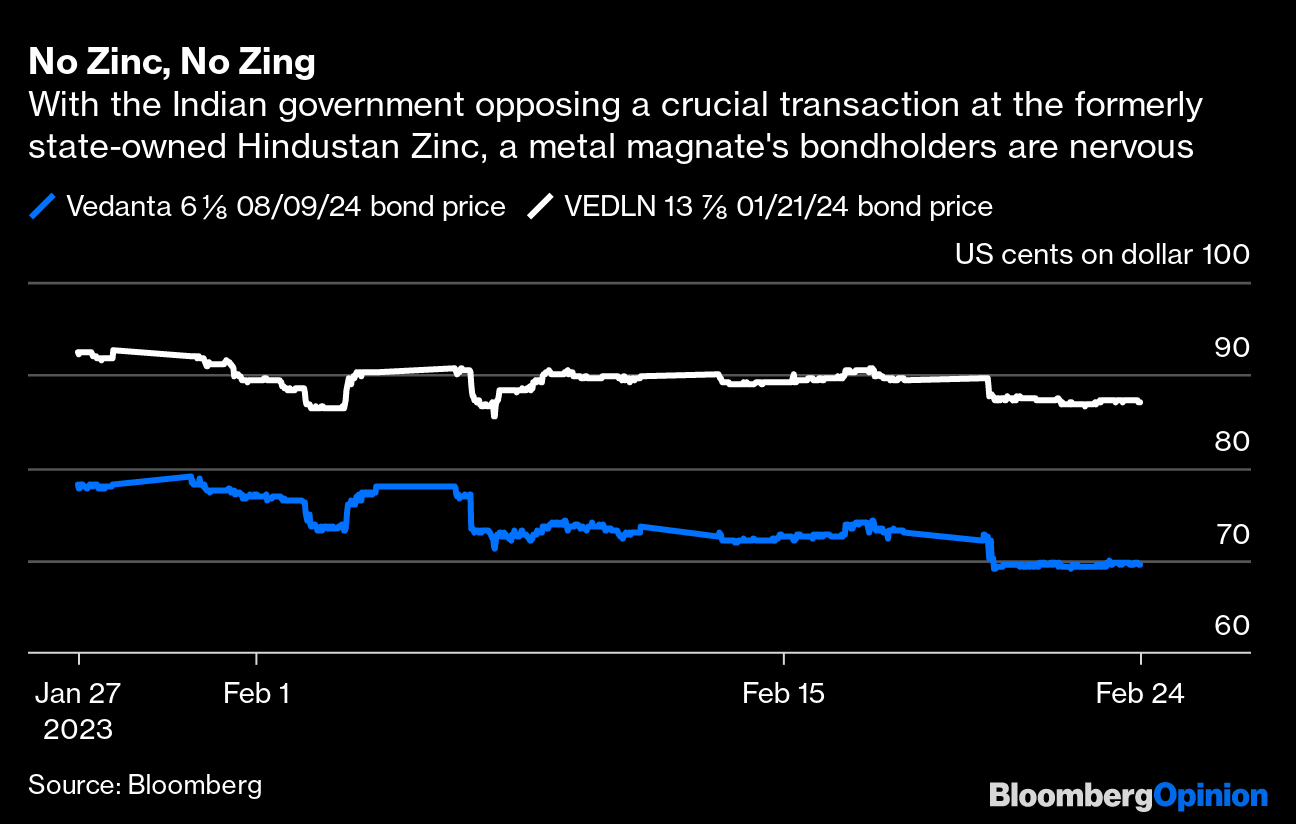
What was supposed to be a quick dash to the ATM has become an uncertain enough adventure for Vedanta Resources bondholders to drive the price of the August 2024 note below 70 cents on the dollar. The next few weeks will be crucial for fundraising. If it fails, the issuer's B- credit rating, already deep in the junk-bond category, could come under pressure, S&P said this month. Adani's net debt pile of $24 billion may be three times as large as Agarwal's, but his bonds are still rated at the lowest rung of investment grade.
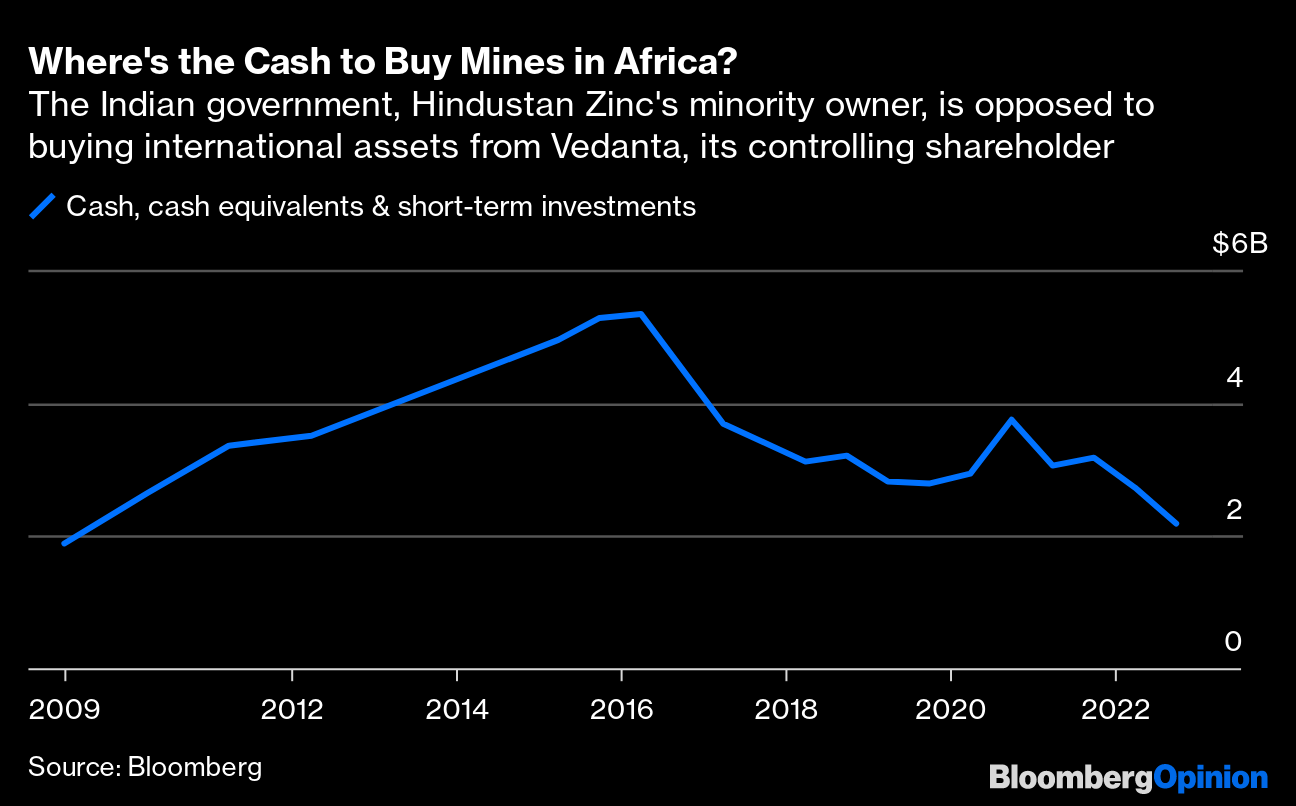
What happened to get everyone worried was this: Hindustan Zinc Ltd., which Agarwal had started buying from the Indian government two decades ago in a privatization deal, has a cash pile, albeit much smaller than before, of $2 billion. Plus, the miner garners between $300 million and $600 million Ebitda(1) every quarter. So Vedanta Ltd., which now owns 65% of the firm, decided in January to offload THL Zinc Ltd. Mauritius to Hindustan Zinc. That cash deal, representing mining interests in South Africa and Namibia, was valued at roughly $3 billion in phases over 18 months. Since Vedanta Ltd. is 70% owned by Vedanta Resources, it would have taken care of the latter's liquidity needs.
Except there was one problem. New Delhi, which still owns about 30% of Hindustan Zinc, balked at the transaction. “We would urge the company to explore other cashless methods for acquisition of these assets,” the Indian government said in a Feb. 17 letter, threatening to explore legal avenues if Hindustan Zinc still decided to go ahead with the purchase.
This presents two problems for the mining magnate. First, unless China's economic revival turns things around, the post-pandemic era of supernormal commodity profits could be over. If Agarwal can't take Hindustan Zinc's cash all the way up to his privately held Vedanta Resources, his ability to pay down debt may be impaired, forcing him to borrow more. But with the Fed giving no indication that it's done raising rates and existing Vedanta Resources bonds dropping in value, he might struggle to raise fresh money at a reasonable cost.
Agarwal's second challenge is political. If he tries to force the asset sale and incurs the government's displeasure in the process, his ambition to partner with Taiwan's Foxconn Technology Group for a $19 billion semiconductor factory might come under a cloud.
Already, that project is being watched closely by opposition politicians in neighboring Maharashtra who have slammed its last-minute relocation to Prime Minister Narendra Modi's home state of Gujarat. Besides, taxpayers will bear half the cost of chip-manufacturing units, and India's general elections are due next year. Influential voices, such as the University of Chicago economist Raghuram Rajan, a former central bank governor, have questioned Vedanta's involvement, citing its lack of chipmaking competence. “I simply do not understand how these players are being picked,” he said in a TV interview.
Seven years ago, Agarwal's creditors were even more jittery than now. Back then, the zinc miner helped him out with a special dividend. New Delhi didn't mind the maneuver because at the time the firm had more than $5 billion in cash. Besides, as a minority shareholder, the finance ministry also got its share of the bounty. This time around, though, Agarwal seems to have overreached.
A New York short seller has accused the Adani group of stock-price manipulation and accounting fraud, allegations that the former centi-billionaire has unequivocally denied. But his stocks keep getting pummeled. With the scandal putting the Modi administration under heightened scrutiny about entanglement of public purpose with private profit, metals-mogul Agarwal's top priority should be to stay out of the headlines. A legal skirmish with the government is no strategy for keeping one's head under the parapet.
More from Bloomberg Opinion:
- Mining's Growth Dilemma: Elements by Clara Ferreira Marques
- Make in India? It Will Require More Than Subsidies: Mihir Sharma
- Oops, India's Industrial Policy Misfires - Again: Andy Mukherjee
(1) Earnings before interest, taxes, depreciation and amortization.
This column does not necessarily reflect the opinion of the editorial board or Bloomberg LP and its owners.
Andy Mukherjee is a Bloomberg Opinion columnist covering industrial companies and financial services in Asia. Previously, he worked for Reuters, the Straits Times and Bloomberg News.
More stories like this are available on bloomberg.com/opinion
©2023 Bloomberg L.P.

-
One Battle After Another: India's Corporate Dynasties Battle For Control

2026 could go down as Corporate India's year of succession wars, governance battles and family fault lines.
-
Rs 50-Lakh Gold In Bank Locker, Rs 3 Lakh Of Protection: The Gap Most Families Don't Know About
The RBI ties a bank's liability to the annual locker rent and families who want to insure their jewellery face a separate question about how to prove what was inside.
-
The More Food Turns Into Fuel, The Harder It Is To Read Agricultural Markets | The Reason Why
A policy designed to reduce dependence on imported fuel can create new pressures elsewhere in the food economy.
-
Your iPhone Costs 12 Grams Of Gold, A Car About 100. What Does Your Life Weigh?
Measured in rupees, almost everything looks more expensive than it did a generation ago. Measured in grams of gold, a lot of it has become cheaper.
-
Gold Is Rs 22,000 Cheaper Than A Month Ago. Should You Buy Amid The Wedding Season?
Gold's potential slide to $3,500 could save around Rs 4,700 per 10 grams, but a soft inflation print could just as easily push prices back up. One way to split the risk is to buy in parts, some now and the rest after the Fed's Dec. 9 decision.
-
AI Agents Are Gaining Power. Who Governs Them?
Artificial intelligence agents promise to transform productivity by moving machines from assisting decisions to executing them. But as organisations delegate greater authority to these AI-agents, they must first establish who controls that authority and who remains accountable when things go wrong.
-
Why Swapping Your Old Gold Can Trigger A Rs 5 Lakh Tax Bill, And How You Can Avoid It Legally
Swapping old gold for new is taxed as a sale and a fresh purchase. Getting your own gold remade can cut most of that bill, though it has its own costs.
-
The AI Trade is Done. The Real Opportunity for Investors Starts in 2027 | Unhedged Position
As pureplay AI stocks plunge and circular, capex-led financing unwinds, 2027 is set to be a year of reckoning for AI companies. Yet the bust clears the way for a better opportunity for investors in 2027 -- shifting the spotlight from AI builders to the companies using AI.
-
Leadership As Mission: Why The Age Of AI Demands More Human Leadership
Debjani Ghosh examines how AI is changing leadership, arguing that its success must be measured by its impact on people and the accountability of those guiding its use.
-
We May Need Another Tukaram Mundhe To Fight Air Pollution | The Reason Why
Developers may install basic measures such as sprinklers and green nets, resume work, and continue violating rules when this equipment stops working.









