A Manager Who Saw India Credit Crisis Now Warns Of Realty Stress
The next flash point in India's credit markets could be real-estate debt.
That's the view of ICICI Prudential Life Insurance Co., a major corporate bond buyer and one of the country's top life insurers. The firm avoided investing in debt of stressed companies before credit market strains spread last year.
That crisis was triggered by shock defaults by major infrastructure financier IL&FS Group, and its fallout pushed up financing costs for a range of borrowers including wealthy property tycoons struggling to roll over debt. The country hardly needs more stresses now just as credit markets regain some normalcy after policy makers took steps to inject more liquidity into the financial system.
"While most of the credit market is healthy, one needs to be cautious on NBFCs having large exposure to the real-estate sector," said Chief Investment Officer Manish Kumar, who oversees Rs 1.1 lakh crore ($15.8 billion) at ICICI Prudential Life. Pressure may rise at non-bank firms, raising the need for lenders to liquidate assets or for stronger developers to buy up projects, he said.
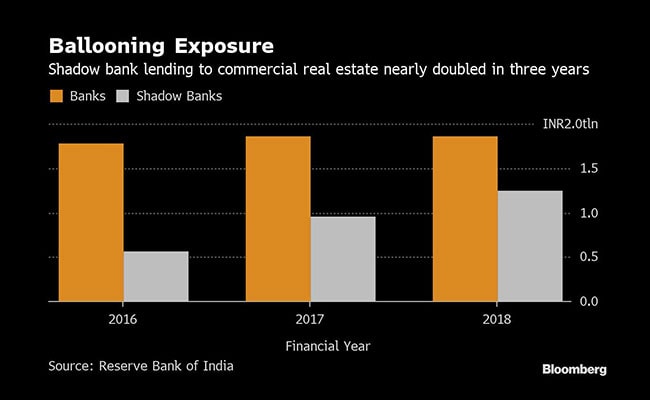
Shadow banks lent heavily to the property industry in recent years, helping to fuel a construction boom. They now face rising risks that weaker developers may struggle to repay those borrowings, as housing sales have failed to keep pace with debt expansion. Teetering economic activity also isn't helping.
Earlier this year, troubles for mortgage lender Dewan Housing Finance Corp. were among factors that pushed up financing costs.
An analysis of about 11,000 home builders by research firm Liases Foras in February showed that developers on average have to repay twice as much in debt each year as the income they generate that can be used to service it. Property prices in India's biggest cities have been flagging -- home values in Mumbai sank 11 percent last year.
That all means property debt investors need to be extra cautious, but there are still pockets of opportunity, according to ICICI Prudential. The firm has raised corporate bond holdings to 33 percent from 31 percent since the IL&FS crisis, mainly by increasing investments in notes issued by top-rated housing finance firms and bonds that will be serviced by the government.
Kumar's Other Thoughts:
ICICI Prudential is mildly positive on Indian equities and will continue to invest in stocks which won't be affected by whichever party comes to power, such as some private banks, and some businesses tied to infrastructure and cement producers. The country's equity valuations are higher than their long-term average, but that's a new normal now as liquidity, globally, is boosting shares. Local stocks can offer good returns if earnings rise. In the medium term, both debt and equity are attractive, and the election shouldn't deter investors because polls don't fundamentally or structurally change the direction of the market.

-
AI Bias In Investing Cannot Be Eliminated, But It Can Be Governed

Framing is a particularly important example as identical financial information presented in terms of gains rather than losses can lead an LLM to reach a different assessment.
-
Joining The Dots | Dark Skies, Steady Diya: Why Hope Holds This Diwali
With war, a weak rupee and foreign outflows weighing on sentiment, policymakers at the NDTV World Summit and market veterans at NDTV Profit Ignite: Diwali Edition offered the same advice: stay invested and filter out the noise.
-
The Curious Case of Equitas Small Finance Bank And A CEO Who Quit For Stock
PN Vasudevan believes persistent investor concerns over a perceived conflict of interest had become a governance overhang on Equitas Small Finance Bank's stock, even as the lender improved profitability and asset quality.
-
Talking Points This Week: AI Cash Burn, A Tiger Comeback And An India That Still Finds Its Own Path
India is not immune to higher oil or tighter global liquidity, yet its earnings base is broader, its domestic policy levers are still available.
-
Foreign Investors Own Half Of HDFC Bank and ICICI Bank. An LTCG Cut Could Matter Most Here
Foreign portfolio investors have US$115 billion parked in HDFC Bank, ICICI Bank. If the government cuts long-term capital gains tax, Jefferies says returning foreign money could land here first.
-
'Never Seen This Level Of Negativity': Sandeep Tandon Says The Next Rally May Be Closer Than You Think
Veteran investor Sandeep Tandon says foreign selling is easing, large-caps are due a comeback and mid-caps are crowded, while he turns positive on gold, power and pharma this Diwali.
-
Indians Stay With Family, Not In Hotels | The Reason Why
India still lacks enough clean, reliable and affordable hotels for budget-conscious travellers.
-
The Economic Imperative: Analysing The Material Driving Force Behind India-Canada Strategic Reset
This economic complementarity is further reinforced by deep institutional investment ties and talent mobility, which form the bedrock of the bilateral framework.
-
Medicine Pricing: Where Must Profit Stop?
India must confront excessive margins, hidden incentives and regulatory gaps that threaten the integrity of medicine.
-
Why Amazon And Flipkart Are Struggling To Beat Meesho In India's Smaller Cities
With 274 million users and lowest-cost logistics, Meesho is defending its value commerce crown against giants like Amazon and Flipkart.










